Page 54 of 58
Re: What have you accomplished today?
Posted: Thu Oct 09, 2025 3:39 am
by bradrn
Man in Space wrote: ↑Wed Oct 08, 2025 10:36 pm
Technically yesterday, but I finally got (most of) the Caber logograms indexed to their referent term(s) in my spreadsheet. Hopefully now I’m in a better position to make new ones and avoid duplicating existing ones.
How do you store logograms in a spreadsheet?
Re: What have you accomplished today?
Posted: Thu Oct 09, 2025 3:48 am
by xxx
bradrn wrote: ↑Thu Oct 09, 2025 3:39 am
How do you store logograms in a spreadsheet?
and especially how to use text functions with...
Re: What have you accomplished today?
Posted: Thu Oct 09, 2025 6:49 am
by Man in Space
bradrn wrote: ↑Thu Oct 09, 2025 3:39 am
Man in Space wrote: ↑Wed Oct 08, 2025 10:36 pm
Technically yesterday, but I finally got (most of) the Caber logograms indexed to their referent term(s) in my spreadsheet. Hopefully now I’m in a better position to make new ones and avoid duplicating existing ones.
How do you store logograms in a spreadsheet?
I don’t—I save them as images with alphanumeric filenames: alpha tells you the resolution (I have several standard ones), whereas the numeric is like the glyph’s Social Security number and increments. The numeric identifier is strictly for my own keeping things organized. My main
CC spreadsheet now tells you the numeric in the dictionary entry; previously I had a separate thing for recording glyphs by number but now I can more easily reference this information.
Re: What have you accomplished today?
Posted: Thu Oct 09, 2025 6:51 am
by bradrn
Man in Space wrote: ↑Thu Oct 09, 2025 6:49 am
bradrn wrote: ↑Thu Oct 09, 2025 3:39 am
Man in Space wrote: ↑Wed Oct 08, 2025 10:36 pm
Technically yesterday, but I finally got (most of) the Caber logograms indexed to their referent term(s) in my spreadsheet. Hopefully now I’m in a better position to make new ones and avoid duplicating existing ones.
How do you store logograms in a spreadsheet?
I don’t—I save them as images with alphanumeric filenames: alpha tells you the resolution (I have several standard ones), whereas the numeric is like the glyph’s Social Security number and increments. My main
CC spreadsheet now tells you the numeric in the dictionary entry.
Hmm, OK. I guess I could do something like that for Eŋes, but it seems painful…
Re: What have you accomplished today?
Posted: Thu Oct 09, 2025 6:53 am
by Man in Space
bradrn wrote: ↑Thu Oct 09, 2025 6:51 am
Man in Space wrote: ↑Thu Oct 09, 2025 6:49 am
bradrn wrote: ↑Thu Oct 09, 2025 3:39 am
How do you store logograms in a spreadsheet?
I don’t—I save them as images with alphanumeric filenames: alpha tells you the resolution (I have several standard ones), whereas the numeric is like the glyph’s Social Security number and increments. My main
CC spreadsheet now tells you the numeric in the dictionary entry.
Hmm, OK. I guess I could do something like that for Eŋes, but it seems painful…
I edited the post to clarify a bit but you ninja’d me with the quote.
Re: What have you accomplished today?
Posted: Thu Oct 09, 2025 7:29 am
by bradrn
Man in Space wrote: ↑Thu Oct 09, 2025 6:53 am
bradrn wrote: ↑Thu Oct 09, 2025 6:51 am
Man in Space wrote: ↑Thu Oct 09, 2025 6:49 am
I don’t—I save them as images with alphanumeric filenames: alpha tells you the resolution (I have several standard ones), whereas the numeric is like the glyph’s Social Security number and increments. My main
CC spreadsheet now tells you the numeric in the dictionary entry.
Hmm, OK. I guess I could do something like that for Eŋes, but it seems painful…
I edited the post to clarify a bit but you ninja’d me with the quote.
I don’t see how your edit changes anything? Either way, I feel like it’s just asking for the words, numbers and glyphs to get out of sync with each other… let alone the annoyance of managing so many little image files.
Re: What have you accomplished today?
Posted: Thu Oct 09, 2025 4:16 pm
by Man in Space
bradrn wrote: ↑Thu Oct 09, 2025 7:29 am
Man in Space wrote: ↑Thu Oct 09, 2025 6:53 am
bradrn wrote: ↑Thu Oct 09, 2025 6:51 am
Hmm, OK. I guess I could do something like that for Eŋes, but it seems painful…
I edited the post to clarify a bit but you ninja’d me with the quote.
I don’t see how your edit changes anything? Either way, I feel like it’s just asking for the words, numbers and glyphs to get out of sync with each other… let alone the annoyance of managing so many little image files.
My aim is to keep updating as I go along. My original system was an inconsistent cowboy job of a mess; now I can easily reference the characters as I require them/need to see what glyphs exist vs. what are needed.
Re: What have you accomplished today?
Posted: Fri Oct 10, 2025 2:22 am
by xxx
How do you find your way around...
Classifying logograms has always been difficult,
from semantic classifications (thesaurus-style)
to graphic classifications (like Chinese characters by number of strokes)
to phonetic classifications (using the alphabet !?)...
For 3SDeductiveLanguage(1Sense=1Sign=1Sound),
the 3S equality means that the three are confused :
Classification by meaning gives a classification by sign resemblance,
and a classification by sound...
However, I only have about a hundred operands,
which fit on a credit card format,
and easily in mind...
Re: What have you accomplished today?
Posted: Sat Oct 11, 2025 3:41 pm
by malloc
WeepingElf wrote: ↑Sun Oct 05, 2025 7:28 amThere are decimal systems in which '6' to '9' are derived from '5+1' to '5+4' (which is probably what Travis means). In the same way, a base-12 system can easily be built on roots for just '1' to '6': '7' is '6+1' and so on.
That is certainly one approach I have considered. The decimal systems you describe are technically called biquinary, which would make this form of base-12 biseximal. Another major challenge is that the most common measurement systems like metric assume base-10 numbers. Having said that, I do have some promising ideas for synthesizing metric with base-12 numbers. For instance, 12³ meters (1728m) fills the niche of miles and kilometers nicely while 1/12³ tonnes (0.5787kg) approximates pounds and kilograms.
Re: What have you accomplished today?
Posted: Sun Oct 12, 2025 1:55 pm
by alice
malloc wrote: ↑Sat Oct 11, 2025 3:41 pm
Having said that, I do have some promising ideas for synthesizing metric with base-12 numbers. For instance, 12³ meters (1728m) fills the niche of miles and kilometers nicely while 1/12³ tonnes (0.5787kg) approximates pounds and kilograms.
The second of these is actually quite close to the British pint (568 ml), too.
Re: What have you accomplished today?
Posted: Sun Oct 12, 2025 4:32 pm
by Axas mlö
malloc wrote: ↑Sat Oct 11, 2025 3:41 pm
That is certainly one approach I have considered. The decimal systems you describe are technically called biquinary, which would make this form of base-12 biseximal. Another major challenge is that the most common measurement systems like metric assume base-10 numbers. Having said that, I do have some promising ideas for synthesizing metric with base-12 numbers. For instance, 12³ meters (1728m) fills the niche of miles and kilometers nicely while 1/12³ tonnes (0.5787kg) approximates pounds and kilograms.
I like that. So do you choose just one metric unit of weight, one of length, etc, and then power-of-12 multiples of those?
Re: What have you accomplished today?
Posted: Fri Dec 05, 2025 3:54 pm
by lëtzeshark
I noticed that I'm up to about 465 dictionary entries for my revamped version of Mis and about 635 entries for Oshaharu. (Maybe the former will soon be celebrated by revamping the Mislandic ljöv banknotes.)
Re: What have you accomplished today?
Posted: Sat Dec 06, 2025 4:38 am
by xxx

lexember time...
without a lexicon, I prefer to practice transllexember, translating the words from the previous day...
Re: What have you accomplished today?
Posted: Fri Dec 19, 2025 5:50 am
by WeepingElf
I did the overdue update of
my conlang pages: uploaded two new essays (
A Guide to Indo-European Diachronic Conlanging and
Notes on Quendian), and updated the links section.
Re: What have you accomplished today?
Posted: Fri Dec 19, 2025 1:11 pm
by rotting bones
Thanks. This will be helpful for a beginner like me.
I do have IE-like languages. One is so much of a generic Eurolang with some Czech-like attributes that I'm embarrassed to post it. I also don't like its current aesthetic:
Iš rámo fospyin še beihüin, ši.
the beer drink-3PL and laugh-3PL now
We drink beer and laugh, now.
Re: What have you accomplished today?
Posted: Wed Dec 31, 2025 9:13 pm
by lëtzeshark
I still like money.
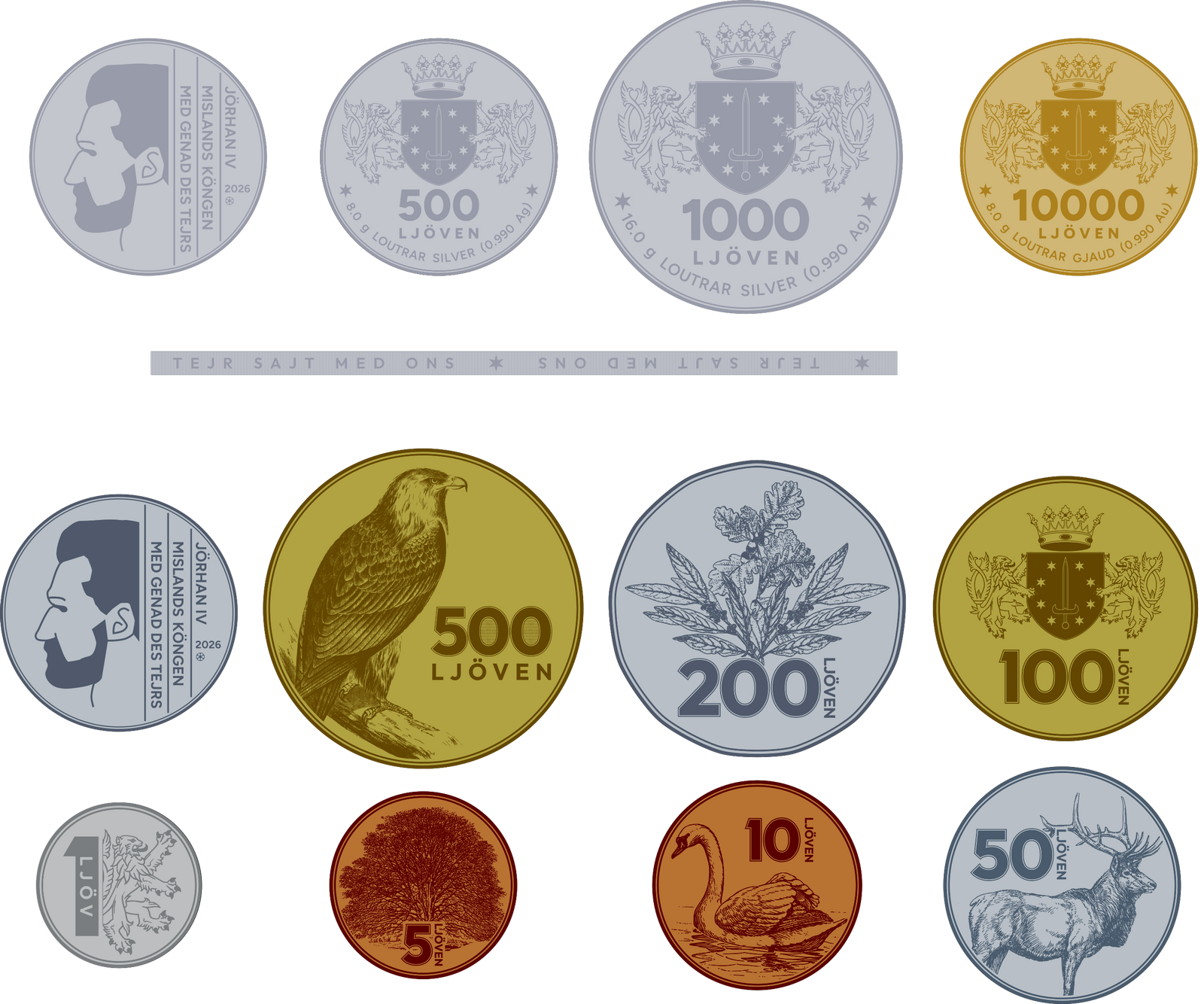
New Misland coins, featuring both bullion coins in gold and silver for the investor in you as well as the circulation coins. Circulation coins range in value from 1 ljöv (~USD 0.0032), rarely used, to 500 ljöven (~USD 1.58). Most commonly used coins are the 10, 50, and 100 ljöven denominations, partly because there also (for now) exists a 500-ljöv banknote and the 200 is a newly introduced denomination.
Re: What have you accomplished today?
Posted: Fri Jan 02, 2026 7:27 am
by Emily
fixed a couple of long-standing sca errors and the associated incorrect inflection issues in early modern gothic. working now on trying to get all my documentation sorted out, updated, and consistent. also took the opportunity to update my
zbb post with an index of all my existing anthologica dictionary entries for the gothic project
Re: What have you accomplished today?
Posted: Fri Jan 09, 2026 4:25 pm
by äreo
Since the new year began I have not been as keenly attentive to Msérsca, but I have been mulling over its comparative constructions for several days, and that slower, more undulating pattern of attention has been to some clear benefit.
I'd already established that Msérsca had a comparative construction with the ablative, as in:
Páth cálirá torra.
stone wood-ABL strong.PRES
Stone is stronger than wood.
And "strong" lacking a distinctive comparative suffix is something I'm unaccustomed to as a speaker of IE-languages (and even non-IE European & some Caucasian languages have this feature), but it felt fine for Msérsca. And according to WALS (I recently looked), this is quite common!
However, I've also determined that there is a verb ulta to be far (from), exceed, surpass, and that it can be suffixed (and slightly altered via sound change) to a verb in a construction much like English outdo, outrun, etc., giving
Páth cál torrauta.
"Stone outstrongs wood."
I think spíni to follow, come next could be used this way as well, giving a slightly different sense:
Páth cál torraspíni.
"Stone is actually stronger than wood." / "Stone turns out to be even stronger than wood."
Now of course this ends up being quite similar to European comparative suffix world, and I may even find that there are what amount to suppletive forms for to be better vs. to be good. But I think it would be ungrammatical to say *Páth cálirá torrauta. There is a nuance here, though, that if I reverse the order of the nouns being compared, the construction is perfectly fine. This is because the ablative has also developed a function as a topic marker for non-subjects. So we are perfectly free to say:
Calirá páth torrauta.
"As for wood, stone is stronger [than it]."
Re: What have you accomplished today?
Posted: Sat Jan 10, 2026 12:33 pm
by WeepingElf
After reading
this highly interesting book, I found the Old Albic word for 'bird':
phintá (< Proto-Hesperic
*p'etnah < PIE
*petnos (root
*pet- 'to fly'). The idea came from chapter 5, which discusses a suffix
-annos found in several Celtic bird names, for which it gives PIE
*petnos (the loss of
*p is regular in Celtic) as a possible etymology. I decided that Celtic got it from Hesperic, and with the sound changes I have in mind for Old Albic, I got
phintá, which also sounds very fitting to me.
Re: What have you accomplished today?
Posted: Sat Jan 10, 2026 8:11 pm
by äreo
WeepingElf wrote: ↑Sat Jan 10, 2026 12:33 pm
After reading
this highly interesting book, I found the Old Albic word for 'bird':
phintá (< Proto-Hesperic
*p'etnah < PIE
*petnos (root
*pet- 'to fly'). The idea came from chapter 5, which discusses a suffix
-annos found in several Celtic bird names, for which it gives PIE
*petnos (the loss of
*p is regular in Celtic) as a possible etymology. I decided that Celtic got it from Hesperic, and with the sound changes I have in mind for Old Albic, I got
phintá, which also sounds very fitting to me.
I like the sound of it too. As it happens, one of Msérsca's words for
bird (basically
passerine) is
pín