Update on Pakuni Studies 2020:
I finished making etymologies for the approximately 20 x 20 plants and animals from all geological periods! ( This accompanies special research I've been doing the last few years into animal word comparative etymology, a little done specifically for this Pakuni language. ) ( Last year I hand-crafted words for many prehistoric plants and animals as well as hominid tools and hunting techniques. Maybe that was always a conlanging dream of mine. )
But I don't know if I'll then go through and use the etymologies to make the words in Pakuni. It would be a lot of work.
( I added this to the facebook group Paleontology to which I post: To explore animal word comparative etymology, paleontology, and other subjects, I have designed an experiment where I invent words for prehistoric plants and animals in an artificial language partially of my own creation. This research has been very interesting and probably unique for the insights it has yielded regarding the use and creation of words in paleontology. )
...
And then the last thing I have to do with Pakuni for this year, or one of the last, is "space out" the English translations of the Art of War passages I selected. These two Art of War books by Sunzi and Sunbi are from about 500 BC and the Era of Confucius. I include the original texts in Classical Chinese, a language with which I am very familiar. ( One of the themes of Pakuni is prehistoric hunting but I didn't have any Classical Chinese texts on hunting and instead had this one on war. There's been some overlap and it's been interesting altogether. Great vocabulary, some insights and wisdom. )
But I don't know if I'll translate any of these many texts into Pakuni, this year. It's been a lot of work already. I did some work on body part vocabulary earlier, might do more, and then might focus on nature vocabulary after that. The language has ended up rich in hand-crafted body part vocabulary because a lot of the hand-crafted attention has gone to dinosaur name etymologies and words, which often include roots refering to body parts.
I actually computer-generated some 100,000 words for Pakuni but this year haven't felt like getting on the computer to use them. But they're there to show technique and method and in case I need them otherwise.
...
I also finished the Sumerian text about a giant bird that I wanted to add. And I'm still working on Sumerian signs on the side, just a bit.
...
I think about adding some more nursery rhymes. I've always wanted to do that for Pakuni. It would also be a good collection of texts to have for the Pakuni corpus. It was a kid's show. A lot of the texts I added are kid-friendly on various levels. I have this sizeable collection now of dinosaur books which are mostly geared toward kids, actually, with large amounts of illustrations and surprising levels of scientific detail. And the etymologies refer to these books and their art. So far as I can tell, I never actually studied much about dinosaurs as a grown-up.
I've had the same experience collecting books on Ancient Egypt: Many are kids books. Dinosaurs and Ancient Egypt are more likely to show up in the kids books sections of used bookstores and thrift stores, worldwide. I actually specialize quite a lot in Ancient Egypt and don't totally like this. But it is what is. And that, folks, is what anthropology is all about.

(I'm an amateur anthropologist.)
Images:
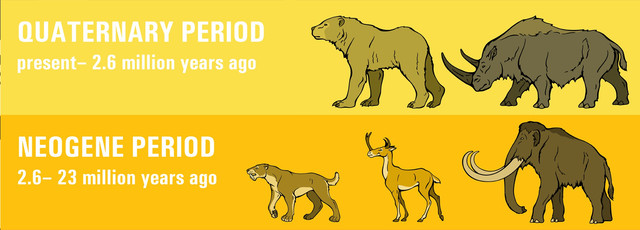
Detail from a nice large image of the geological record.
This one is great and it's very zoomable.
https://deanbolton.ca/Geological-Time-Scale