Page 108 of 111

Re: British Politics Guide

Posted: Mon Jan 26, 2026 5:47 pm
by Raphael
alice wrote: Mon Jan 26, 2026 2:38 pm There's also the thinking, which is very common in British media and political circles, that "Government" == "public sector" == "inherently irredeemably inefficient and ultimately and inevitably nothing more than a gross waste of taxpayers' money", and doing it privately will, obviously, simutaneously cost one-tenth and deliver ten times. because of "the discipline of the market", or something.
Lērisama wrote: Mon Jan 26, 2026 2:51 pm Yes, because introducing profit into the expenses side of the equation always means it costs less.
Oh, an excuse for me to post my Opinion - it's the kind of Opinion that starts with a capital "O" - on state/government contractors. It's an Opinion I formed a while ago, but I think it was confirmed and strengthened by the recent shenanigans of the contractor company which is theoretically supposed to take away the wastepaper around here.

Let's start with the claim that alice alludes to. There is a case to be made that competition in the market combined with the profit motive motivates businesses to do their best. It's not as clear-cut as the free market theorists say it is, for reasons I won't get into for now, but you can make the case.

But this can only work if the users of a product can freely choose between buying the product from different possible suppliers. In a situation where a business has a captive audience of people who can't avoid buying from it, the whole argument falls apart, because the business no longer has to motivate customers to stay loyal to it.

In fact, once you're a captive audience for someone who's selling you something, you're the less likely to get decent quality, the more that someone wants to maximize profits. After all, quality costs money, and the more money a business spends, the fewer profits it can make. That touches on Lērisama's point.

Do government/state contractors have to compete for customers? No, they just have to convince specific politicians to keep confirming their contracts. They don't have to do that by providing high quality. They can promise the politicians low costs, which, of course, automatically means not putting all that much money into their product. They can simply bribe the politicians. They can be the politicians' cousins. They can send the most physically attractive of their women employees to the straight men among the politicians. There are many ways. Few of which involve being serious about high quality.

For a contractor business, the general public, to which it is supposed to deliver goods or services, is a captive audience. See above for what that means.

Regular private businesses and regular state agencies each have their upsides and downsides. The upside of a regular private business is that it has to compete against other private businesses, which means that it might be motivated to keep its customers happy, so that they don't run away. The downside of a regular private business is what Lērisama mentioned: it has to spent a part of its budget on profits, which means that it has less money left to spend on quality.

The upside of a regular state agency is that it can spend its entire budget on doing whatever it's theoretically supposed to be doing. The downside of a regular state agency is that it usually doesn't have to compete.

It follows that a contractor business combines the downsides of a regular state agency and a regular private business, and has neither of their upsides.

Finally there's the question of whether a state contractor business should be called a "business" in the first place. After all, its money still comes from the state's budgets. An entity which gets its money entirely from the state is for all intents and purposes a state agency, even if the law officially treats it as a private business.

The main practical difference between a regular state agency and an officially private state contractor business is that, if the people in charge of a regular state agency take some of the money in the agency's budget and pay it out to themselves, that's called "embezzlement", while, if the people in charge of an officially private state contractor business take some of the money in the agency's budget and pay it out to themselves, that's called "paying out dividends". So the whole practise of having state contractors provide public service is basically just legalized embezzlement.

Sorry if I only told you things you already know, but I had to get that off my chest.
Re: British Politics Guide

Posted: Mon Jan 26, 2026 5:52 pm
by bradrn
Raphael wrote: Mon Jan 26, 2026 5:47 pm Let's start with the claim that alice alludes to. There is a case to be made that competition in the market combined with the profit motive motivates businesses to do their best. It's not as clear-cut as the free market theorists say it is, for reasons I won't get into for now, but you can make the case.

But this can only work if the users of a product can freely choose between buying the product from different possible suppliers. In a situation where a business has a captive audience of people who can't avoid buying from it, the whole argument falls apart, because the business no longer has to motivate customers to stay loyal to it.

In fact, once you're a captive audience for someone who's selling you something, you're the less likely to get decent quality, the more that someone wants to maximize profits. After all, quality costs money, and the more money a business spends, the fewer profits it can make. That touches on Lērisama's point.
I believe the term you’re looking for is ‘monopoly’.

Re: British Politics Guide

Posted: Tue Jan 27, 2026 4:14 am
by Raphael
bradrn wrote: Mon Jan 26, 2026 12:18 pm
Raphael wrote: Mon Jan 26, 2026 12:08 pm (I especially like one long quote in one episode that basically completely demolishes the entire premise of the whole show, though I'm not sure if the writers realized that when they wrote it.)
Which one?
Right now my plan is that if no one has guessed it by around 9 PM British and Irish time, around 10 PM my own local time today evening, I'll post it.

Re: British Politics Guide

Posted: Tue Jan 27, 2026 6:55 am
by Lērisama
Thank you Raphael. You're right. There probably is a more economisty way of putting it, but you have explained my point quite well.

Re: British Politics Guide

Posted: Tue Jan 27, 2026 8:03 am
by Raphael
Lērisama wrote: Tue Jan 27, 2026 6:55 am Thank you Raphael. You're right. There probably is a more economisty way of putting it, but you have explained my point quite well.
Thank you! Not sure about the more economisty way of putting it - much of the economics profession seems to be in systematic denial about what we're saying.

Re: British Politics Guide

Posted: Tue Jan 27, 2026 3:11 pm
by Raphael
Raphael wrote: Mon Jan 26, 2026 12:08 pm (I especially like one long quote in one episode that basically completely demolishes the entire premise of the whole show, though I'm not sure if the writers realized that when they wrote it.)
Since no one guessed this, I was talking about this quote from Series 3, Episode 6, The Whisky Priest:
Sir Humphrey: I have served 11 governments in the past 30 years. If I'd believed in all their policies, I'd have been passionately committed to keeping out of the Common Market, and passionately committed to joining it. I'd have been utterly convinced of the rightness of nationalising steel and of denationalising it and renationalising it. Capital punishment? I'd have been a fervent retentionist and an ardent abolitionist. I'd have been a Keynesian and a Friedmanite, a grammar school preserver and destroyer, a nationalisation freak and a privatisation maniac, but above all, I would have been a stark-staring raving schizophrenic!
The reason why I think this quote completely demolishes the entire premise of the whole show is that that premise, as far as I can see, was above all that under the UK's government structure, the political leaders would never be able to institute any new policies or make any major changes, because the civil servants would always find some way to derail their efforts to do that. But here you had Sir Humphrey list a whole lot of of major policy changes which various political leaders did successfully implement over the course of his career in the Civil Service.

Re: British Politics Guide

Posted: Tue Jan 27, 2026 3:39 pm
by Lērisama
Raphael wrote: Tue Jan 27, 2026 3:11 pm
Sir Humphrey: I have served 11 governments in the past 30 years. If I'd believed in all their policies, I'd have been passionately committed to keeping out of the Common Market, and passionately committed to joining it. I'd have been utterly convinced of the rightness of nationalising steel and of denationalising it and renationalising it. Capital punishment? I'd have been a fervent retentionist and an ardent abolitionist. I'd have been a Keynesian and a Friedmanite, a grammar school preserver and destroyer, a nationalisation freak and a privatisation maniac, but above all, I would have been a stark-staring raving schizophrenic!
The reason why I think this quote completely demolishes the entire premise of the whole show is that that premise, as far as I can see, was above all that under the UK's government structure, the political leaders would never be able to institute any new policies or make any major changes, because the civil servants would always find some way to derail their efforts to do that. But here you had Sir Humphrey list a whole lot of of major policy changes which various political leaders did successfully implement over the course of his career in the Civil Service.
I don't think that was the message of the show. It's certainly an admission from Sir Humphrey that he's not as omnipotent as he claims to be, but it's an established fact of the show that if the Prime Minister is really committed to something, the civil service isn't always able to block it¹. And even Jim Hacker managed to implement some things³. It made out that the civil service was powerful and had its own interests, but I don't think they weren't supposed to be a total break on policy, although I'll grant there are certainly arguments that way.

¹ See the end of series 1², when the PM tries to shut down the department
² I think.
³ Including what we'd now call data protection legislation – not insignificant.

Re: British Politics Guide

Posted: Tue Jan 27, 2026 3:54 pm
by zompist
Raphael wrote: Tue Jan 27, 2026 3:11 pm
Yes, Minister wrote: Sir Humphrey: I have served 11 governments in the past 30 years. If I'd believed in all their policies, I'd have been passionately committed to keeping out of the Common Market, and passionately committed to joining it. I'd have been utterly convinced of the rightness of nationalising steel and of denationalising it and renationalising it. Capital punishment? I'd have been a fervent retentionist and an ardent abolitionist. I'd have been a Keynesian and a Friedmanite, a grammar school preserver and destroyer, a nationalisation freak and a privatisation maniac, but above all, I would have been a stark-staring raving schizophrenic!
The reason why I think this quote completely demolishes the entire premise of the whole show is that that premise, as far as I can see, was above all that under the UK's government structure, the political leaders would never be able to institute any new policies or make any major changes, because the civil servants would always find some way to derail their efforts to do that. But here you had Sir Humphrey list a whole lot of of major policy changes which various political leaders did successfully implement over the course of his career in the Civil Service.
I think Humphrey is being a bit dramatic, which is something he does. He's using big issues to make his point— correct, so far as I know— that the permanent Civil Service is and should be apolitical, not listing wildly between Conservative and Labour positions. But the show is not about big issues (where, as you note, the government does tend to get its way). It's about minor things— as I recall, a typical plot is that Hacker wants to issue a strong statement about reducing the Civil Service, and after "redactions" he gets white papers that defuse the proposal entirely. The show is entirely if entertainingly cynical; it's about things not getting done, or getting done for absurd reasons.

To my knowledge, it's very well-informed satire— the creators talked to actual bureaucrats and often used their anecdotes— and captured something most viewers and pundits were not aware of, this conflict between ministers and their apolitical staff.

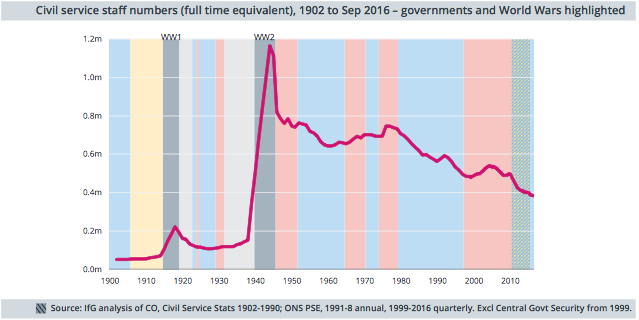
Are they correct on the immutability of the civil service? Complicated. Here's actual UK civil service employment:

Image

On a macro level— 1946 to 2010— they're wrong, the workforce was cut in half. But the writers didn't have this chart; they were writing in 1980–1982. If you look at the 1950–1980 period, the numbers were pretty stable, and had been increasing under both parties for 20 years. The Yes, Minister viewpoint is fairly accurate for the time of writing.

I'd also note that the comedy largely derives from its breathtaking cynicism, and it's intended to be contrarian, one step short of upsetting. At one point Humphrey says Britain joined the EEC in order to mess it up; at another he says the perennial enemy of the UK is France. Is that really true? No more than Hacker's own cynical statements about politics, e.g. "First rule in politics: never believe anything until it's officially denied." A certain level of cynicism about government is warranted; but cynicism and defeatism are ultimately reactionary.

Re: British Politics Guide

Posted: Tue Jan 27, 2026 4:03 pm
by bradrn
Raphael wrote: Tue Jan 27, 2026 3:11 pm
Sir Humphrey: I have served 11 governments in the past 30 years. If I'd believed in all their policies, I'd have been passionately committed to keeping out of the Common Market, and passionately committed to joining it. I'd have been utterly convinced of the rightness of nationalising steel and of denationalising it and renationalising it. Capital punishment? I'd have been a fervent retentionist and an ardent abolitionist. I'd have been a Keynesian and a Friedmanite, a grammar school preserver and destroyer, a nationalisation freak and a privatisation maniac, but above all, I would have been a stark-staring raving schizophrenic!
The reason why I think this quote completely demolishes the entire premise of the whole show is that that premise, as far as I can see, was above all that under the UK's government structure, the political leaders would never be able to institute any new policies or make any major changes, because the civil servants would always find some way to derail their efforts to do that. But here you had Sir Humphrey list a whole lot of of major policy changes which various political leaders did successfully implement over the course of his career in the Civil Service.
I understand this quote very differently: Humphrey says he would have been, not has been. In this quote he makes no claim to have actually allowed any of those efforts to happen, rather than blocking them at every turn.

(Of course Lērisama’s point is also correct.)

Re: British Politics Guide

Posted: Tue Jan 27, 2026 5:15 pm
by Raphael
Fair points. Though...
zompist wrote: Tue Jan 27, 2026 3:54 pm
I'd also note that the comedy largely derives from its breathtaking cynicism, and it's intended to be contrarian, one step short of upsetting.
Oh, I think that the show's cynicism is still somewhat limited. My impression is that Hacker, Bernard, and even Sir Humphrey are at least partly portrayed as meaning well, though, of course, they often have very different ideas of what "meaning well" means. This is, IMO, different from the view of life that Armando Ianucci's various satires seem to be based on, where there's apparently rarely ever any non-scummy character in sight.
At one point Humphrey says Britain joined the EEC in order to mess it up; at another he says the perennial enemy of the UK is France. Is that really true?
The "our military is really meant to defend us against the villainous French"-line seems to be a perennial joke among some British leftists who use it as a way to ridicule the whole idea that Britain should have a military at all. IMNSHO that not a very wise stance to take in the Age of Putin.

As for motives for joining the EEC/EU, well, in the same scene, Sir Humphrey says that the Germans joined in order to "cleanse themselves of genocide and apply for readmission to the human race". Frankly, judging from what I've seen some British Remainers say during the debates over Brexit, for some pro-EU Britons, that seems to have been part of their motivation, too.

bradrn wrote: Tue Jan 27, 2026 4:03 pm I understand this quote very differently: Humphrey says he would have been, not has been. In this quote he makes no claim to have actually allowed any of those efforts to happen, rather than blocking them at every turn.

(Of course Lērisama’s point is also correct.)
My point is that the Civil Service didn't prevent any of these policy changes, when, going by how Yes, Minister showed things to work, it should have done so.

Re: British Politics Guide

Posted: Tue Jan 27, 2026 5:42 pm
by zompist
Raphael wrote: Tue Jan 27, 2026 5:15 pm Fair points. Though...
zompist wrote: Tue Jan 27, 2026 3:54 pm
I'd also note that the comedy largely derives from its breathtaking cynicism, and it's intended to be contrarian, one step short of upsetting.
Oh, I think that the show's cynicism is still somewhat limited. My impression is that Hacker, Bernard, and even Sir Humphrey are at least partly portrayed as meaning well, though, of course, they often have very different ideas of what "meaning well" means. This is, IMO, different from the view of life that Armando Ianucci's various satires seem to be based on, where there's apparently rarely ever any non-scummy character in sight.
The only Ianucci I've seen is The Death of Stalin, but he had one hell of a good target there.

It's hard to call Humphrey scum, but he's something of a low-key comic villain. After all, his plan in almost all circumstances is to defend the status quo... which is sometimes commendable, but overall reactionary. The conservatives win, after all, if everyone agrees that all changes, and especially the people who want those changes, are laughable.

But again, I don't think it's intended to be taken too seriously. Are the French really the most important enemy of the Brits? No, but it's funny to say so, especially if the viewer is expecting to hear that the Russians are.

Re: British Politics Guide

Posted: Tue Jan 27, 2026 6:09 pm
by Raphael
zompist wrote: Tue Jan 27, 2026 5:42 pm The only Ianucci I've seen is The Death of Stalin, but he had one hell of a good target there.
I've seen some early episodes of Veep, too, and I can't think of any major character on that show with whom I'd want to spend any more time than I'd absolutely have to. Except maybe Sue. And from what I've heard, that seems to have been his approach with The Thick of It, too. (I tried to watch the first episode of The Thick of It once, but from my perspective, the handheld camera approach to shooting it makes it effectively unwatchable.)
It's hard to call Humphrey scum, but he's something of a low-key comic villain. After all, his plan in almost all circumstances is to defend the status quo... which is sometimes commendable, but overall reactionary. The conservatives win, after all, if everyone agrees that all changes, and especially the people who want those changes, are laughable.
Usually, you're completely right on that. But in Britain during the Thatcher years, it was generally the Conservative Government which wanted, and often got, all kinds of changes to the status quo, while their opponents usually tried to prevent those changes.

Re: British Politics Guide

Posted: Wed Jan 28, 2026 1:42 am
by Lērisama
Raphael wrote: Tue Jan 27, 2026 5:15 pm
At one point Humphrey says Britain joined the EEC in order to mess it up; at another he says the perennial enemy of the UK is France. Is that really true?
The "our military is really meant to defend us against the villainous French"-line seems to be a perennial joke among some British leftists who use it as a way to ridicule the whole idea that Britain should have a military at all. IMNSHO that not a very wise stance to take in the Age of Putin.
That quote was about the nuclear deterrent, wasn't it? In which case it's a bit more subtle. Our deterrent is dependent enough on the American one that serious people occasionally worry if it will work in the event we need it with while a Trumplike figure is in charge. So if America is on board, their own deterrent would be used, and if it isn't, then we can't rely on our own – hence the jokes about how it's really for the French. (I would he highly unsurprised if someone had used it for the army as a whole, but I don't think that's its meaning here.)

As for motives for joining the EEC/EU, well, in the same scene, Sir Humphrey says that the Germans joined in order to "cleanse themselves of genocide and apply for readmission to the human race". Frankly, judging from what I've seen some British Remainers say during the debates over Brexit, for some pro-EU Britons, that seems to have been part of their motivation, too.
Things got quite heated towards the end there. Pretty much noöne was basing their decisions on anything other than strongly held feelings about identity.

Re: British Politics Guide

Posted: Wed Jan 28, 2026 2:05 am
by Raphael
Lērisama wrote: Wed Jan 28, 2026 1:42 am Things got quite heated towards the end there. Pretty much noöne was basing their decisions on anything other than strongly held feelings about identity.
Yes, exactly. I was mainly thinking of Elton John's statement "I am a European. I am not a stupid, colonial, imperialist English idiot.”

However, the handful of left-wing Leavers might have been an exception to that. Say about them what you want, but they did seem to base their position on some kind of impression about how the EU actually works and what it actually does, while everyone else was mainly for or against the idea of the EU. (Though people who emotionally leaned towards Leave but voted Remain because they were worried about the practical consequences of leaving might have been another exception from the pattern.)

Re: British Politics Guide

Posted: Wed Jan 28, 2026 3:15 am
by alice
zompist wrote: Tue Jan 27, 2026 3:54 pmI'd also note that the comedy largely derives from its breathtaking cynicism, and it's intended to be contrarian, one step short of upsetting. At one point Humphrey says Britain joined the EEC in order to mess it up; at another he says the perennial enemy of the UK is France. Is that really true? No more than Hacker's own cynical statements about politics, e.g. "First rule in politics: never believe anything until it's officially denied." A certain level of cynicism about government is warranted; but cynicism and defeatism are ultimately reactionary.
I remember seeing, many moons ago, an article on the BBC website (I think) which argued that Yes, Minister was actually an insiduous piece of libertarian propaganda intended to foster the idea that government is inevitably heavily bureaucratic, immorally inefficient, and interested principally in self-perpetuation. This is probably overdoing it; such stereotyped visions of governments go back centuries.

In any case, it'll be fondly remembered, and deservedly so, for many classic moments, among which I'll mention just two: the brief sight-gag about Sir Humphrey's tie, and the absolutely spot-on descriptions of the British newspapers.

Re: British Politics Guide

Posted: Wed Jan 28, 2026 3:29 am
by Ares Land
alice wrote: Wed Jan 28, 2026 3:15 am
I remember seeing, many moons ago, an article on the BBC website (I think) which argued that Yes, Minister was actually an insiduous piece of libertarian propaganda intended to foster the idea that government is inevitably heavily bureaucratic, immorally inefficient, and interested principally in self-perpetuation. This is probably overdoing it; such stereotyped visions of governments go back centuries.

In any case, it'll be fondly remembered, and deservedly so, for many classic moments, among which I'll mention just two: the brief sight-gag about Sir Humphrey's tie, and the absolutely spot-on descriptions of the British newspapers.
A more accurate view is perhaps that the show has attracted interest from libertarian and other deep state conspiracy theorists in recent years.

Re: British Politics Guide

Posted: Wed Jan 28, 2026 5:45 am
by bradrn
alice wrote: Wed Jan 28, 2026 3:15 am I remember seeing, many moons ago, an article on the BBC website (I think) which argued that Yes, Minister was actually an insiduous piece of libertarian propaganda intended to foster the idea that government is inevitably heavily bureaucratic, immorally inefficient, and interested principally in self-perpetuation.
To me this seemed pretty self-evident. Doesn’t stop it from being very funny and often correct satire, of course.

Re: British Politics Guide

Posted: Wed Jan 28, 2026 5:48 am
by Raphael
alice wrote: Wed Jan 28, 2026 3:15 am
I remember seeing, many moons ago, an article on the BBC website (I think) which argued that Yes, Minister was actually an insiduous piece of libertarian propaganda intended to foster the idea that government is inevitably heavily bureaucratic, immorally inefficient, and interested principally in self-perpetuation. This is probably overdoing it; such stereotyped visions of governments go back centuries.
Ares Land wrote: Wed Jan 28, 2026 3:29 am A more accurate view is perhaps that the show has attracted interest from libertarian and other deep state conspiracy theorists in recent years.
As I mentioned earlier, it was co-written by a (mostly) left-winger and a Thatcherite, which means that you can say all kinds of contradictory things about its politics, which might well all be true. I once read the memoirs of the left-wing one of the writers, Comedy Rules by Jonathan Lynn, which provide some interesting background.

Here on the ZBB, one of our no-longer-posting resident right-wingers once brought up Yes, Minister in the context of the first Trump Administration, which was pretty ridiculous, given that the highest levels of the US Government are generally staffed by political appointees, not civil servants.

Oh, and going back to
alice wrote: Wed Jan 28, 2026 3:15 am I remember seeing, many moons ago,
"Many moons have passed since birth of Chul..."

Re: British Politics Guide

Posted: Wed Feb 04, 2026 6:39 pm
by rotting bones
Raphael wrote: Tue Jan 27, 2026 3:11 pm
Raphael wrote: Mon Jan 26, 2026 12:08 pm (I especially like one long quote in one episode that basically completely demolishes the entire premise of the whole show, though I'm not sure if the writers realized that when they wrote it.)
Since no one guessed this, I was talking about this quote from Series 3, Episode 6, The Whisky Priest:
Sir Humphrey: I have served 11 governments in the past 30 years. If I'd believed in all their policies, I'd have been passionately committed to keeping out of the Common Market, and passionately committed to joining it. I'd have been utterly convinced of the rightness of nationalising steel and of denationalising it and renationalising it. Capital punishment? I'd have been a fervent retentionist and an ardent abolitionist. I'd have been a Keynesian and a Friedmanite, a grammar school preserver and destroyer, a nationalisation freak and a privatisation maniac, but above all, I would have been a stark-staring raving schizophrenic!
The reason why I think this quote completely demolishes the entire premise of the whole show is that that premise, as far as I can see, was above all that under the UK's government structure, the political leaders would never be able to institute any new policies or make any major changes, because the civil servants would always find some way to derail their efforts to do that. But here you had Sir Humphrey list a whole lot of of major policy changes which various political leaders did successfully implement over the course of his career in the Civil Service.
What about this one?
Sir Humphrey: Minister, the evidence that you're proposing to submit is not only untrue, it is also, which is much more serious, unwise. Now, we've been through all this before. The expansion of the Civil Service is the result of parliamentary legislation, not bureaucratic empire building.
Hacker: So when this next comes up in Question Time, you want me to tell Parliament that it's their fault that the Civil Service is too big?
Sir Humphrey: But it's the truth, Minister.
Hacker: I don't want the truth! I want something I can tell Parliament! Humphrey, you're my permanent secretary, you're supposed to enact my policies. Yet, I still don't understand why you seem implacably opposed to them. I must know where you stand on all this.
Kind of minimizes Humphrey's scheming, doesn't it?

BTW, this is one of the funniest lines ever: "The identity of the official whose alleged responsibility for this hypothetical oversight has been the subject of recent discussion is not shrouded in quite such impenetrable obscurity as certain previous disclosures may have led you to assume; but not to put too fine a point on it, the individual in question is, it may surprise you to learn, one whom your present interlocutor is in the habit of defining by means of the perpendicular pronoun."

Re: British Politics Guide

Posted: Thu Feb 05, 2026 5:39 am
by bradrn
rotting bones wrote: Wed Feb 04, 2026 6:39 pm Kind of minimizes Humphrey's scheming, doesn't it?
Of course it does; it’s him saying it, isn’t it?

(And it’s quite clear that Hacker does just as much scheming as Humphrey, too.)