Page 129 of 151
Re: English questions
Posted: Tue Feb 17, 2026 7:14 am
by Man in Space
Magenta to me is one of those “impossible colors”, with a deeper/more intense saturation. Pink is generally light red—kind of like how Russian distinguishes between dark and light blue.
Re: English questions
Posted: Tue Feb 17, 2026 7:36 am
by Raphael
Man in Space wrote: ↑Tue Feb 17, 2026 7:14 am
Magenta to me is one of those “impossible colors”, with a deeper/more intense saturation. Pink is generally light red—kind of like how Russian distinguishes between dark and light blue.
What is an "impossible color"?
Re: English questions
Posted: Tue Feb 17, 2026 12:39 pm
by jcb
Raphael wrote: ↑Tue Feb 17, 2026 7:36 am
Man in Space wrote: ↑Tue Feb 17, 2026 7:14 am
Magenta to me is one of those “impossible colors”, with a deeper/more intense saturation. Pink is generally light red—kind of like how Russian distinguishes between dark and light blue.
What is an "impossible color"?
I think he's referring to this
https://youtu.be/uHexBGAqNpo?si=wq_wosCYzZm_jff-&t=77 , or maybe this
https://www.youtube.com/watch?v=8FSpCAs5KZg .
(Note also that the latter video is wrong. Magenta doesn't exist any less than any other color just because there isn't a single wavelength of light that produces it. All colors are equally imaginary productions of our brains.
Edit: The yellow that you see from a picture of a banana on a computer screen that's produced by combining multiple wavelengths of light isn't any less yellow than the yellow of seeing a real banana in person that (I assume) is produced by a single wavelength of light.)
Re: English questions
Posted: Wed Feb 18, 2026 1:18 am
by hwhatting
For me, magenta is just a shade of pink.
Re: English questions
Posted: Wed Feb 18, 2026 5:37 am
by bradrn
jcb wrote: ↑Tue Feb 17, 2026 12:39 pm
Edit: The yellow that you see from a picture of a banana on a computer screen that's produced by combining multiple wavelengths of light isn't any less yellow than the yellow of seeing a real banana in person that (I assume) is produced by a single wavelength of light.)
The yellow of a real banana certainly wouldn’t be a single wavelength either.
Re: English questions
Posted: Wed Feb 18, 2026 7:19 am
by Lērisama
Based on this quote of Malloc's:
malloc wrote: ↑Tue Feb 17, 2026 8:58 pm
Today is the Chinese New Year, Marti Gras, and the beginning of Ramadan all on the same day. Just found that an interesting coincidence.
How would you usually refer to the Tuesday before Lent starts¹?
¹ Although in my experience, it's a mich bigger thing than Lent on its own is, but I'm trying to avoid naming it in the question
Re: English questions
Posted: Wed Feb 18, 2026 8:10 am
by Travis B.
Lērisama wrote: ↑Wed Feb 18, 2026 7:19 am
Based on this quote of Malloc's:
malloc wrote: ↑Tue Feb 17, 2026 8:58 pm
Today is the Chinese New Year, Marti Gras, and the beginning of Ramadan all on the same day. Just found that an interesting coincidence.
How would you usually refer to the Tuesday before Lent starts¹?
¹ Although in my experience, it's a mich bigger thing than Lent on its own is, but I'm trying to avoid naming it in the question
Mardi Gras, Fat Tuesday, or in the US or Canada (but not Poland) Pączki Day.
Re: English questions
Posted: Wed Feb 18, 2026 8:15 am
by Travis B.
I should note that Mardi Gras is phonologically abnormal in the dialect of English here (which may explain why malloc spelled it as "Marti Gras") -- it is pronounced [ˌmʌːʁˤ(ɾ)iːˈɡʁˤɑ(ː)], and thus is one of only two words that have raising of START before a lenis plosive phoneme, the other being target -- as if it had a fortis plosive phoneme in this position (however, in the dialect here the vowel is long, not short).
Re: English questions
Posted: Wed Feb 18, 2026 1:15 pm
by jcb
zompist wrote: ↑Tue Feb 17, 2026 6:10 am
Pink is lighter for me, prototypically a bleached red. This picture seems pretty central:

Magenta is darker and bluer. E.g. this girl's hair:

There's certainly a lot of overlap. I can't find a good picture of actual magenta ink-- most illos are made on the computer, I think. This may come close, as it's intended as a test print:

Your definitions agree with mine. I agree, that bow is a prototypical case of the original meaning of pink. As for that hair, I would call it magenta, but I note that "magenta" is an uncommon unbasic term that most people don't use. If you asked a random person on the street what color that hair is, they'd probably say "pink" and not "magenta". (Sure, I would say "magenta", but that's because I'm a weirdo that uses many literary words and constructions in everyday speech.)
***
I found this image:
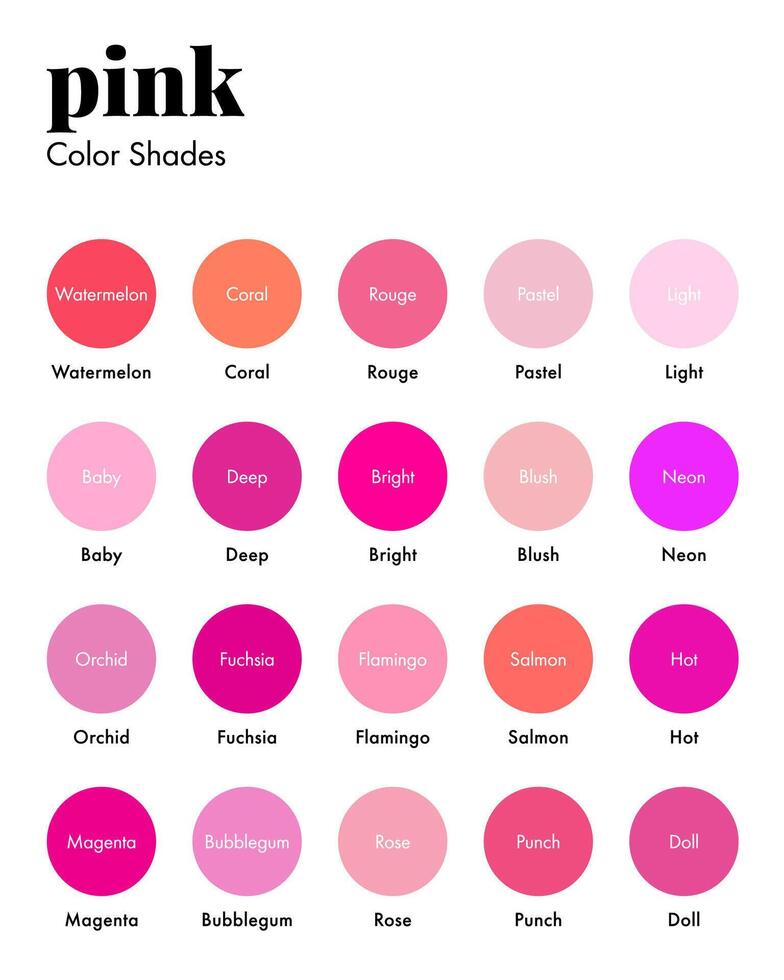
My thoughts:
* "watermelon" is red.
* "coral" and "salmon" are orange.
* "rouge, deep, bright, neon, fuchsia, hot, magenta, punch, doll" are magenta.
* The rest are pink.
But the ones I call magenta are commonly called pink.
Re: English questions
Posted: Wed Feb 18, 2026 3:05 pm
by Raphael
jcb wrote: ↑Wed Feb 18, 2026 1:15 pm
I found this image:
My thoughts:
* "watermelon" is red.
* "coral" and "salmon" are orange.
* "rouge, deep, bright, neon, fuchsia, hot, magenta, punch, doll" are magenta.
* The rest are pink.
The "neon" shade looks more like purple to me, but aside from that, I agree with you.
Re: English questions
Posted: Wed Feb 18, 2026 3:10 pm
by zompist
jcb wrote: ↑Wed Feb 18, 2026 1:15 pm
If you asked a random person on the street what color that hair is, they'd probably say "pink" and not "magenta". (Sure, I would say "magenta", but that's because I'm a weirdo that uses many literary words and constructions in everyday speech.)
Yeah, magenta may well be a subclass of pink.
* "watermelon" is red.
* "coral" and "salmon" are orange.
* "rouge, deep, bright, neon, fuchsia, hot, magenta, punch, doll" are magenta.
* The rest are pink.
I agree except for "hot" and "punch". "Punch" is just a dark or dusky pink to me, while it's hard for me to call the other one anything but "hot pink".
I was curious about etymology— it turns out "magenta" was named for a Napoleonic battle. It was originally a dye whose inventor called it fuchsine. Not too surprisingly, it's magenta in color.

This in turn derives from fuchsias (which were named for a dude named Fuchs). Like most flowers there are a lot of variations— actual fuchsia flowers can be bicolored and range from pink to magenta to purple to blue to white.
Re: English questions
Posted: Wed Feb 18, 2026 3:57 pm
by Travis B.
I always find it curious that "fuchsia" is typically pronounced /ˈfjuːʃə/ and not /ˈf{ʊ,uː}k{siː,sj,ʃ}ə/ in English, when normally in English StG <ch> is borrowed as /k/ and a /j/ is typically only inserted for <ü>/<ue>...
Re: English questions
Posted: Wed Feb 18, 2026 4:08 pm
by Raphael
Travis B. wrote: ↑Wed Feb 18, 2026 3:57 pm
I always find it curious that "fuchsia" is typically pronounced /ˈfjuːʃə/ and not /ˈf{ʊ,uː}k{siː,sj,ʃ}ə/ in English, when normally in English StG <ch> is borrowed as /k/ and a /j/ is typically only inserted for <ü>/<ue>...
How big is the share of the population who pronounce it at all in the first place, anyway?
Re: English questions
Posted: Wed Feb 18, 2026 4:14 pm
by Travis B.
Raphael wrote: ↑Wed Feb 18, 2026 4:08 pm
Travis B. wrote: ↑Wed Feb 18, 2026 3:57 pm
I always find it curious that "fuchsia" is typically pronounced /ˈfjuːʃə/ and not /ˈf{ʊ,uː}k{siː,sj,ʃ}ə/ in English, when normally in English StG <ch> is borrowed as /k/ and a /j/ is typically only inserted for <ü>/<ue>...
How big is the share of the population who pronounce it at all in the first place, anyway?
I had long heard of
fuchsia as referring to the color, since I was a kid, and I certainly did not come up with /ˈfjuːʃə/ myself; I only as an adult learned that
fuchsia was named after a plant, and that that plant was named after a certain Fuchs.
Edit: Incidentally,
Wiktionary does list a pronunciation /ˈfuːksi.ə/ but says it is "obsolete".
Re: English questions
Posted: Wed Feb 18, 2026 4:41 pm
by /ˌnɐˈɾɛndɚduːd/
zompist wrote: ↑Wed Feb 18, 2026 3:10 pm
jcb wrote: ↑Wed Feb 18, 2026 1:15 pm
If you asked a random person on the street what color that hair is, they'd probably say "pink" and not "magenta". (Sure, I would say "magenta", but that's because I'm a weirdo that uses many literary words and constructions in everyday speech.)
Yeah, magenta may well be a subclass of pink.
IMO, magenta refers to the color #ff00ff, though most people would call it hot pink or neon pink.
Re: English questions
Posted: Wed Feb 18, 2026 4:56 pm
by zompist
/ˌnɐ.ˈɾɛn.dɚ.ˌduːd/ wrote: ↑Wed Feb 18, 2026 4:41 pm
IMO, magenta refers to the color #ff00ff, though most people would call it hot pink or neon pink.
Sure, computer nerds are going to think of that color. Though I feel I should point out that monitors are not magic— obviously you can vary the brightness, and a particular monitor may be slightly more blue- or red-shifted. For that matter, your eyes will vary slightly from everyone else's.
Color printing relies on black, magenta, cyan, and yellow ink. There's even less guarantee that all batches of magenta ink are the "same color".
Probably most of you know this, but computer and print colors are alternate ways of fooling the eye, which has three types of color receptors. Color scientists say we are trichromats. What's usually called color blindness is more accurately dichromacy. Some animals have more color receptors, and thus would not find either our computer or print illustrations to look right.
Re: English questions
Posted: Wed Feb 18, 2026 6:13 pm
by Richard W
Travis B. wrote: ↑Wed Feb 18, 2026 3:57 pm
I always find it curious that "fuchsia" is typically pronounced /ˈfjuːʃə/ and not /ˈf{ʊ,uː}k{siː,sj,ʃ}ə/ in English, when normally in English StG <ch> is borrowed as /k/ and a /j/ is typically only inserted for <ü>/<ue>...
I've always assumed the 'c' is ignored so as to avoid a taboo first syllable.
Re: English questions
Posted: Wed Feb 18, 2026 6:19 pm
by Richard W
Lērisama wrote: ↑Wed Feb 18, 2026 7:19 am
How would you usually refer to the Tuesday before Lent starts¹?
I call it
pancake day or
Shrove Tuesday. I prefer the latter, but the risk of it not being understood is distressingly high.
Re: English questions
Posted: Wed Feb 18, 2026 10:12 pm
by jcb
zompist wrote: ↑Wed Feb 18, 2026 3:10 pm
I was curious about etymology— it turns out "magenta" was named for a Napoleonic battle. It was originally a dye whose inventor called it fuchsine. Not too surprisingly, it's magenta in color.
This in turn derives from fuchsias (which were named for a dude named Fuchs). Like most flowers there are a lot of variations— actual fuchsia flowers can be bicolored and range from pink to magenta to purple to blue to white.
A battle in 1859 under Napoleon III counts as Napoleonic?
-
https://en.wikipedia.org/wiki/Battle_of_Magenta
Re: English questions
Posted: Wed Feb 18, 2026 10:21 pm
by jcb
zompist wrote: ↑Wed Feb 18, 2026 4:56 pm
/ˌnɐ.ˈɾɛn.dɚ.ˌduːd/ wrote: ↑Wed Feb 18, 2026 4:41 pm
IMO, magenta refers to the color #ff00ff, though most people would call it hot pink or neon pink.
Sure, computer nerds are going to think of that color. Though I feel I should point out that monitors are not magic— obviously you can vary the brightness, and a particular monitor may be slightly more blue- or red-shifted. For that matter, your eyes will vary slightly from everyone else's.
Color printing relies on black, magenta, cyan, and yellow ink. There's even less guarantee that all batches of magenta ink are the "same color".
Probably most of you know this, but computer and print colors are alternate ways of fooling the eye, which has three types of color receptors. Color scientists say we are trichromats. What's usually called color blindness is more accurately dichromacy. Some animals have more color receptors, and thus would not find either our computer or print illustrations to look right.
As an addendum, what I think that most people don't realize is that tetrachromats like birds that can see ultraviolet wavelengths don't merely add another color/hue into the trichromatic color/hue wheel, but add a whole other *dimension* of color to the color/hue wheel, which makes it a color/hue sphere, I suppose.
-
https://science.ubc.ca/news/hummingbird ... ly-imagine