Page 184 of 216
Re: Conlang Random Thread
Posted: Tue Jul 22, 2025 9:30 am
by Glass Half Baked
Most of my conlangs are a posteriori, in part because I like history and historical linguistics, and in part because I think fitting a language into an existing context is a fun challenge. Out of curiosity, what ratio of a priori to a posteriori languages do you all gravitate toward?
Re: Conlang Random Thread
Posted: Tue Jul 22, 2025 11:18 am
by Raphael
Glass Half Baked wrote: ↑Tue Jul 22, 2025 9:30 am
Most of my conlangs are a posteriori, in part because I like history and historical linguistics, and in part because I think fitting a language into an existing context is a fun challenge. Out of curiosity, what ratio of a priori to a posteriori languages do you all gravitate toward?
Back when I did some very limited conlanging (naming languages only), it was for a conworld project that would have been about a planet unrelated to Earth, so a posteriori wouldn't have made sense. Besides, not having to worry about plausible derivations of linguistic developments made things easier.
Re: Conlang Random Thread
Posted: Tue Jul 22, 2025 11:41 am
by malloc
Glass Half Baked wrote: ↑Tue Jul 22, 2025 9:30 amMost of my conlangs are a posteriori, in part because I like history and historical linguistics, and in part because I think fitting a language into an existing context is a fun challenge. Out of curiosity, what ratio of a priori to a posteriori languages do you all gravitate toward?
I have always gravitated toward
a priori since my conlang ideas simply don't fit existing languages all that well.
Re: Conlang Random Thread
Posted: Tue Jul 22, 2025 11:59 am
by WeepingElf
Glass Half Baked wrote: ↑Tue Jul 22, 2025 9:30 am
Most of my conlangs are a posteriori, in part because I like history and historical linguistics, and in part because I think fitting a language into an existing context is a fun challenge. Out of curiosity, what ratio of a priori to a posteriori languages do you all gravitate toward?
Most of my conlangs are a posteriori, too, as I explore lost linguistic lineages of our world in them. Also, I find it easier to work from an existing language than making up a new language entirely. However, for a fantasy world or an alien race, I'd do a priori languages, as their languages ought not to be related to languages of our planet. Also, you can of course do a priori diachronic conlanging, by using an a priori conlang as the protolanguage of a family.
Re: Conlang Random Thread
Posted: Sat Jul 26, 2025 1:58 pm
by Ahzoh
(Just had this post get eaten by an error and the form not being able to be resubmitted due to it, so now I have to retype it from scratch and remember what I wrote)
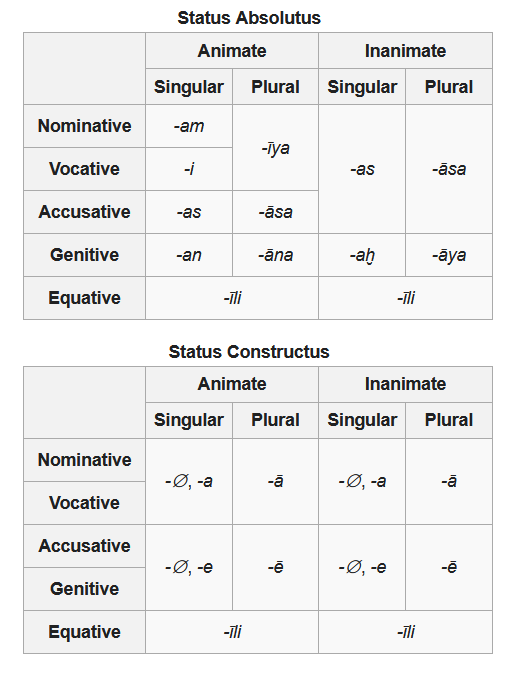
I have reduced the gender system of Vrkhazhian because I wanted to break the association of specific vowels with specific genders (e.g. u = fem, i = masc, a = neut), which I found to be limiting when it came to creating affixes.
Still, I feel uneasy about having most of the endings having the same vocality. Part of my issue is that I don't like certain combination of sounds, like /ix/.
- bigender.png (23.61 KiB) Viewed 22651 times
I have thought about having a consonant-stem vs vowel-stem thing going on, but frankly, theoretically every stem should be consonant-stem due to the syllable structure.
Re: Conlang Random Thread
Posted: Sat Jul 26, 2025 3:15 pm
by keenir
Ahzoh wrote: ↑Sat Jul 26, 2025 1:58 pm
(Just had this post get eaten by an error and the form not being able to be resubmitted due to it, so now I have to retype it from scratch and remember what I wrote)
I have reduced the gender system of Vrkhazhian because I wanted to break the association of specific vowels with specific genders (e.g. u = fem, i = masc, a = neut), which I found to be limiting when it came to creating affixes.
Still, I feel uneasy about having most of the endings having the same vocality.
maybe I'm failing to understand here...if you want to break an association & end having the endings having the same vocality...perhaps expand/enlarge the vowel system or the gender system?
Re: Conlang Random Thread
Posted: Sat Jul 26, 2025 3:17 pm
by malloc
Ahzoh wrote: ↑Sat Jul 26, 2025 1:58 pmStill, I feel uneasy about having most of the endings having the same vocality. Part of my issue is that I don't like certain combination of sounds, like /ix/.
Perhaps the language underwent a sound change that eliminated this sequence. Many languages avoid high and especially front vowels around guttural consonants in various ways. The language might lower the vowel yielding /ex/ or front the consonant yielding /iS/ or something along those lines. That would introduce some interesting variation and surface irregularity to the inflectional system as well.
Re: Conlang Random Thread
Posted: Sat Jul 26, 2025 5:42 pm
by Ahzoh
keenir wrote: ↑Sat Jul 26, 2025 3:15 pm
Ahzoh wrote: ↑Sat Jul 26, 2025 1:58 pm
(Just had this post get eaten by an error and the form not being able to be resubmitted due to it, so now I have to retype it from scratch and remember what I wrote)
I have reduced the gender system of Vrkhazhian because I wanted to break the association of specific vowels with specific genders (e.g. u = fem, i = masc, a = neut), which I found to be limiting when it came to creating affixes.
Still, I feel uneasy about having most of the endings having the same vocality.
maybe I'm failing to understand here...if you want to break an association & end having the endings having the same vocality...perhaps expand/enlarge the vowel system or the gender system?
My conlang only has four vowels, especially because I hate /o/ and o-like vowels
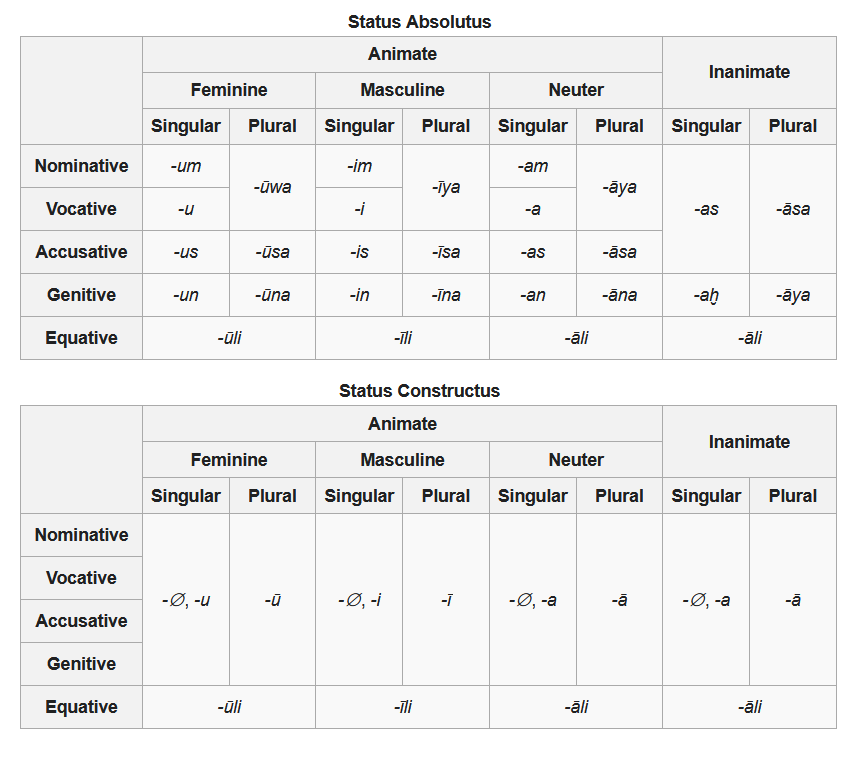
The old system for reference
- fourgenderednouns.png (34.63 KiB) Viewed 22628 times
The formula of all the cases being gender vowel + consonant got boring. Adding more vowels doesn't necessarily solve the problem.
Re: Conlang Random Thread
Posted: Sat Jul 26, 2025 5:44 pm
by Ahzoh
malloc wrote: ↑Sat Jul 26, 2025 3:17 pm
Ahzoh wrote: ↑Sat Jul 26, 2025 1:58 pmStill, I feel uneasy about having most of the endings having the same vocality. Part of my issue is that I don't like certain combination of sounds, like /ix/.
Perhaps the language underwent a sound change that eliminated this sequence. Many languages avoid high and especially front vowels around guttural consonants in various ways. The language might lower the vowel yielding /ex/ or front the consonant yielding /iS/ or something along those lines. That would introduce some interesting variation and surface irregularity to the inflectional system as well.
Well it could be like Hittite, where every stem essentially became a-stems. Hurro-Urartian is similar where every root has a thematic i-vowel
Re: Conlang Random Thread
Posted: Sun Jul 27, 2025 12:50 pm
by Ahzoh
I think to solve my issue, I could justify some vocalic-stems as the remnants of some afroasiatic style "root extensions":
- -uw = an avoidance or venerative suffix
Examples: ḥaǰ-uw "boar", sis-uw "the god Sisu", mam-uw "the goddess Mamu"
- -bi = kinship?
Examples: raḥ-bi "man", lum-bi "woman", sim-bi "child"
- -ǰi = augmentive?
Examples: jan-ǰi "king, ruler", ma-ǰi "sea", nar-ǰi "the god Nardi"
Re: Conlang Random Thread
Posted: Wed Jul 30, 2025 5:27 pm
by jal
Glass Half Baked wrote: ↑Tue Jul 22, 2025 9:30 amOut of curiosity, what ratio of a priori to a posteriori languages do you all gravitate toward?
Except for Sajiwan (which is a Caribbean English Creole, and as such bound by the general rules of CECs), all my conlangs are
a priori, though Fake Latinic and Fake Germanic of course heavily borrow from both grammar and vocabulary of the languages they immitate. This is mostly because I find it less restrictive, and easier, to create a language
a priori, and a lot of my conlangs start out as though experiments.
June 2016, which I plan to revisit one day, can be said to be somewhat
a posteriori, as it is part of the Balkan Sprachbund and as such has grammatical features and some vocabulary that is common for such languages.
JAL
Re: Conlang Random Thread
Posted: Thu Jul 31, 2025 1:16 am
by hwhatting
The only conlangs I'm continuously working on, the languages of Tarra, are a posteriori - Tautisca is a Western Indo-European language, Lemba Romana, Mədan and Ilan are Romlangs.
Re: Conlang Random Thread
Posted: Mon Aug 04, 2025 4:15 am
by Morkai5
The dictionary of my conlang only includes part of speech and the translation to English and my natlang. What else should include?
Re: Conlang Random Thread
Posted: Mon Aug 04, 2025 5:07 am
by bradrn
Morkai5 wrote: ↑Mon Aug 04, 2025 4:15 am
The dictionary of my conlang only includes part of speech and the translation to English and my natlang. What else should include?
I suggest reading Coward & Grimes’s
Making Dictionaries — it’s written with reference to the MDF software in particular, but has a lot of broadly relevant advice too.
More generally, I strongly recommend reading zompist’s Lexipedia.
Re: Conlang Random Thread
Posted: Mon Aug 04, 2025 6:14 am
by Morkai5
bradrn wrote: ↑Mon Aug 04, 2025 5:07 am
I suggest reading Coward & Grimes’s
Making Dictionaries — it’s written with reference to the MDF software in particular, but has a lot of broadly relevant advice too.
More generally, I strongly recommend reading zompist’s Lexipedia.
Thanks, will do!
Re: Conlang Random Thread
Posted: Mon Aug 04, 2025 6:28 am
by xxx
Glass Half Baked wrote: ↑Tue Jul 22, 2025 9:30 am
Most of my conlangs are a posteriori, in part because I like history and historical linguistics, and in part because I think fitting a language into an existing context is a fun challenge. Out of curiosity, what ratio of a priori to a posteriori languages do you all gravitate toward?
here, a priori conlang in the strong sense, using semantic primes and no linguistics...
Re: Conlang Random Thread
Posted: Fri Aug 15, 2025 6:29 pm
by malloc
Currently working on the phonoaesthetics of my latest project. I am looking for ways to avoid too many harsh consonants in successive syllables, as this project includes not only clicks but aspirate and ejective consonants. One obvious approach is lenition with plosives becoming fricatives or approximants between vowels. However this process would clearly need some limitations to avoid the improbable situation of plosives rarely appearing within words, e.g. something like *tapakatapaka > tawağarawağa.
Re: Conlang Random Thread
Posted: Fri Aug 15, 2025 7:46 pm
by Richard W
malloc wrote: ↑Fri Aug 15, 2025 6:29 pm
However this process would clearly need some limitations to avoid the improbable situation of plosives rarely appearing within words, e.g. something like *
tapakatapaka >
tawağarawağa.
Prakrit in tis development from Old Indic dropped single unaspirated dental and velar plosives between vowels, so the results need not be too dire. Two things preserved other plosives between vowels:
- Clusters with plosives were reduced to single plosives
- Retroflex and palatal stops were preserved.
Re: Conlang Random Thread
Posted: Fri Aug 15, 2025 9:19 pm
by keenir
malloc wrote: ↑Fri Aug 15, 2025 6:29 pm However this process would clearly need some limitations to avoid the improbable situation of plosives rarely appearing within words, e.g. something like *
tapakatapaka >
tawağarawağa.
Something that is improbable, is not impossible; if anything, it makes it further unique. To my eye, having plosives only on the initial and closing syllables of a word, would be a good way - a fine shortcut - to telling where a word begins and ends, even if the script lacks spaces between words. Just a thought.
I like what you're doing so far, but its your call.
Re: Conlang Random Thread
Posted: Fri Aug 15, 2025 9:28 pm
by bradrn
malloc wrote: ↑Fri Aug 15, 2025 6:29 pm
However this process would clearly need some limitations to avoid the improbable situation of plosives rarely appearing within words, e.g. something like *
tapakatapaka >
tawağarawağa.
‘Improbable’? Isn’t Spanish like that? (Amongst other languages.)