Page 194 of 204
Re: Conlang Random Thread
Posted: Sat Mar 21, 2026 9:09 pm
by rotting bones
malloc wrote: ↑Sat Mar 21, 2026 8:49 pm
rotting bones wrote: ↑Sat Mar 21, 2026 7:43 pmIn technical contexts, English uses numbers with a base of 2 (edit: or 16). I've been thinking Ancient Galactic uses different bases in different ordinary contexts.
How so? Programmers use binary and hexadecimal, but not usually spoken and certainly not for cardinal numbers. Not even the most hard-core techbro would count to "four sixteens and five".
You are right. It's rare in spoken language. I'm counting the technical usage. For example, I know off the top of my head that 41 in hex is the capital letter A. I'm not even sure why I know that. Even when I needed to know ASCII for BASIC, I'm sure I usually wrote 65 in base 10. 41 only came up when I opened binaries in a hex editor. I understand if you think that doesn't count as English.
Re: Conlang Random Thread
Posted: Sun Mar 22, 2026 9:18 am
by Travis B.
To me hex is quite natural, just as natural as decimal (and much more natural than raw binary). In particular I find it more natural to think in terms of powers of two in the context of hex than in the context of decimal. Conversely, raw binary is just confusing with all the 1's and 0's, even though when thinking of binary operations on hex numbers I will mentally convert from hex to binary and back again.
Re: Conlang Random Thread
Posted: Sun Mar 22, 2026 9:20 pm
by malloc
Travis B. wrote: ↑Sun Mar 22, 2026 9:18 amTo me hex is quite natural, just as natural as decimal (and much more natural than raw binary). In particular I find it more natural to think in terms of powers of two in the context of hex than in the context of decimal. Conversely, raw binary is just confusing with all the 1's and 0's, even though when thinking of binary operations on hex numbers I will mentally convert from hex to binary and back again.
Certainly there are ways to make it work intuitively. Nonetheless it looks like numbers generally evolve out of counting digits, usually leading to multiples of five as the base. Presumably the arithmetical benefits of binary or derived bases are only apparent if you're already familiar with numbers some other way.
Re: Conlang Random Thread
Posted: Sun Mar 22, 2026 9:57 pm
by rotting bones
malloc wrote: ↑Sun Mar 22, 2026 9:20 pm
Certainly there are ways to make it work intuitively. Nonetheless it looks like numbers generally evolve out of counting digits, usually leading to multiples of five as the base. Presumably the arithmetical benefits of binary or derived bases are only apparent if you're already familiar with numbers some other way.
There are many ways to get the base you want.
For 16, you could count each finger, excluding the thumb, twice. Once on the tip and once on a joint.
It's natural to exclude the thumb if you're using it to do the counting. Every time you get to 16, you could fold a finger. This will let you count to 8 × 16 = 128.
Is there a rule saying the speakers of a language must use the same counting method in every context? Different bases could be useful in different contexts, and the counting method could change accordingly, at least in theory.
Re: Conlang Random Thread
Posted: Sun Mar 22, 2026 11:20 pm
by Ahzoh
I do wonder if base-10 being the most common in the world is common for a reason or if it's merely coin-flip chance and there's an alternate universe where base-12 is just as likely to be the predominant number base.
Re: Conlang Random Thread
Posted: Mon Mar 23, 2026 5:01 am
by WeepingElf
Ahzoh wrote: ↑Sun Mar 22, 2026 11:20 pm
I do wonder if base-10 being the most common in the world is common for a reason or if it's merely coin-flip chance and there's an alternate universe where base-12 is just as likely to be the predominant number base.
Well, it is obvious that base 10 is most common because we have 10 fingers. But if you count with the thumb against the finger segments as my con-people do (and I do myself), you get base 12.
Re: Conlang Random Thread
Posted: Mon Mar 23, 2026 5:07 am
by rotting bones
WeepingElf wrote: ↑Mon Mar 23, 2026 5:01 am
Ahzoh wrote: ↑Sun Mar 22, 2026 11:20 pm
I do wonder if base-10 being the most common in the world is common for a reason or if it's merely coin-flip chance and there's an alternate universe where base-12 is just as likely to be the predominant number base.
Well, it is obvious that base 10 is most common because we have 10 fingers. But if you count with the thumb against the finger segments as my con-people do (and I do myself), you get base 12.
Counting the creases and tips (ignoring the thumbs) gives you 16 per hand.
Re: Conlang Random Thread
Posted: Mon Mar 23, 2026 9:07 am
by jal
malloc wrote: ↑Sat Mar 21, 2026 8:49 pmHow so? Programmers use binary and hexadecimal, but not usually spoken and certainly not for cardinal numbers. Not even the most hard-core techbro would count to "four sixteens and five".
"fourty-five hex" is common enough though.
JAL
Re: Conlang Random Thread
Posted: Mon Mar 23, 2026 9:16 am
by Ahzoh
WeepingElf wrote: ↑Mon Mar 23, 2026 5:01 am
Ahzoh wrote: ↑Sun Mar 22, 2026 11:20 pm
I do wonder if base-10 being the most common in the world is common for a reason or if it's merely coin-flip chance and there's an alternate universe where base-12 is just as likely to be the predominant number base.
Well, it is obvious that base 10 is most common because we have 10 fingers. But if you count with the thumb against the finger segments as my con-people do (and I do myself), you get base 12.
It is also just as obvious that we have 3 joints per digit. Though I suppose the one advantage base-10 has is you can just show your hands to others
Re: Conlang Random Thread
Posted: Mon Mar 23, 2026 11:34 am
by /ˌnɐ.ˈɾɛn.dɚ.ˌduːd/
rotting bones wrote: ↑Mon Mar 23, 2026 5:07 am
WeepingElf wrote: ↑Mon Mar 23, 2026 5:01 am
Ahzoh wrote: ↑Sun Mar 22, 2026 11:20 pm
I do wonder if base-10 being the most common in the world is common for a reason or if it's merely coin-flip chance and there's an alternate universe where base-12 is just as likely to be the predominant number base.
Well, it is obvious that base 10 is most common because we have 10 fingers. But if you count with the thumb against the finger segments as my con-people do (and I do myself), you get base 12.
Counting the creases and tips (ignoring the thumbs) gives you 16 per hand.
another way to count to base 16 on your hands, and the most intuitive IMO, is to count on the one hand with the thumb down for 1 - 4, then repeat on the same hand with the thumb raised for 5 - 8, and then add in the other hand for 9 - 12 and 13 - 16. it also gives a tidy sub-base of four.
Re: Conlang Random Thread
Posted: Mon Mar 23, 2026 11:58 am
by malloc
My point is not that you can't count in binary or hexadecimal. There are hand-counting systems for both after all. Rather, it's that humans don't naturally count that. Whenever numbers evolve among humans, they almost always occur in fives, tens, or twenties. So the hexadecimal system feels inherently less human even if it technically works better.
Re: Conlang Random Thread
Posted: Mon Mar 23, 2026 12:16 pm
by rotting bones
malloc wrote: ↑Mon Mar 23, 2026 11:58 am
My point is not that you can't count in binary or hexadecimal. There are hand-counting systems for both after all. Rather, it's that humans don't naturally count that. Whenever numbers evolve among humans, they almost always occur in fives, tens, or twenties. So the hexadecimal system feels inherently less human even if it technically works better.
The languages in our current sample haven't evolved in a state of society that benefits from hexadecimal counting.
Re: Conlang Random Thread
Posted: Mon Mar 23, 2026 12:17 pm
by rotting bones
Travis B. wrote: ↑Sun Mar 22, 2026 9:18 am
To me hex is quite natural, just as natural as decimal (and much more natural than raw binary). In particular I find it more natural to think in terms of powers of two in the context of hex than in the context of decimal. Conversely, raw binary is just confusing with all the 1's and 0's, even though when thinking of binary operations on hex numbers I will mentally convert from hex to binary and back again.
Hex is useful in computing because there's a straightforward correspondence between hex and binary. I'm sure you're aware of this. Hex is like binary with some transparent compression.
Re: Conlang Random Thread
Posted: Mon Mar 23, 2026 1:09 pm
by Ahzoh
Hex also sounds magical. I expect techwizards and synthwitches to be making incantations in hexadecimal.
Re: Conlang Random Thread
Posted: Mon Mar 23, 2026 1:59 pm
by Richard W
rotting bones wrote: ↑Sun Mar 22, 2026 9:57 pm
Is there a rule saying the speakers of a language must use the same counting method in every context? Different bases could be useful in different contexts, and the counting method could change accordingly, at least in theory.
No. English sheep counting numerals are usually used as part of a vigesimal system, albeit with the number of twenties being noted physically rather than vocally.
One also has the standard French cardinals, which are decimal up to 69 and then go sexagesimal from 70 to 99 (or is it 119?).
We of course have the mixed base systems, as with 16 ounces = one pound, 14 pounds = 1 stone, 8 stone = one cwt, 20 cwt = 1 ton.
I gather that Akkadian speakers used base 60 for arithmetic but base 10 for speech.
One can also consider the various Anglo-Saxon shillings: early Mercian of 4 pennies, early West Saxon of 5 pennies, and the later shilling of 12 pennies.
Re: Conlang Random Thread
Posted: Mon Mar 23, 2026 2:22 pm
by Travis B.
rotting bones wrote: ↑Mon Mar 23, 2026 12:17 pm
Travis B. wrote: ↑Sun Mar 22, 2026 9:18 am
To me hex is quite natural, just as natural as decimal (and much more natural than raw binary). In particular I find it more natural to think in terms of powers of two in the context of hex than in the context of decimal. Conversely, raw binary is just confusing with all the 1's and 0's, even though when thinking of binary operations on hex numbers I will mentally convert from hex to binary and back again.
Hex is useful in computing because there's a straightforward correspondence between hex and binary. I'm sure you're aware of this. Hex is like binary with some transparent compression.
Hex is often easier to mentally deal with than plain binary, because human brains just aren't suited to dealing with long strings of ones and zeroes whereas hex digits are much easier on the brain.
Re: Conlang Random Thread
Posted: Mon Mar 23, 2026 3:17 pm
by jal
malloc wrote: ↑Mon Mar 23, 2026 11:58 amWhenever numbers evolve among humans, they almost always occur in fives, tens, or twenties.
Or twelves and 60s. Well, maybe not often, but it was a very important one with quite some reach...
JAL
Re: Conlang Random Thread
Posted: Mon Mar 23, 2026 6:16 pm
by /ˌnɐ.ˈɾɛn.dɚ.ˌduːd/
jal wrote: ↑Mon Mar 23, 2026 3:17 pm
malloc wrote: ↑Mon Mar 23, 2026 11:58 amWhenever numbers evolve among humans, they almost always occur in fives, tens, or twenties.
Or twelves and 60s. Well, maybe not often, but it was a very important one with quite some reach...
JAL
and while they have most commonly evolved as those, it's important to note that that doesn't mean that numbers
can't evolve in a hexadecimal format, especially with a smaller sub-base.
Re: Conlang Random Thread
Posted: Mon Mar 23, 2026 10:30 pm
by malloc
jal wrote: ↑Mon Mar 23, 2026 3:17 pmOr twelves and 60s. Well, maybe not often, but it was a very important one with quite some reach...
One of my other projects actually uses a combination of twelve and sixty which I quite like. I ended up sketching an entire measurement system based on that.
rotting bones wrote: ↑Mon Mar 23, 2026 12:16 pmThe languages in our current sample haven't evolved in a state of society that benefits from hexadecimal counting.
True, although the main use case for hexadecimal is software engineering which is quite niche. The vast majority of people even today never program computers and thus have little use for hexadecimal.
Re: Conlang Random Thread
Posted: Tue Mar 24, 2026 9:44 pm
by Ahzoh
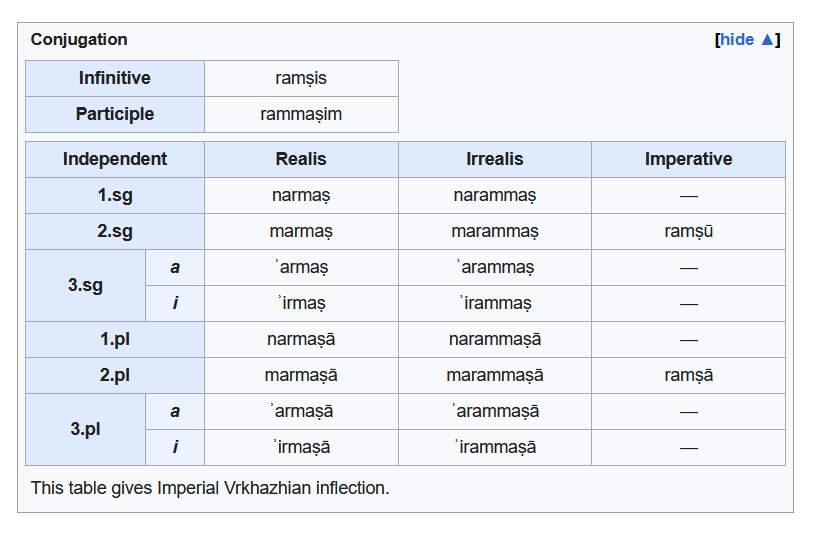
Does it make sense to have distinct person markers for animate versus inanimate or should it be more along the lines of human versus nonhuman?
- newtable2.png (37.02 KiB) Viewed 347 times