Page 196 of 216
Re: Conlang Random Thread
Posted: Fri Mar 27, 2026 7:25 am
by bradrn
Ahzoh wrote: ↑Fri Mar 27, 2026 7:22 am
bradrn wrote: ↑Fri Mar 27, 2026 7:14 am
Ahzoh wrote: ↑Fri Mar 27, 2026 6:56 am
Just change of order. The fronting of constituents in an otherwise verb-first head-initial language is marker enough.
Not sure I agree. For instance, this sentence could be interpreted with two different constituent orders:
Ḳābam ʾiḫūt kapâs ʾarśēki
"it was the king who poured water into his vessel" (S-V-O-X)
"it was the king who the water poured into his vessel (O-V-S-X)
Obviously in this case the correct interpretation is the former, but there are other sentences which might be much more ambiguous.
(If your answer is, ‘the interpretation is always deduced from context’ — that’s fine, plenty of natlangs do that too. But you need to explicitly specify that that’s what you want.)
The second interpretation is impossible since the verb is marked with an animate subject prefix and water is inanimate-marked.
Between animates, the situation is still unambiguous since the nominative is -m and the accusative is -s.
Oh, OK; I misunderstood what was meant by ‘just change of order’.
Though I'm now not sure how much the V1 default in Vrkhazhian obeys the various theoretical approaches used to explain the occurence of V1 in real languages. Especially when SVO is possible order.
Plenty of languages alternate between V1 and V2 word orders. (I already mentioned Dinka; Mayan languages do it too, and in fact allow fronting of
both constituents at once.) I couldn’t care less about what theories the Chomskyanists have come up with to contort these languages into the shape of English.
Re: Conlang Random Thread
Posted: Fri Mar 27, 2026 7:34 am
by Ahzoh
bradrn wrote: ↑Fri Mar 27, 2026 7:25 am
Plenty of languages alternate between V1 and V2 word orders. (I already mentioned Dinka; Mayan languages do it too, and in fact allow fronting of
both constituents at once.) I couldn’t care less about what theories the Chomskyanists have come up with to contort these languages into the shape of English.
Sure, I chose V1 because I consider the
what (i.e. the action) to be more important and prominent than the
who, and maybe my speakers do as well.
Still, I've noticed that most, if not nearly all, of the languages I know of that have V1 order either have polypersonal marking or have object clitics, neither which Vrkhazhian has. So maybe those things are something that allows them to defy the proposed "verb-object bonding" principle.
Ultimately, It all depends on whether one should consider the verb and object as one unit separate from the subject (seems to be the case for most languages, leading to the "verb-object bonding" principle) or if only the verb is the main unit to which subject and object are equally subordinate.
Relatedly:
https://linguistics.stackexchange.com/q ... evelopment
Re: Conlang Random Thread
Posted: Fri Mar 27, 2026 7:40 am
by Travis B.
Ahzoh, if you are at all concerned about ambiguity (e.g. of inanimates) one thing you could consider adding is
inverse marking (forgive my linking to the Wiki) by which if an object is higher on some person/animacy/topicality hierarchy than the subject, you'd apply inverse marking, typically on the verb. I think inverse marking is a neat feature to have, and often put it in my languages. (While in many cases it can eliminate the need for noun subject/object case-marking, it is still compatible with it for the sake of added redundancy.)
Please ignore the parts about Ojibwe and its obviative 3rd person, though ─ that is really a peculiarity of Algonquian languages that is besides the point of what inverse marking really is.
Re: Conlang Random Thread
Posted: Fri Mar 27, 2026 7:45 am
by Ahzoh
Travis B. wrote: ↑Fri Mar 27, 2026 7:40 am
Ahzoh, if you are at all concerned about ambiguity (e.g. of inanimates) one thing you could consider adding is
inverse marking (forgive my linking to the Wiki) by which if an object is higher on some person/animacy/topicality hierarchy than the subject, you'd apply inverse marking, typically on the verb. I think inverse marking is a neat feature to have, and often put it in my languages. (While in many cases it can eliminate the need for noun subject/object case-marking, it is still compatible with it for the sake of added redundancy.)
I have considered but it just means more affixes, which I have troubles fitting into my verb paradigm.
I still have not solved negative marking
Re: Conlang Random Thread
Posted: Fri Mar 27, 2026 3:15 pm
by malloc
So my current proposal for binary-hexadecimal numbers includes roots for one, two, four, eight, and sixteen. Numbers below thirty-two are formed by combining the appropriate roots from highest to lowest. Thus thirteen becomes eight-four-one (1101) and twenty-five becomes sixteen-eight-one (11001) and so forth. Numbers thirty-two and beyond begin with their quotient when divided by sixteen, then sixteen itself, and the remainder of division. Thus sixty-nine becomes four-sixteen-four-one while eighty-three becomes four-one-sixteen-two-one. Still larger numbers use an element which turns each root into successively doubled powers of 256 with the same formula of quotient-base-remainder. Thus two-thousand and twenty-six becomes four-two-one-one-256.POWER-eight-four-two-sixteen-eight-two (11111101010).
Despite the conceptual elegance of this system, it suffers from one glaring problem, namely that humans simply don't naturally count this way. Certainly they could learn this system and become proficient with practice, but it would never occur to people developing numbers for the first time. This system really only makes sense to people familiar with low-level computing programming like C and assembly, a tiny proportion of humanity that is only getting smaller with C and assembly largely obsolete and generative AI rapidly taking over coding.
Re: Conlang Random Thread
Posted: Fri Mar 27, 2026 3:26 pm
by Travis B.
malloc wrote: ↑Fri Mar 27, 2026 3:15 pm
Despite the conceptual elegance of this system, it suffers from one glaring problem, namely that humans simply don't naturally count this way. Certainly they could learn this system and become proficient with practice, but it would never occur to people developing numbers for the first time. This system really only makes sense to people familiar with low-level computing programming like C and assembly, a tiny proportion of humanity that is only getting smaller with C and assembly largely obsolete and generative AI rapidly taking over coding.
I use hex
all the time, and programming in languages where you care about bits is by no means obsolete. I do most of my work at my day job in C++ after all. And AI really is not going to replace programmers overall; at most programmers will turn into AI-herders (the AI's are not going to think up what they are going to do all by themselves, someone has to tell them
precisely what they are to do, and afterwards verify that they did it correctly and did not hallucinate anything).
Re: Conlang Random Thread
Posted: Fri Mar 27, 2026 4:25 pm
by malloc
Travis B. wrote: ↑Fri Mar 27, 2026 3:26 pmI use hex all the time, and programming in languages where you care about bits is by no means obsolete. I do most of my work at my day job in C++ after all. And AI really is not going to replace programmers overall; at most programmers will turn into AI-herders (the AI's are not going to think up what they are going to do all by themselves, someone has to tell them precisely what they are to do, and afterwards verify that they did it correctly and did not hallucinate anything).
Sure, but you don't need hexadecimal to vibe-code in high level languages like JavaScript or Python, which characterizes the majority of software engineers these days. My point is that hexadecimal has such niche usage (and that niche is rapidly shrinking) that it seems hard to justify using for my project, regardless of its conceptual elegance.
Re: Conlang Random Thread
Posted: Fri Mar 27, 2026 4:38 pm
by bradrn
malloc wrote: ↑Fri Mar 27, 2026 4:25 pm
My point is that hexadecimal has such niche usage (and that niche is rapidly shrinking) that it seems hard to justify using for my project, regardless of its conceptual elegance.
For such a project isn’t ‘conceptual elegance’ enough on its own?
Re: Conlang Random Thread
Posted: Fri Mar 27, 2026 4:39 pm
by Travis B.
malloc wrote: ↑Fri Mar 27, 2026 4:25 pm
Travis B. wrote: ↑Fri Mar 27, 2026 3:26 pmI use hex all the time, and programming in languages where you care about bits is by no means obsolete. I do most of my work at my day job in C++ after all. And AI really is not going to replace programmers overall; at most programmers will turn into AI-herders (the AI's are not going to think up what they are going to do all by themselves, someone has to tell them precisely what they are to do, and afterwards verify that they did it correctly and did not hallucinate anything).
Sure, but you don't need hexadecimal to vibe-code in high level languages like JavaScript or Python, which characterizes the majority of software engineers these days. My point is that hexadecimal has such niche usage (and that niche is rapidly shrinking) that it seems hard to justify using for my project, regardless of its conceptual elegance.
Anyone who has programmed a proper embedded system needs to know about things like bitfields and bitmasks, for which hex is essential, and embedded systems are in
everything.
Re: Conlang Random Thread
Posted: Sat Mar 28, 2026 3:50 pm
by jal
Travis B. wrote: ↑Fri Mar 27, 2026 4:39 pmAnyone who has programmed a proper embedded system needs to know about things like bitfields and bitmasks, for which hex is essential, and embedded systems are in
everything.
Naaah, let's just vibe code that pacemaker software! AI ftw!
JAL
Re: Conlang Random Thread
Posted: Sat Mar 28, 2026 4:02 pm
by jal
Interesting, though I'm not sure I agree with the post telling SOV is common in kids speech because of easy retrieval. I once read that English-speaking children prefer SVO as that's about the only word order in English, while Dutch children prefer SOV, as it's the most common word order in V2 languages, where the V in second position is an auxiliary verb that children tend to skip (hence also the use of infinitives by said children: "[name] broodje eten" ("[name] bread eat", from overheard "[name] gaat/moet/wil een broodje eten", or question "gaat/moet/wil [name] een broodje eten?").
JAL
Re: Conlang Random Thread
Posted: Mon Mar 30, 2026 7:42 am
by rotting bones
An attempt to apply months of intermittently studying PIE linguistics:
https://snapshotsofthelabyrinth.photo.b ... lai-umnos/ I'm trying to create an IE conlang that is neither exclusively centum nor satem, along with a culture that fits the location where such a language would probably be spoken. I'm still thinking about the aesthetics.
I also have a sketch for a non-IE agglutinative language spoken by the farmers who were conquered by the horse lords. Currently, that language supplies only toponyms and some technical farming terminology. It has open syllables with lots of geminate l, n, s, and clusters like "nth". I'm worried I overdid it. I don't really understand what pattern of borrowings would be realistic either.
Re: Conlang Random Thread
Posted: Mon Mar 30, 2026 2:38 pm
by Travis B.
rotting bones wrote: ↑Mon Mar 30, 2026 7:42 am
An attempt to apply months of intermittently studying PIE linguistics:
https://snapshotsofthelabyrinth.photo.b ... lai-umnos/ I'm trying to create an IE conlang that is neither exclusively centum nor satem, along with a culture that fits the location where such a language would probably be spoken. I'm still thinking about the aesthetics.
I also have a sketch for a non-IE agglutinative language spoken by the farmers who were conquered by the horse lords. Currently, that language supplies only toponyms and some technical farming terminology. It has open syllables with lots of geminate l, n, s, and clusters like "nth". I'm worried I overdid it. I don't really understand what pattern of borrowings would be realistic either.
The specific cluster "nth" makes me think of Pre-Greek.
Re: Conlang Random Thread
Posted: Mon Mar 30, 2026 6:21 pm
by rotting bones
Travis B. wrote: ↑Mon Mar 30, 2026 2:38 pm
The specific cluster "nth" makes me think of Pre-Greek.
You might have noticed "psūkān".
Re: Conlang Random Thread
Posted: Mon Mar 30, 2026 8:55 pm
by Travis B.
rotting bones wrote: ↑Mon Mar 30, 2026 6:21 pm
Travis B. wrote: ↑Mon Mar 30, 2026 2:38 pm
The specific cluster "nth" makes me think of Pre-Greek.
You might have noticed "psūkān".
The language does have the look and feel of an old IE language, I must say.
Re: Conlang Random Thread
Posted: Mon Mar 30, 2026 9:41 pm
by rotting bones
Travis B. wrote: ↑Mon Mar 30, 2026 8:55 pm
The language does have the look and feel of an old IE language, I must say.
Thanks. I'm thinking of a Sword and Sorcery setting.
Re: Conlang Random Thread
Posted: Tue Mar 31, 2026 12:52 am
by Ahzoh
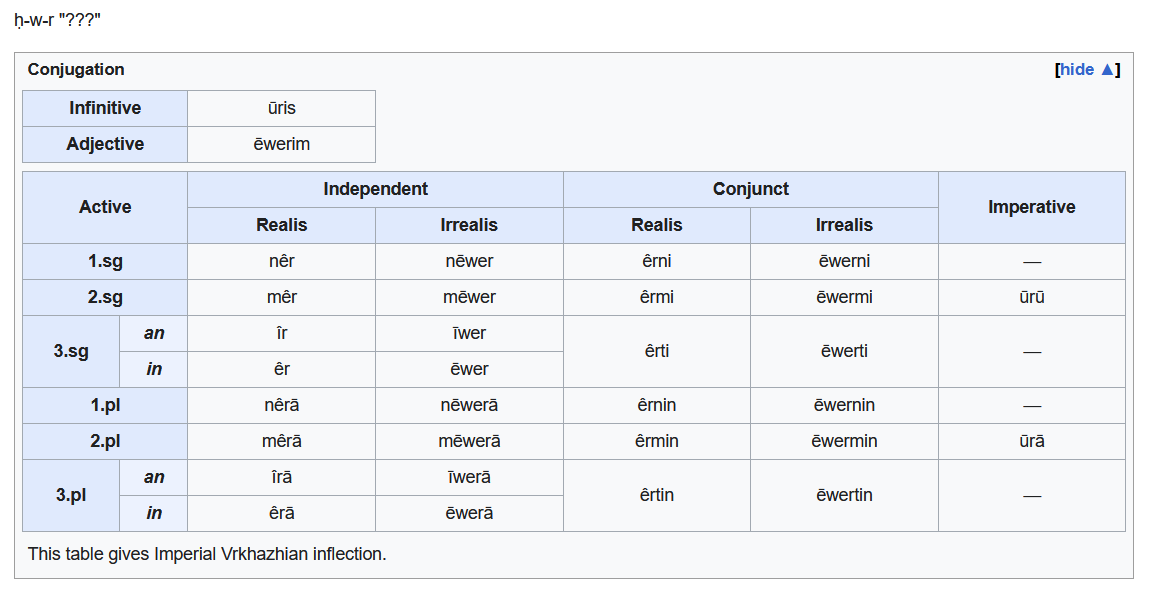
A possible negative verb where the main verb is conjugated in the conjunct form
narmaṣ "I heard" >
nêr ramaṣni "I did not hear"
marmaṣ "you heard" >
mêr ramaṣmi "you did not hear"
irmaṣ "he/she heard" >
îr ramaṣti "he/she did not hear"
narammaṣ "I will hear" >
nēwer rammaṣni "I will not hear"
ramṣū "hear!" >
ūrū rammaṣni! "do not hear!"
I don't know if the conjunct verb should match the negative verb in modality or always be irrealis.
I am also uncertain about the possibility of double conjuncts
- doubleweak.png (39.11 KiB) Viewed 2527 times
Re: Conlang Random Thread
Posted: Tue Mar 31, 2026 7:27 pm
by Ahzoh
If consonants were to determine the quality of an epenthetic vowel, would /i/ appear after sonorants while /a/ appears after obstruents, or the other way around?
Re: Conlang Random Thread
Posted: Tue Mar 31, 2026 7:56 pm
by Z500
Ahzoh wrote: ↑Tue Mar 31, 2026 12:52 am
A possible negative verb where the main verb is conjugated in the conjunct form
narmaṣ "I heard" >
nêr ramaṣni "I did not hear"
marmaṣ "you heard" >
mêr ramaṣmi "you did not hear"
irmaṣ "he/she heard" >
îr ramaṣti "he/she did not hear"
narammaṣ "I will hear" >
nēwer rammaṣni "I will not hear"
ramṣū "hear!" >
ūrū rammaṣni! "do not hear!"
I don't know if the conjunct verb should match the negative verb in modality or always be irrealis.
I am also uncertain about the possibility of double conjuncts
doubleweak.png
Interesting, if I'm reading this chart right, the root is only fully expressed in the irrealis conjunct?
Re: Conlang Random Thread
Posted: Tue Mar 31, 2026 8:44 pm
by Travis B.
Ahzoh wrote: ↑Tue Mar 31, 2026 7:27 pm
If consonants were to determine the quality of an epenthetic vowel, would /i/ appear after sonorants while /a/ appears after obstruents, or the other way around?
I would think the other way around, as /a/ is "more sonorant" than /i/ I'd think.