Page 197 of 216
Re: Conlang Random Thread
Posted: Tue Mar 31, 2026 8:46 pm
by Travis B.
Z500 wrote: ↑Tue Mar 31, 2026 7:56 pm
Ahzoh wrote: ↑Tue Mar 31, 2026 12:52 am
A possible negative verb where the main verb is conjugated in the conjunct form
narmaṣ "I heard" >
nêr ramaṣni "I did not hear"
marmaṣ "you heard" >
mêr ramaṣmi "you did not hear"
irmaṣ "he/she heard" >
îr ramaṣti "he/she did not hear"
narammaṣ "I will hear" >
nēwer rammaṣni "I will not hear"
ramṣū "hear!" >
ūrū rammaṣni! "do not hear!"
I don't know if the conjunct verb should match the negative verb in modality or always be irrealis.
I am also uncertain about the possibility of double conjuncts
doubleweak.png
Interesting, if I'm reading this chart right, the root is only fully expressed in the irrealis conjunct?
One hint here, though, is I suspect this is a "weak root" where semivowels and like are liable to disappear in various forms (Vrkazhian IIRC is old Semitic (read: Akkadian)-inspired).
Re: Conlang Random Thread
Posted: Tue Mar 31, 2026 8:55 pm
by Ahzoh
Travis B. wrote: ↑Tue Mar 31, 2026 8:44 pm
Ahzoh wrote: ↑Tue Mar 31, 2026 7:27 pm
If consonants were to determine the quality of an epenthetic vowel, would /i/ appear after sonorants while /a/ appears after obstruents, or the other way around?
I would think the other way around, as /a/ is "more sonorant" than /i/ I'd think.
So /a/ after sonorants and /i/ after obstruents
Re: Conlang Random Thread
Posted: Tue Mar 31, 2026 8:56 pm
by malloc
Ahzoh wrote: ↑Tue Mar 31, 2026 7:27 pmIf consonants were to determine the quality of an epenthetic vowel, would /i/ appear after sonorants while /a/ appears after obstruents, or the other way around?
I had the impression that consonant place has more impact on vowel quality than consonant manner. Coronal and palatal consonants often lead to vowel fronting while guttural consonants like uvulars generally push vowels lower and further back, for instance.
Re: Conlang Random Thread
Posted: Tue Mar 31, 2026 9:24 pm
by Ahzoh
I realized that the sound changes that lead to the negative verb forms wasn't quite sensible.
These changes look cleaner, though I'm not a fan of medial glottal stop.
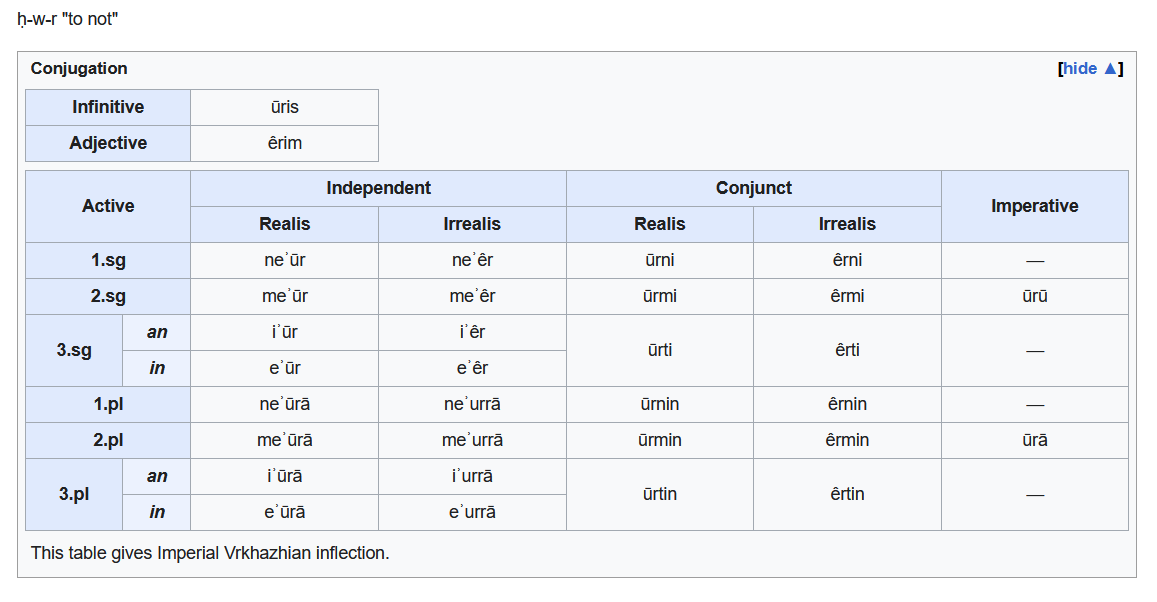
- tonot1.png (35.11 KiB) Viewed 2896 times
However, I like this verb better and i think this will be the negative verb. The other one will have some other meaning
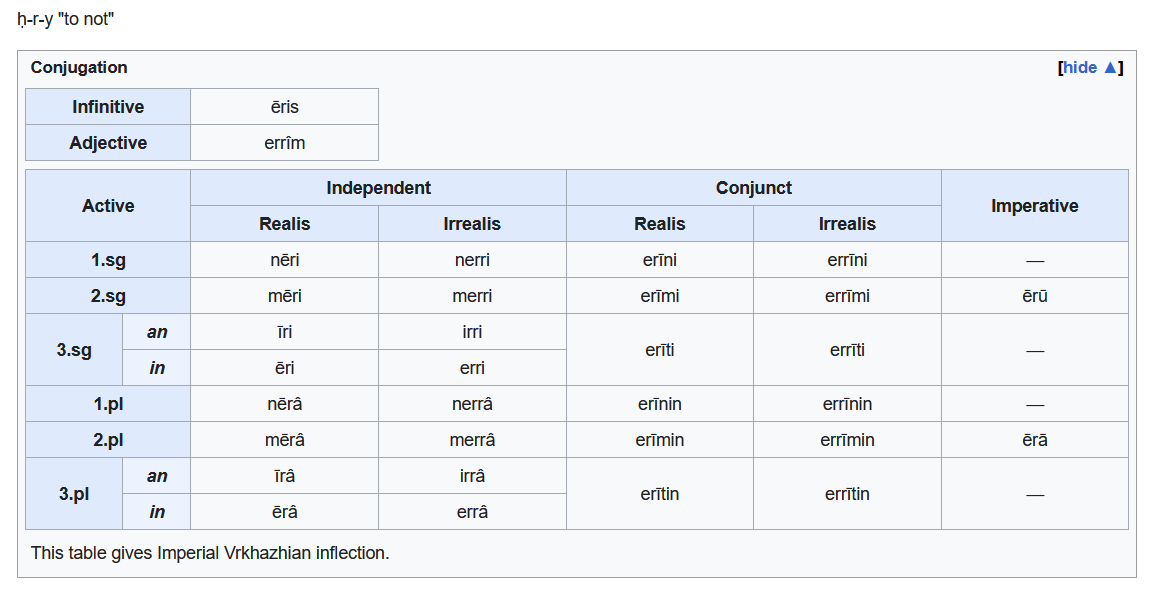
- tonot2.png (33.69 KiB) Viewed 2896 times
Also, some additional mood clitics
nā= "optative, desirative"
nī= "commissive"
ḫā= "counterfactual"
nā=naparraḫ "I want to say" /
nā=nerri parraḫni "I do not want to say"
nī=naparraḫ "I shall say" /
nī=nerri parraḫni "I shall not say"
ḫā=naparraḫ "I would have said" /
ḫā=nerri parraḫni "I would not have said"
Re: Conlang Random Thread
Posted: Thu Apr 02, 2026 10:00 am
by Ahzoh
I like the idea of verbs taking the conjunct form when they act with an auxiliary verb
iṣdi "he/she ate" (realis)
iṣdâ "they ate" (realis)
iṣaddi "he/she will eat" (irrealis)
iṣaddâ "they will eat" (irrealis)
īri ṣadīti "he/she did not eat" (realis)
īrâ ṣadītin "they did not eat" (realis)
irri ṣaddīti "he/she will not eat" (irrealis)
irrâ ṣaddītin "they will not eat" (irrealis)
simbīya ṣaddītin "children who will eat" (conjunct behaving as relative clause)
But it creates an unpleasant situation of there being double conjunct verbs
simbīya [errītin ṣaddītin] "children who will not eat"
idninā [erītin ṣadītin] "they slept when they did not eat"
iṣdâ [erītin danintin] "they ate when they did not sleep"
It is most unpleasant when the main clause is negative
irrâ ṣadītin [danintin] "they did not eat when they slept"
Re: Conlang Random Thread
Posted: Fri Apr 03, 2026 6:21 pm
by rotting bones
This second draft broke my brain:
https://snapshotsofthelabyrinth.photo.b ... eis-bazda/
I do like the sound. On the other hand, this is basically Latin.
Re: Conlang Random Thread
Posted: Fri Apr 03, 2026 10:52 pm
by malloc
What is the difference between /ai/ and /ay/ among the diphthongs?
Re: Conlang Random Thread
Posted: Sat Apr 04, 2026 12:14 am
by rotting bones
malloc wrote: ↑Fri Apr 03, 2026 10:52 pm
What is the difference between /ai/ and /ay/ among the diphthongs?
I was thinking of adding a glide rule that's currently not listed. There would be no change in orthography, I think.
I was also considering a major change: collapsing the cases to common, genitive, locative and vocative. That would make it less Latin. It would also change everything I have so far.
Also, the nouns are predominantly feminine currently. It could be funny to have an old IE language where the other genders are exceptions.
Re: Conlang Random Thread
Posted: Mon Apr 06, 2026 5:09 pm
by rotting bones
I tried to document a few more of my sound changes:
https://snapshotsofthelabyrinth.photo.b ... eis-bazda/ I hope I didn't break something else like last time.
Re: Conlang Random Thread
Posted: Mon Apr 06, 2026 10:51 pm
by rotting bones
I know Sauleis Bazdaa is even more of a work in progress than usual for me, but does anything look unnatural in this draft?
Have I misunderstood anything, such as thematic/athematic, which I learned about by Googling?
Does anything look ugly, like too much [z]?
What should I tackle next, filling out the remaining declensions/conjugations, or correcting something?
I don't want to get rid of the case system. Is there a way to make the language less like Latin while maintaining realism without getting rid of the case system?
Re: Conlang Random Thread
Posted: Tue Apr 07, 2026 3:50 am
by jal
rotting bones wrote: ↑Mon Apr 06, 2026 10:51 pmI don't want to get rid of the case system. Is there a way to make the language less like Latin while maintaining realism without getting rid of the case system?
Not sure I would call the case system "Latin". It's more just a run of the mill IE case system. Could be Classical Greek or Slavic as well. If you want something non-IE, just look at case systems in other language families. But there's nothing inherently wrong with an IE case system for a conlang, I'd say.
JAL
Re: Conlang Random Thread
Posted: Tue Apr 07, 2026 5:04 am
by rotting bones
jal wrote: ↑Tue Apr 07, 2026 3:50 am
rotting bones wrote: ↑Mon Apr 06, 2026 10:51 pmI don't want to get rid of the case system. Is there a way to make the language less like Latin while maintaining realism without getting rid of the case system?
Not sure I would call the case system "Latin". It's more just a run of the mill IE case system. Could be Classical Greek or Slavic as well. If you want something non-IE, just look at case systems in other language families. But there's nothing inherently wrong with an IE case system for a conlang, I'd say.
JAL
Thanks.
Re: Conlang Random Thread
Posted: Tue Apr 07, 2026 8:27 am
by Travis B.
rotting bones wrote: ↑Mon Apr 06, 2026 10:51 pm
I know Sauleis Bazdaa is even more of a work in progress than usual for me, but does anything look unnatural in this draft?
Have I misunderstood anything, such as thematic/athematic, which I learned about by Googling?
Does anything look ugly, like too much [z]?
What should I tackle next, filling out the remaining declensions/conjugations, or correcting something?
I don't want to get rid of the case system. Is there a way to make the language less like Latin while maintaining realism without getting rid of the case system?
Nothing here looks unnatural based on my (admittedly limited) knowledge of old IE. Your language looks like 'old IE with [z]', but I would not say there is too much [z]. If you want to make it look less Latin-ish, I would look at Old Indo-Iranian, Old Germanic, and Common Slavic as sources of inspiration IMO.
Re: Conlang Random Thread
Posted: Tue Apr 07, 2026 12:26 pm
by Travis B.
I must, say, though that I am a fan of uncommon alignments, and you could for the sake of making your language a bit more, well, interesting adopt one of these; e.g. you could adopt split ergativity on the model of Hindustani.
Re: Conlang Random Thread
Posted: Tue Apr 07, 2026 3:03 pm
by malloc
rotting bones wrote: ↑Mon Apr 06, 2026 10:51 pmDoes anything look ugly, like too much [z]?
I quite like /z/ myself. One of my other projects features it heavily.
Re: Conlang Random Thread
Posted: Tue Apr 07, 2026 4:39 pm
by rotting bones
Clearly I wasn't crazy enough last time. In my second attempt, what could a fully voiced IE language sound like with long nasal vowels?
https://snapshotsofthelabyrinth.photo.b ... rdi-mazdo/ Might have fucked up the ergativity. Not sure. Compare Kurmanji Kurdish.
Re: Conlang Random Thread
Posted: Tue Apr 07, 2026 5:00 pm
by Travis B.
Okay, now, I suggest preserving voicelessness on stops in at least a few more environments (e.g. you could derive /p t k/ from reduction of consonant clusters in a more broad fashion) along with at least some voiceless /s/'s.
Edit: and again, you could derive voiceless /s/ from reduction of consonant clusters containing sibilants.
Re: Conlang Random Thread
Posted: Tue Apr 07, 2026 6:52 pm
by bradrn
rotting bones wrote: ↑Tue Apr 07, 2026 4:39 pm
Might have fucked up the ergativity. Not sure. Compare Kurmanji Kurdish.
Don’t know about Kurmanji, but I’ve seen a suggestion that this same sort of system (two cases swapping roles with tense) has been reconstructed for Proto-Pamir. However:
- This system appears to have been rather unstable and to my understanding is not attested in any modern Pamir language, all having shifted to something different. (This is how Rushani got its infamous transitive alignment.)
- Wikipedia claims that ‘Pamir’ is in fact merely an areal classification with no single common ancestor. The book I got this from was written in 1994, so maybe there’s been more research since then. Or maybe Wikipedia is wrong as usual…
Re: Conlang Random Thread
Posted: Tue Apr 07, 2026 7:11 pm
by rotting bones
Thanks, all.
I don't think Kurmanji has this exact system. The structure is vaguely similar. This particular system was intended to be lunacy like the phonology. I'm concerned I might have confused myself while following it.
Re: Conlang Random Thread
Posted: Tue Apr 07, 2026 7:46 pm
by rotting bones
For the record, this is what Wikipedia says about Kurdish: "Transitive verbs show nominative/accusative marking in the present tense, and ergative marking in the past tense."
Source:
https://en.wikipedia.org/wiki/Kurdish_grammar