A note on the Voynich Manuscript
Posted: Sun Feb 25, 2024 6:54 am
I have spent some thoughts on the Voynich Manuscript (VMS) which I wish to share with you.
I think I need not tell you what the VMS is, should you have not heard of it yet, see Wikipedia.
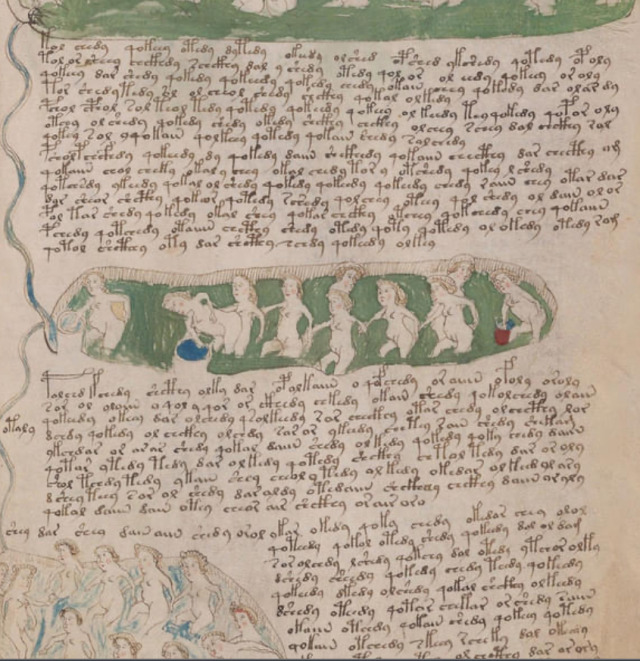
Nobody has managed to decipher it yet. The many illustrations in the VMS give a hint at the content matter, which seems to encompass such things as astrology, medicine and herb-lore. Thus, it appears to be a kind of repository of hermetic knowledge, and the obscurity is deliberate: it is written the way it is to prevent the uninitiated from reading it.
The VMS has been C14-dated to the early 15th century, and there are reasons to assume that it was made in northern Italy. The writing system is clearly an alphabet, with 36 letters, of which 11 are variants of other letters with a horizontal stroke added. The alphabet looks like a close relative or derivation of the Latin alphabet.
There is a commonly used transliteration, the "European (or Extensible) Voynich Alphabet" (EVA), based on the letter shapes. This mostly gives quite pronounceable readings of the VMS text, so it is likely that it guessed at least the basic sound categories such as vowels, sonorants and obstruents, correctly. If there is a kind of letter substitution cipher involved, it seems to preserve those categories. But it may be that there is no such thing, and the EVA is actually close to the intended pronunciation. The following letters are the ones to which horizontal strokes are sometimes added: a, e, i, o, y, and p, t, k, f, s, h. So the horizontal stroke is added either to vowels or to voiceless obstruents. Perhaps this is a kind of length marker, and in the unknown language of the VMS, only voiceless obstruents may be geminated.
So what about the language? It is obviously unknown. The idea that it is an obscure natural language, such as a pre-Roman, perhaps even pre-IE, language surviving somewhere in the Alps cannot be ruled out, but more likely, we are dealing with an invented language. It is not impossible that someone made up a language in 15th-century Italy; other early conlangs such as Hildegard of Bingen's Lingua Ignota, John Dee's Enochian or the Near Eastern Balaybalan come to one's mind here.