Page 1 of 1
Pine: A Descriptive Grammar
Posted: Tue Oct 14, 2025 4:03 pm
by Niskullit
Hey,
I thought I'd share the first and as-of-yet incomplete draft of my second conlang project, Pine. As far as I know it's the largest grammar of a non-natural language. It is called Pine, and it is a sort of spiritual successor to Siwa, my previous project. I've been working on it for a bit over a decade.
You can download the book here:
https://drive.google.com/file/d/1tDaTAT ... p=drivesdk
I appreciate any and all feedback! Enjoy

Re: Pine: A Descriptive Grammar
Posted: Tue Oct 14, 2025 5:15 pm
by sasasha
What a heartfelt foreword.
And what an enormous grammar. The contents by itself spans 20 pages.
It is (obviously) interesting, though it is probably something I could only ever dip into a bit here and there. Oh for an infinite lifespan, to be able to absorb everything interesting that was ever created. As they say, middyt gỉkṡu gvai niskỷt ỉ kủketan (‘I don’t know all the details of the matter’).
You sound like a very committed and creative human being and I’m happy that you have decided to birth this object to show others what you have been doing with your energy.
I suspect it would be quite difficult for someone to learn Pine from this document due to its size. Perhaps a future step is for you to condense your material into a digest version which gives a learner (or interested party in general) a more achievable goal. However, I can see that that wasn’t your intention here, and I commend your thoroughness in documenting the language for yourself.
Re: Pine: A Descriptive Grammar
Posted: Wed Oct 15, 2025 4:32 am
by Niskullit
Thank you very much
What you mention about the digestability of the grammar is something I've thought about quite a bit, but it is an unavoidable consequence of my goal - to describe the language to the fullest extent of my abilities. I'm far from done, this is only the first draft. Many things are missing (formal description of dialects, an introduction, I removed a section that contains texts in Pine, which is supposed to be a sort of reading guide that functions as an anthropological description of the people and culture, but it needs a lot of work yet so I decided not to share it). I also eventually want to include sound samples for every glossed example (of which there are over 1700). I have a lot of big ideas, and my output has slowed to a crawl due to being a father and a PhD student. All this to say that yes, I know and want to create a less dense, more approachable version, but it's something for the distant future.
Also, you just inadvertently showed me a typo in the book, it should be mittyt, not middyt
I'll go fix that!
Re: Pine: A Descriptive Grammar
Posted: Wed Oct 15, 2025 5:19 am
by WeepingElf
Wow, this impresses by sheer size.
Re: Pine: A Descriptive Grammar
Posted: Wed Oct 15, 2025 7:24 am
by Niskullit
Thank you, but I would hope the actual content is more impressive. Not a work lunch read, so I don't expect anyone to have much to say about it yet, but I guarantee that it's where the good stuff is.
Re: Pine: A Descriptive Grammar
Posted: Wed Oct 15, 2025 11:48 am
by bradrn
I’d like to make some kind of constructive comment on this, but… there’s just so much, I wouldn’t even know where to start. I think perhaps some glossed texts might help, or even an outline of the grammar. (Many recent reference grammars start with a grammatical sketch as the first chapter to help the reader get an overview.)
EDIT: Random typo spotted — ‘weather’→‘whether’ on p627. Also, this is worth reading regarding 2>1:
https://twpl.library.utoronto.ca/index. ... 1518/66131
Re: Pine: A Descriptive Grammar
Posted: Thu Oct 16, 2025 4:09 am
by Niskullit
thank you! And yes, that is a little drawback of posting such a large amount of info, it's not really realistic to expect any feedback on the contents of the book (yet).
The 2>1 hierarchy is actually a total coincidence. I developed the idea for Pine based on an LSD trip, only to have it validated by algonquian languages later on. They were onto something! The logic being that most of the time, we use language to talk to a second person, and unless you're an annoying person, normal in-person conversation is less about the first person and more about the second person. That was one of the 'revelations' I had during that trip. And that my second person's second person may be my third person - the relative part of the relative coordinate alignment of Pine. A sort of recursive, trippy feeling that the deixis shifts between 2nd, 1st and 3rd.
I'll fix the typo, thank you very much!
Re: Pine: A Descriptive Grammar
Posted: Thu Oct 16, 2025 4:23 am
by bradrn
Niskullit wrote: ↑Thu Oct 16, 2025 4:09 am
The 2>1 hierarchy is actually a total coincidence. I developed the idea for Pine based on an LSD trip, only to have it validated by algonquian languages later on. They were onto something!
Except they don’t actually ‘validate’ it: see the paper I linked.
The logic being that most of the time, we use language to talk to a second person, and unless you're an annoying person, normal in-person conversation is less about the first person and more about the second person.
Reading this, I think you may be interested to learn about the so-called ‘egophoric’ (or ‘conjunct/disjunct’) systems. Basically, most conversation is from the perspective of first person, addressed to second person — but in
questions (and some other constructions), we take the perspective of second person addressing first person. Reflecting this, some languages (mostly in Tibeto-Burman and Barbacoan) have a system of two person markers, which flip roles depending on sentence type: the ‘conjunct’ marks first person in declaratives but second person in interrogatives, and
vice versa for the ‘disjunct’ marker. (I think there’s variation on what happens to third person.)
Re: Pine: A Descriptive Grammar
Posted: Thu Oct 16, 2025 6:07 am
by Niskullit
I did read through the part on the hierarchy, but only very quickly. Most of my knowledge of algonquian languages is based on the Nishnaabemwin grammar, which does, if I remember correctly, describe the hierarchy according to the myth highlighted in the paper. The argument in the paper seems to be that a 2>1 hierarchy cannot be ascribed to the family because of variations, and only the non-local hierarchy (3>3'>0) seem to be conserved across languages. But I don't think it's wrong to talk about a 2>1 hierarchy if you don't intend to go into comparative algonquian verbal morphology too deeply. The idea is there but executed differently under different conditions, is what I take away from it.
In Pine, the hierarchy seems to be stiffer, as the system depends entirely on the suprapositional/infrapositional (higher/lower) order of the arguments, and suffixes are entirely independent of the arguments. -i always means +1°, no matter who the arguments may be. So it's similar, and this idea that came to me is reflected (maybe more so than validated) *to a degree* by algonquian languages.
The idea of interrogatives shifting the frame from first to second is fascinating, I've never come across that concept before! No such trippiness in Pine. They don't even affect word order, other than by introducing a tag-interrogative set of particles. Word order is dictated by order, and interrogation does not affect order (direct interrogatives are always in the 'autonomous' order, indirect interrogatives are always in the 'hyponomous' order), so it's a different mechanism that controls word order. I guess one reason for that is that order (autonomous vs. hyponomous) is supracategorical to all other aspects of clause type. All autonomous clause types have the same word order, regardless of their subcategories. It's the highest order constraint on word order. I'm not sure I'm explaining this very well, but hopefully you get the gist.
Re: Pine: A Descriptive Grammar
Posted: Fri Oct 17, 2025 12:09 pm
by rotting bones
Thanks. I don't know much about linguistics, so I will probably be learning from this.
Re: Pine: A Descriptive Grammar
Posted: Mon Nov 03, 2025 7:51 am
by Niskullit
Re: Pine: A Descriptive Grammar
Posted: Thu Nov 06, 2025 8:51 am
by Niskullit
I also recorded a short cautionary tale (a tṡukvi) in Pine about angelica and giant hogweed, two similar plants, one of which can cause severe burns.
https://youtu.be/LrfoLtpzByU?si=s9IprxNuqc2oC0bv
Re: Pine: A Descriptive Grammar
Posted: Tue Nov 18, 2025 6:58 am
by Niskullit
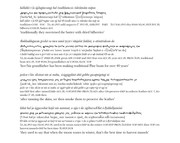
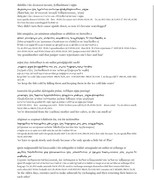
And now the first article of the universal declaration of human rights in Pine.
https://www.youtube.com/watch?v=SvW6UKHePoE
Some notes on the vocabulary you might find interesting:
bulkkuġġami | free, derived from the root bulk- 'tether', with the abessive suffix -uġġami 'without'
naġv- | 'to be born' is cognate with the copula naġan 'to be', and forms a sort of translative form (not many verbs use a -v- to indicate translativity but they exist)
niṡki | 'person' which is also the root of the name of the language, Niṡkullit (person-language), and here it's prefixed as niṡke- to gaḍḍa 'worth' (gảhinnit 'from worth') and mikvi 'right' (from migi 'right, correct'). Coincidentally, niṡkemỉgvunnit could also mean 'from people-food', but obviously the context makes it clear the word is mikvi (<mỉgvunnit in the elative) and not miġvu (mỉkvunnit in the elative, also).
alguss- | 'to be given' is actually an ornative form of algu 'gift' (from alk- 'to give'), so its literal meaning is more akin to 'go around with a gift', which it can mean literally.
mỉddukkut and
migisoatsƛikkut | here the suffix -kkut is a comitative ('with'), and the citation form of the words are mittuġma 'reason' (-ġma is a common abstract noun formant, from mid- 'to know') and migi+sasƛi 'right(eous) responsibility' or conscience, i.e. the responsibility to act righteously.
issineidnittyt | here -ttyt is also the comitative of the words issinennippyt, where issi- is a preffix meaning 'well, good, correctly, harmoniously' and nennippyt is derived from nennen 'friend' (which itself is derived from nen- 'to sit', because those who sit together are...friends - it is actually a nominalised form of the hyponomous, so it literally means 'who sits'), with the suffix -pput/-ppyt which shows a behavior or some sort of attribute, so fraternity or brotherhood is here more like 'the attribute of behaving like good friends'. It also means 'philanthropy'.
tṡavvuttug- : a verb made up of the root tṡavv- which literally means 'to flow, to proceed' with the medial voice suffix -uttug-, so 'to flow oneself', or 'to behave'.e'.
Re: Pine: A Descriptive Grammar
Posted: Thu Nov 20, 2025 8:29 am
by Niskullit
I figured it's a bit heavy to dump 1217 pages of grammar for some people, and I've seen a lot of these PPT-like presentations, so I thought I'd start a little series called Pine Digest, where I go explore some of the grammar of Pine in a more easily digestible format. This is the first one on the polypersonal alignment system of Pine. Let me know if you'd tweak the depth, difficulty level or anything for future instalments.
I call it Tsungotsuonkkukkit (piece-by-small-piece Pine)
https://drive.google.com/file/d/1n_YrmI ... sp=sharing
Re: Pine: A Descriptive Grammar
Posted: Thu Nov 20, 2025 8:35 am
by Raphael
I like the writing system. Doesn't look quite like anything I've seen.
Re: Pine: A Descriptive Grammar
Posted: Thu Nov 20, 2025 8:38 am
by bradrn
That’s certainly an interesting variation on hierarchical alignment. Any thoughts as to how it could have evolved?
Re: Pine: A Descriptive Grammar
Posted: Thu Nov 20, 2025 2:55 pm
by Niskullit
bradrn wrote: ↑Thu Nov 20, 2025 8:38 am
That’s certainly an interesting variation on hierarchical alignment. Any thoughts as to how it could have evolved?
Thank you! Yes, there is a somewhat sensible explanation/in-world theory. There is some correspondence between the form of these suffixes and deixis markers. For example -i (first degree) and e- proximal deixis (as in -de "this here" and eset "thus"), and -et (third degree) and an older form of the distal/obviate deixis (for example -go "that one over there/that one [obviate], which was then -i-go > -ek > -et). So the degrees would have originated as deixis markers. These were reanalysed and would have undergone massive changes when they cliticised with the theme (the core inflectional part of the verb).
Re: Pine: A Descriptive Grammar
Posted: Fri Nov 21, 2025 7:47 am
by Niskullit
Raphael wrote: ↑Thu Nov 20, 2025 8:35 am
I like the writing system. Doesn't look quite like anything I've seen.
thank you! The main inspirations were Ogham, Mongolian and Georgian! In the in-world history of Pine, it's hypothesized that they developed the script after coming in contact with Irish monks in the later part of the first millenium. Since Pineland is real-world Iceland, and I've always thought the idea of Irish monks eeking out some sort of religious mission in Iceland was insane, I decided that it should cross over to Pine's in-world.
Re: Pine: A Descriptive Grammar
Posted: Sun Nov 23, 2025 11:40 pm
by rotting bones
I like the sound of this language.
Re: Pine: A Descriptive Grammar
Posted: Wed Aug 05, 2026 5:16 am
by Niskullit
forgot to add this here in case someone is curious
www.niskullit.conlang.org