Lusitanian: on tones, animacy and uvulars in the westernmost Indo-European branch
Posted: Mon May 11, 2026 2:27 pm
by þeprussianfrog
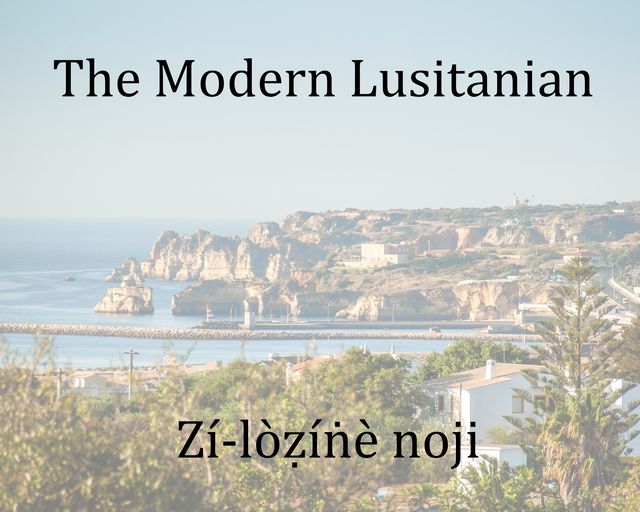
A fully tonal language in Europe, related to Celtic but not quite so, and one of Iberia's three* "relics"... Here comes Modern Lusitanian!
More: show
Lusitanian language, also known as Lozhine, Algarvian, Lusitan or Eghervian (endonym: loẓíṅè) is an Indo-European language, natively spoken in southwestern Iberian Peninsula (in the Kingdom of the Algarve, as well as parts of Portugal and Spain), on the Azores and Madeira, and by the Lusitanian diaspora around the world (most importantly including the Americas, Benelux, Middle East and North Africa). It constitutes an independent branch of the Indo-European family, Lusitanic, which is closely linked to the Celtic languages in the Celto-Lusitanic group, and, possibly to the Italic languages in the even larger, disputed grouping, Italo-Celtic (also known as Italo-Celto-Lusitanic). The number of Lusitanian speakers around the world is roughly 4.5-7 millions.
Lusitanian is clearly very closely related to Celtic.
The main phonological differences between Proto-Lusitanic and early Proto-Celtic are:
- reflections of Proto-Indo-European *p (Proto-Lusitanic retained it; Proto-Celtic lost it)
- reflections of the syllabic resonants *m̥, *n̥ (*am, *an in Celtic; *em, *en in Lusitanic)
Historically, there were proposals to link Lusitanian more closely with Italic, based on the latter's preservation of *p and similar reflections of the syllabic resonants in some of the Italic languages, such as Latin, as well as some similar morphological innovations. However, different features link Lusitanian closer to Celtic, including the reflexes of aspirated stops, the eRa > aRa change and preservation of the dual. Still, the Italo-Celtic proposal still includes Lusitanic.
Either way, the Early Proto-Lusitanic speakers probably originated from an area near the Alps, similarly to the proposed Celtic and Italic homelands (and possibly between these two). After that, they migrated west, into Iberia, and eventually settled in the western region: ancient Lusitania roughly corresponds to the central Portugal, western Spain and northern Algarve. Proposed links to the linguistically unclassified ancient peoples of Central Europe, most notably Ligurians and Belgians, are unclear; it is possible they were Para-Lusitanic speakers. In addition to the group known (to Romans and Greeks) as Lusitani, other adjacent Western Iberian tribes such as Vettones, Turduli and Conii, may have also been Lusitanic speakers. It remains unclear which specific area did the dialect ancestral to Modern Lusitanian originate from; however, after the Roman conquest of Iberia, the probable territory where it did survive was Serra da Estrela mountain range, in modern day Eastern Portugal. The migration southwards happened later, all the way in the Middle Ages.
Phonology and orthography
The feature of Lusitanian that is, perhaps, the most unusual for the Indo-European family is the presence of lexical tone; unlike other tonal European languages, such as Swedish, Latvian and Limburgish, that possess a pitch-accent system associated with stressed syllables only, Lusitanian has independent tones on every syllable, making it fully tonal.
When did tone evolve in Lusitanian is rather unclear; however, various Medieval sources describe the speech of Algarvians as "melodic-sounding" and compare it to the Ancient Greek pitch accent or tonal systems of West African languages, which indicates that some degree of tonality must have already been around back then. The tone system first arose when Lusitanian lost a three-way distinction between it's consonants (fricatives and stops): "fortis" voiceless (likely geminated), "lenis" voiceless and voiced, with the latter two merging but giving different tones to the following vowels ("lenis" voiceless gave high tone and voiced gave low tone). "Fortis" voiceless shortened, but gave vowels high tone as well. All other consonants were voiced and gave low tones.
Modern Lusitanian posesses two main register tones, high and low, and two contour tones, rising and falling. Tone is vital for distinguishing the meaning of the word: for instance, geṛ (with low tone) means "leg" and géṛ (with rising tone) means "car".
Aside from tones, Lusitanian posesses other phonological features that are rather rare in Western European languages, but common in Northwest Africa, which is also close to its homeland: uvular plosive [q] and glottal stop [ʔ]. These occur in the abundant borrowings from languages such as Arabic - but also, less commonly, in words inherited from PIE.
Features similar to other modern Iberian languages include the contrast between two rhotic consonants: "soft" [ɾ] and "hard" [ʁ] and the 5-monophthong vowel system.
The vowel system consists of 5 monophthongs, as mentioned above, and 4 diphthongs. Vowels aren't distinguished by length; syllables with any of these can carry any of the 4 tones.
Monophthongs
i u
e o
a
Diphthongs
au ai
ou oi
The consonant system:
Nasals
m n ɲ
Stops
p t k q ʔ
b d g
Affricates
tʃ
Fricatives
f s ʃ χ h
v z ʒ ʁ
Approximants
ɫ ʎ j w
Flaps
ɾ
Lusitanian is written with Latin alphabet. Modern Lusitanian alphabet includes 33 letters (49 with all the vowel variants included):
A a [a] (Ā ā, À à, Á á)
B b [b]
C c [k]
Ċ ċ [tʃ]
D d [d]
E e [e] (Ē ē, È è, É é)
F f [f]
G g [g]
H h [h]
I i [i] (Ī ī, Ì ì, Í í)
J j [j]
K k [k]
L l [ɫ]
Ḷ ḷ [ʎ]
M m [m]
N n [n]
Ṅ ṅ [ɲ]
O o [o] (Ō ō, Ò ò, Ó ó)
P p [p]
Q q [q]
R r [ɾ]
Ṛ ṛ [ʁ]
S s [s]
Ṣ ṣ [ʃ]
T t [t]
U u [u] (Ū ū, Ù ù, Ú ú)
V v [v]
W w [w]
X x [x]
Y y [j]
Z z [z]
Ẓ ẓ [ʒ]
‘ [ʔ]
Tones are marked with diacritics (markeed characters are typically not considered distinct letters and are seen as additional forms of the basic letter).
Ā ā Ō ō Ē ē Ī ī Ū ū - high
À à Ò ò È è Ì ì Ù ù - falling
A a O o E e I i U u - low
Á á Ó ó É é Í í Ú ú - rising
Orthography is heavily phonetic, and was reformed recently, soon after the Algarve achieved independence. However, an old-style orthography, influenced by Portuguese, is still commonly found in older texts and is often used by Lusitanian diaspora outside the Algarve, and Arabic script is used by some Muslim Lusitanians in the Middle East.
Grammar
Grammatically, Lusitanian is moderately inflected, with a large number of more analytic features (though relatively far lower than, say, English).
In nominals, there are two genders (masculine and feminine), two numbers (singular and plural, with notable remnants of dual, which attestedly persisted as a functional element well into the Early Middle Ages), three cases (nominative, accusative, genitive - but see below) and an innovated system of animacy (animate and inanimate).
(Sometimes, the retained Indo-European system of gender and the innovated Lusitanic system of animacy are blended, and animacy is seen as a subgender; thus, Lusitanian is seen instead as having animate masculine, animate feminine, inanimate masculine and inanimate feminine genders).
Lusitanian system of animacy evolved after the endings of nominative and accusative forms merged (this is also when the neuter gender disappeared, blending, primarily, with masculine) in most declension types; afterwards, a new distinction between animate and inanimate objects developed, in a similar fashion to Slavic: genitive being partially repurposed as a new accusative for the animate nominals. Thus, technically, there are 2 somewhat different case systems in Lusitanian animate and inanimate words, both consisting of 2 cases: nominative and accusative-genitive in animates, nominative-accusative + genitive in inanimates.
An example of animate noun is ip (stallion), with nominative form ip and accusative-genitive form ibú.
An example of inanimate noun is bín (marshland), with nominative-accusative form bín and genitive form bíṅù.
Adjectives in Lusitanian overwhelmingly follow the noun. The language is heavily prepositional. Articles are only definite (similarly to Irish, Basque and Arabic, and distinctly from Romance), and are proclitic and linked with a hyphen. Clitics such as prepositions and articles carry tone, and via tone sandhi influence the content word (compare loẓíṅè and zí-lòẓíṅè).
Verbs in Lusitanian are less inflectional than those in neighbouring Romance languages; far more analytic forms are present. Rather synthetic, though, is the present conjugation, as shown below:
ẓilgo - I hold
ẓilẓizú - thou hold
ẓilẓiẓú - he/she/it holds
ẓilẓimzú - we hold
ẓilẓidzú - you hold
ẓilẓiṅú - they hold
Lexicon
Lusitanians, living at the crossroads of different cultures and being under the rule of various external powers (most importantly Romans, Visigoths, Arabs and Portuguese) at different points in their history, ended up incorporating an extensive number of loanwords into their language. Even the name of the modern Lusitanian-majority state, Algarve (Eṛérv) is a Portuguese-influenced Arabic word in origins, coming from Arabic (الغرب), literally "the west", with final -v influenced by Portuguese Algarve. An interesting tendence in Lusitanian when adapting words from non-tonal, stress-based languages is the shift of the stressed syllable into the high tone, and the unstressed syllables into the low tone, and following tone sandhi changing some of those into rising/falling.