
I might have posted this in the Linguistic Miscellany Thread, but it's not really scholarly or about the field of linguistics, so I'm starting a new thread for it.
A brief recent back-and-forth over in the English questions thread (https://www.verduria.org/viewtopic.php?p=103681#p103681) led me to the conclusion that in British English, the term "nincompoop" seems to be basically what British people who, themselves, don't fit into certain hostile stereotypes about British people, have traditionally called those British people, or at least British men, who do fit into those hostile stereotypes. So in a way, it's almost kind of like a British slur form of the term "British person".
And this got me wondering - are there equivalent terms in other languages and cultures? Do the French have an unfriendly term for a chain-smoking, easily agitated professional academic with strong opinions on everything, but especially on the latest fashionable developments in philosophy, the arts, and cuisine? Is there an unfriendly Finnish term for someone who rarely ever says anything? Do the Chinese have something unfriendly which they call an academic overachiever with a strong commitment to the pop culture idea of Confucian values?
In US English, "redneck" might be close to what I'm getting at, but perhaps it's not an exact fit.
I can't really think of any German uncomplimentary terms for a humorless workaholic who's obsessed with order, discipline, and always following the rules, but the way some post-World-War-2 subcultures have used "Blockwart" comes close.
Words in a language used for the most stereotypical members of the corresponding culture
-
zompist
- Site Admin
- Posts: 4373
- Joined: Sun Jul 08, 2018 5:46 am
- Location: Right here, probably
- Contact:
Re: Words in a language used for the most stereotypical members of the corresponding culture
I don't think "nincompoop" means what you think it does. It just means a foolish or silly person— I'm not aware that there's a difference in British usage, nor do I think that the outsider stereotype of Brits is that they're foolish.
I think what you're getting at is more covered by "twit". Monty Python had an "Upper Class Twit of the Year" sketch.
National stereotypes usually have several components, and aren't going to have close internal equivalents. As a general thing, I'd expect that outsiders' view of nation X is similar to X's view of their own major metropolis. Thus Europeans probably feel about the French much as the French feel about Paris, and about Americans as Americans feel about New Yorkers.
If you reduce the national stereotype to one quality you can certainly find an equivalent. E.g. a Japanese nerd is an otaku. A French term for a pedant or know-it-all is cuistre.
More interesting to me is when nation X attributes to some other nation qualities that other find in X. In French, for instance, the idea of a sophisticated, maybe overrefined culture is Italy. In English if something is incomprehensible we say "It's Greek to me"; in Greece they say it's Chinese. (In Chinese it's often attributed to heaven, or ghosts.) In both the US and France, if you want to refer to a militaristic nationalist we reach for the Germans— who do Germans refer to?
I think what you're getting at is more covered by "twit". Monty Python had an "Upper Class Twit of the Year" sketch.
National stereotypes usually have several components, and aren't going to have close internal equivalents. As a general thing, I'd expect that outsiders' view of nation X is similar to X's view of their own major metropolis. Thus Europeans probably feel about the French much as the French feel about Paris, and about Americans as Americans feel about New Yorkers.
If you reduce the national stereotype to one quality you can certainly find an equivalent. E.g. a Japanese nerd is an otaku. A French term for a pedant or know-it-all is cuistre.
More interesting to me is when nation X attributes to some other nation qualities that other find in X. In French, for instance, the idea of a sophisticated, maybe overrefined culture is Italy. In English if something is incomprehensible we say "It's Greek to me"; in Greece they say it's Chinese. (In Chinese it's often attributed to heaven, or ghosts.) In both the US and France, if you want to refer to a militaristic nationalist we reach for the Germans— who do Germans refer to?
Re: Words in a language used for the most stereotypical members of the corresponding culture
We don't think of it in that way though. A non-Brit could certainly be a nincompoop and the particular stereotype you mentioned here isn't the most well known. In some circumstances you might see a borrowing of the French rosbifs used in this way though.Raphael wrote: ↑Sun Jan 04, 2026 4:51 pm A brief recent back-and-forth over in the English questions thread (https://www.verduria.org/viewtopic.php?p=103681#p103681) led me to the conclusion that in British English, the term "nincompoop" seems to be basically what British people who, themselves, don't fit into certain hostile stereotypes about British people, have traditionally called those British people, or at least British men, who do fit into those hostile stereotypes. So in a way, it's almost kind of like a British slur form of the term "British person".
LZ – Lēri Ziwi
PS – Proto Sāzlakuic (ancestor of LZ)
PRk – Proto Rākēwuic
XI – Xú Iạlan
VN – verbal noun
SUP – supine
DIRECT – verbal directional
My language stuff
PS – Proto Sāzlakuic (ancestor of LZ)
PRk – Proto Rākēwuic
XI – Xú Iạlan
VN – verbal noun
SUP – supine
DIRECT – verbal directional
My language stuff
Re: Words in a language used for the most stereotypical members of the corresponding culture
No. In English, the metaphorical point about 'Greek' is that most English speakers can't even read the letters. Thus WordPerfect called the use of a preview style where one couldn't actually read the text 'greeking'.zompist wrote: ↑Sun Jan 04, 2026 5:22 pm More interesting to me is when nation X attributes to some other nation qualities that other find in X. In French, for instance, the idea of a sophisticated, maybe overrefined culture is Italy. In English if something is incomprehensible we say "It's Greek to me"; in Greece they say it's Chinese.
Re: Words in a language used for the most stereotypical members of the corresponding culture
I wouldn't say, though, that the external stereotypes of Americans match the American stereotypes of New Yorkers closely at all.zompist wrote: ↑Sun Jan 04, 2026 5:22 pm National stereotypes usually have several components, and aren't going to have close internal equivalents. As a general thing, I'd expect that outsiders' view of nation X is similar to X's view of their own major metropolis. Thus Europeans probably feel about the French much as the French feel about Paris, and about Americans as Americans feel about New Yorkers.
Yaaludinuya siima d'at yiseka wohadetafa gaare.
Ennadinut'a gaare d'ate eetatadi siiman.
T'awraa t'awraa t'awraa t'awraa t'awraa t'awraa t'awraa.
Ennadinut'a gaare d'ate eetatadi siiman.
T'awraa t'awraa t'awraa t'awraa t'awraa t'awraa t'awraa.
-
zompist
- Site Admin
- Posts: 4373
- Joined: Sun Jul 08, 2018 5:46 am
- Location: Right here, probably
- Contact:
Re: Words in a language used for the most stereotypical members of the corresponding culture
No. In English, "It's Greek to me" means that you can't understand it. Try googling it before contradicting.
Also note, it goes back at least to Shakespeare (Julius Caesar, "but for mine own part, it was Greek to me.")-- in context this referred to speaking Greek.
-
zompist
- Site Admin
- Posts: 4373
- Joined: Sun Jul 08, 2018 5:46 am
- Location: Right here, probably
- Contact:
Re: Words in a language used for the most stereotypical members of the corresponding culture
Depends on what stereotypes you're thinking of. Brash, greedy, forceful, hubristic, noisy, self-centered--- I'd say it's a good match.Travis B. wrote: ↑Sun Jan 04, 2026 6:20 pmI wouldn't say, though, that the external stereotypes of Americans match the American stereotypes of New Yorkers closely at all.zompist wrote: ↑Sun Jan 04, 2026 5:22 pm National stereotypes usually have several components, and aren't going to have close internal equivalents. As a general thing, I'd expect that outsiders' view of nation X is similar to X's view of their own major metropolis. Thus Europeans probably feel about the French much as the French feel about Paris, and about Americans as Americans feel about New Yorkers.
Re: Words in a language used for the most stereotypical members of the corresponding culture
We have the word 'franchouillard' for 'very French, and not in a good way'. It implies a certain parochialism and close-mindedness.
Our own stereotype doesn't really match with outsiders' view of French people. We don't see ourselves as particularly intellectual.
Our own stereotype doesn't really match with outsiders' view of French people. We don't see ourselves as particularly intellectual.
I think it sort of works. Parisians are seen as rude, with a lot more money than sense, and generally out of touch.zompist wrote:As a general thing, I'd expect that outsiders' view of nation X is similar to X's view of their own major metropolis. Thus Europeans probably feel about the French much as the French feel about Paris,
-
WeepingElf

- Posts: 2486
- Joined: Sun Jul 15, 2018 12:39 pm
- Location: Braunschweig, Germany
- Contact:
Re: Words in a language used for the most stereotypical members of the corresponding culture
In German, we have Spießer. A Spießer is a prototypical conservative German, fixated on his career, living with his little family in a suburban house with garden gnomes in the garden, doing all his travels (even to the postbox half a kilometre away) with his beloved car (except, of course, his yearly holiday trip to the Mediterranean, that is done by airliner), addicted to his daily dose of meat and TV in the evening with his Feierabendbier, mistrustful of immigrants, and all that.
Re: Words in a language used for the most stereotypical members of the corresponding culture
Those stereotypes match, but at the same time there's the American stereotype of New Yorkers as being pretentious uber-wealthy elites who are often over-educated which doesn't seem to match how non-Americans see Americans (which seems more like things such as that Americans are parochial/ignorant gun-obsessed obese jingoistic people).zompist wrote: ↑Sun Jan 04, 2026 8:02 pmDepends on what stereotypes you're thinking of. Brash, greedy, forceful, hubristic, noisy, self-centered--- I'd say it's a good match.Travis B. wrote: ↑Sun Jan 04, 2026 6:20 pmI wouldn't say, though, that the external stereotypes of Americans match the American stereotypes of New Yorkers closely at all.zompist wrote: ↑Sun Jan 04, 2026 5:22 pm National stereotypes usually have several components, and aren't going to have close internal equivalents. As a general thing, I'd expect that outsiders' view of nation X is similar to X's view of their own major metropolis. Thus Europeans probably feel about the French much as the French feel about Paris, and about Americans as Americans feel about New Yorkers.
Yaaludinuya siima d'at yiseka wohadetafa gaare.
Ennadinut'a gaare d'ate eetatadi siiman.
T'awraa t'awraa t'awraa t'awraa t'awraa t'awraa t'awraa.
Ennadinut'a gaare d'ate eetatadi siiman.
T'awraa t'awraa t'awraa t'awraa t'awraa t'awraa t'awraa.
Re: Words in a language used for the most stereotypical members of the corresponding culture
I'm with Travis here. I'd say that the European stereotype of an American is (the stereotype of) a Texan - boastful, gung-ho, greedy, with a stetson hat, a gun in one hand and the bible in the other.Travis B. wrote: ↑Mon Jan 05, 2026 10:25 amThose stereotypes match, but at the same time there's the American stereotype of New Yorkers as being pretentious uber-wealthy elites who are often over-educated which doesn't seem to match how non-Americans see Americans (which seems more like things such as that Americans are parochial/ignorant gun-obsessed obese jingoistic people).

Re: Words in a language used for the most stereotypical members of the corresponding culture
What are we calling these? Autostereotypes?
For an English one, I would reach for "toff". "Nincompoop" is completely off, as others have said; "twit", whilst closer, is partly funny in Monty Python because it represents the opposite of what the stereotypical upper-class English person sees themself as (i.e. stereotypically they see themselves as educated and rational). So Monty Python are poking fun from the outside, by suggesting that these people are actually idiotic (which is what "twit" chiefly suggests), but part of the humour derives from it feeling slightly anachronistic, slightly risqué, slightly offensive. You can have a working class twit; c.f. "The Twits", in fact, by Roald Dahl, and I think you could use "twit" for people of various nationalities. On the other hand "toffs" themselves would probably agree, begrudgingly, that to others they are a toff, since "toff" largely is about performative class markers that tend to be sources of pride and superiority for the people in question.
As autostereotypes for lower-cass English folk, "chav" and "hooligan" spring to mind; the former is very controversial and no longer socially acceptable, but its brief window of common usage in the naughties seemed to capture something universally recognised in English society, and for a while held internal prestige. I think our society is so deeply entrenched in its class system that in our collective mind there is little to nothing that unites the "toffs" and the "hooligans" into one culture, and the only catch-all terms that spring to mind which hold meaningful stereotypes and manage to transcend the class system are "Brits" (as in "Brits abroad", which points out the shared flaws in rich and poor tourists alike) and, as Lērisama said, "rosbifs", which I think we begrudgingly acknowledge as being quite a funny way to describe us.
I think it's part of the English stereotype that we see ourselves as self-important and above our station (?) so I would go for "toff" as the best all-rounder. I think Mr and Mrs Dursley, for instance, are intended as prototypical English stereotypes, and they are very much "toffs" even though they are 'only' middle-class.
"Toff" also, to my mind, would only be applied to an English person. Someone with the same general qualities from a different country would be called something else (depending on where they were from). It seems completely bound up with Englishness, including the stereotype that English people aspire to social status (domestically and internationally) above their station.
No English people were harmed in the making of this post.
For an English one, I would reach for "toff". "Nincompoop" is completely off, as others have said; "twit", whilst closer, is partly funny in Monty Python because it represents the opposite of what the stereotypical upper-class English person sees themself as (i.e. stereotypically they see themselves as educated and rational). So Monty Python are poking fun from the outside, by suggesting that these people are actually idiotic (which is what "twit" chiefly suggests), but part of the humour derives from it feeling slightly anachronistic, slightly risqué, slightly offensive. You can have a working class twit; c.f. "The Twits", in fact, by Roald Dahl, and I think you could use "twit" for people of various nationalities. On the other hand "toffs" themselves would probably agree, begrudgingly, that to others they are a toff, since "toff" largely is about performative class markers that tend to be sources of pride and superiority for the people in question.
As autostereotypes for lower-cass English folk, "chav" and "hooligan" spring to mind; the former is very controversial and no longer socially acceptable, but its brief window of common usage in the naughties seemed to capture something universally recognised in English society, and for a while held internal prestige. I think our society is so deeply entrenched in its class system that in our collective mind there is little to nothing that unites the "toffs" and the "hooligans" into one culture, and the only catch-all terms that spring to mind which hold meaningful stereotypes and manage to transcend the class system are "Brits" (as in "Brits abroad", which points out the shared flaws in rich and poor tourists alike) and, as Lērisama said, "rosbifs", which I think we begrudgingly acknowledge as being quite a funny way to describe us.
I think it's part of the English stereotype that we see ourselves as self-important and above our station (?) so I would go for "toff" as the best all-rounder. I think Mr and Mrs Dursley, for instance, are intended as prototypical English stereotypes, and they are very much "toffs" even though they are 'only' middle-class.
"Toff" also, to my mind, would only be applied to an English person. Someone with the same general qualities from a different country would be called something else (depending on where they were from). It seems completely bound up with Englishness, including the stereotype that English people aspire to social status (domestically and internationally) above their station.
No English people were harmed in the making of this post.
Re: Words in a language used for the most stereotypical members of the corresponding culture
In Swedish there is a word svennebanan. My understanding is that it refers to a typical conformist Swede. The word banana comes from the observation that when Swedes go on field trip or something, they will typically have a banana as part of their snacks, because fruit is healthy and bananas are convenient because they have a protective shell, but they are easy to peel.
The word comes from a song by the artist Promoe in 2009, but I don't know if this is how he used the word.
The word comes from a song by the artist Promoe in 2009, but I don't know if this is how he used the word.
My latest quiz:
Största städerna på Y i Sydamerika
Största städerna på Y i Sydamerika
Re: Words in a language used for the most stereotypical members of the corresponding culture
I read a day or so ago that the Dursleys actually fit the German stereotype of the Spießer very well.sasasha wrote: ↑Wed Jan 07, 2026 4:28 am I think it's part of the English stereotype that we see ourselves as self-important and above our station (?) so I would go for "toff" as the best all-rounder. I think Mr and Mrs Dursley, for instance, are intended as prototypical English stereotypes, and they are very much "toffs" even though they are 'only' middle-class.
Yaaludinuya siima d'at yiseka wohadetafa gaare.
Ennadinut'a gaare d'ate eetatadi siiman.
T'awraa t'awraa t'awraa t'awraa t'awraa t'awraa t'awraa.
Ennadinut'a gaare d'ate eetatadi siiman.
T'awraa t'awraa t'awraa t'awraa t'awraa t'awraa t'awraa.
Re: Words in a language used for the most stereotypical members of the corresponding culture
Sorry for the belated response! Got distracted.
And then there's the way how in Italy, traditionally, Northern Italians seem to have seen Southern Italians the way the rest of Europe traditionally saw Italians in general.
Partly true, but it might not apply in countries that are mainly stereotyped as rural by outsiders. Like, for instance, some Eastern European countries (https://tvtropes.org/pmwiki/pmwiki.php/Main/Ruritania) or Vimínia.
And then there's the way how in Italy, traditionally, Northern Italians seem to have seen Southern Italians the way the rest of Europe traditionally saw Italians in general.
Travis B. wrote: ↑Mon Jan 05, 2026 10:25 am Those stereotypes match, but at the same time there's the American stereotype of New Yorkers as being pretentious uber-wealthy elites who are often over-educated which doesn't seem to match how non-Americans see Americans (which seems more like things such as that Americans are parochial/ignorant gun-obsessed obese jingoistic people).
Agreed. I once saw a remark by Charlie Stross that in a way, Bavaria is for Germany what Texas is for the USA. Well, more conservative and traditionalist than the average of the country, seen by many people in the rest of the world as the most typical part of the country, but at the same time, for both people in the place itself and people in the rest of the country, it's very much an open question whether the place is even really a part of the country - I'd say he was on to something.
OK, sorry for getting that wrong. My excuse is that I misunderstood this exchange between me and Lērisama:
Thank you for providing that information! Interesting!Qwynegold wrote: ↑Wed Jan 07, 2026 5:23 am In Swedish there is a word svennebanan. My understanding is that it refers to a typical conformist Swede. The word banana comes from the observation that when Swedes go on field trip or something, they will typically have a banana as part of their snacks, because fruit is healthy and bananas are convenient because they have a protective shell, but they are easy to peel.
The word comes from a song by the artist Promoe in 2009, but I don't know if this is how he used the word.
Well, Spießer is basically the German word for (the personality type meaning of) "square", so it's not surprising.Travis B. wrote: ↑Wed Jan 07, 2026 8:15 amI read a day or so ago that the Dursleys actually fit the German stereotype of the Spießer very well.sasasha wrote: ↑Wed Jan 07, 2026 4:28 am I think it's part of the English stereotype that we see ourselves as self-important and above our station (?) so I would go for "toff" as the best all-rounder. I think Mr and Mrs Dursley, for instance, are intended as prototypical English stereotypes, and they are very much "toffs" even though they are 'only' middle-class.
Re: Words in a language used for the most stereotypical members of the corresponding culture
"Square" is precisely how I've seen it translated into English.Raphael wrote: ↑Wed Jan 07, 2026 12:25 pmWell, Spießer is basically the German word for (the personality type meaning of) "square", so it's not surprising.Travis B. wrote: ↑Wed Jan 07, 2026 8:15 amI read a day or so ago that the Dursleys actually fit the German stereotype of the Spießer very well.sasasha wrote: ↑Wed Jan 07, 2026 4:28 am I think it's part of the English stereotype that we see ourselves as self-important and above our station (?) so I would go for "toff" as the best all-rounder. I think Mr and Mrs Dursley, for instance, are intended as prototypical English stereotypes, and they are very much "toffs" even though they are 'only' middle-class.
Yaaludinuya siima d'at yiseka wohadetafa gaare.
Ennadinut'a gaare d'ate eetatadi siiman.
T'awraa t'awraa t'awraa t'awraa t'awraa t'awraa t'awraa.
Ennadinut'a gaare d'ate eetatadi siiman.
T'awraa t'awraa t'awraa t'awraa t'awraa t'awraa t'awraa.
Re: Words in a language used for the most stereotypical members of the corresponding culture
Yes, I'm sorry. I should have been clearer that particular idiot is only one example of nincompoopery¹.
¹ Yes I did phrase this just so I could include the word “nincompoopery.”
LZ – Lēri Ziwi
PS – Proto Sāzlakuic (ancestor of LZ)
PRk – Proto Rākēwuic
XI – Xú Iạlan
VN – verbal noun
SUP – supine
DIRECT – verbal directional
My language stuff
PS – Proto Sāzlakuic (ancestor of LZ)
PRk – Proto Rākēwuic
XI – Xú Iạlan
VN – verbal noun
SUP – supine
DIRECT – verbal directional
My language stuff

Re: Words in a language used for the most stereotypical members of the corresponding culture
There's certainly a German stereotype of the beer-drinking men in lederhosen and doing that dance where they slap each other's faces alternately, and on the distaff side of large-breasted women in dirndls.Raphael wrote: ↑Wed Jan 07, 2026 12:25 pmI once saw a remark by Charlie Stross that in a way, Bavaria is for Germany what Texas is for the USA. Well, more conservative and traditionalist than the average of the country, seen by many people in the rest of the world as the most typical part of the country
mais grand il tour, mais rapid e fort e spes caze la merda
Re: Words in a language used for the most stereotypical members of the corresponding culture
Yeah, mainly because of the way the demarcation lines between the occupation zones were drawn after the war, and the fact that out of the Four Powers, the USA ended up with the biggest influence over global pop culture:alice wrote: ↑Wed Jan 07, 2026 2:49 pmThere's certainly a German stereotype of the beer-drinking men in lederhosen and doing that dance where they slap each other's faces alternately, and on the distaff side of large-breasted women in dirndls.Raphael wrote: ↑Wed Jan 07, 2026 12:25 pmI once saw a remark by Charlie Stross that in a way, Bavaria is for Germany what Texas is for the USA. Well, more conservative and traditionalist than the average of the country, seen by many people in the rest of the world as the most typical part of the country
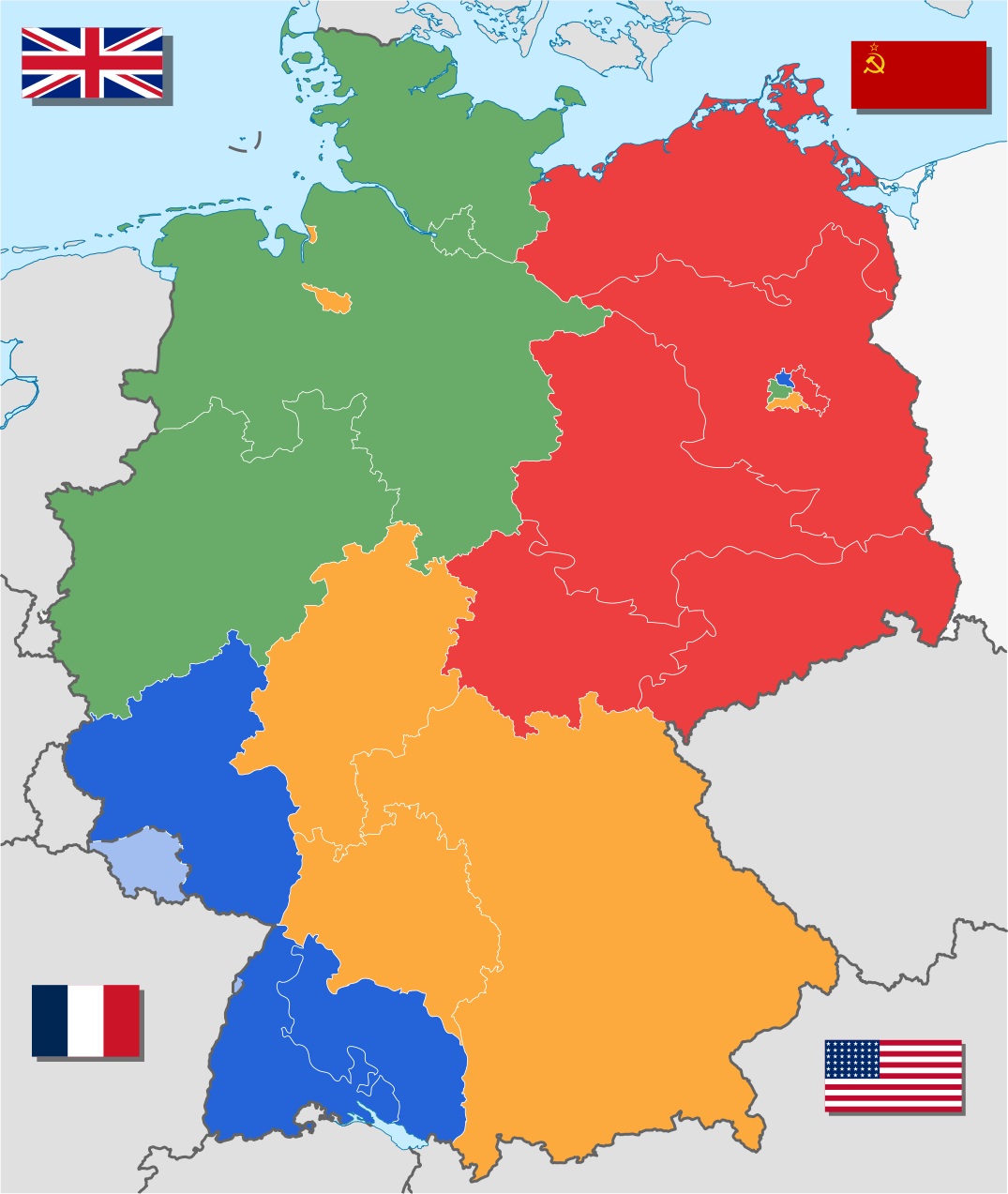
https://tvtropes.org/pmwiki/pmwiki.php/Main/Oktoberfest
-
rotting bones
- Posts: 3353
- Joined: Tue Dec 04, 2018 5:16 pm
Re: Words in a language used for the most stereotypical members of the corresponding culture
The stereotype of the typical Bengali character is probably Lalmohan Ganguly from Feluda: childishly earnest, stuffed with trivia but curiously inept, uncoolness going through the roof while being ultimately good-natured. Probably an artist of some kind. Strangely both skeptical and gullible at the same time. Usually cowardly, but capable of pulling himself together when it really counts.
This is a male stereotype. Women are thought to have more common sense. So, basically a nerd. If you think it's improbable that hundreds of millions would think of themselves as nerdy, the Wikipedia article says "he often epitomizes an average Bengali person": https://en.wikipedia.org/wiki/Lalmohan_Ganguly
In slang, such a role is called এঁদো বাঙালি /ẽd̪o baŋali/, narrow-minded Bengali. There are neutral or more positive ways to describe this personality: নিরীহ গোবেচারা /niriho gobetʃara/, harmless and innocent. সরল সাদাসাপটা /ʃɔrol ʃad̪aʃapta/, simple and straightforward.
People from the west of India are depicted as worldly and competent. Possibly fanatical or dangerous. Probably, but not always with less book learning. These days, probably wealthy. Bengalis are shown as becoming more and more like them over time.
We'll see if this stereotype survives the coming fascist victory in 2026. It already looks dead in Bangladesh. I suppose we had a good run. It's time to move on.
This is a male stereotype. Women are thought to have more common sense. So, basically a nerd. If you think it's improbable that hundreds of millions would think of themselves as nerdy, the Wikipedia article says "he often epitomizes an average Bengali person": https://en.wikipedia.org/wiki/Lalmohan_Ganguly
In slang, such a role is called এঁদো বাঙালি /ẽd̪o baŋali/, narrow-minded Bengali. There are neutral or more positive ways to describe this personality: নিরীহ গোবেচারা /niriho gobetʃara/, harmless and innocent. সরল সাদাসাপটা /ʃɔrol ʃad̪aʃapta/, simple and straightforward.
People from the west of India are depicted as worldly and competent. Possibly fanatical or dangerous. Probably, but not always with less book learning. These days, probably wealthy. Bengalis are shown as becoming more and more like them over time.
We'll see if this stereotype survives the coming fascist victory in 2026. It already looks dead in Bangladesh. I suppose we had a good run. It's time to move on.
Last edited by rotting bones on Thu Jan 08, 2026 2:06 am, edited 1 time in total.