Why does the word "brown" exist?

Natural languages and linguistics
Post Reply
jcb
Posts: 474
Joined: Thu Jul 07, 2022 4:36 pm
Location: American Upper Midwest

Why does the word "brown" exist?

Post by jcb »

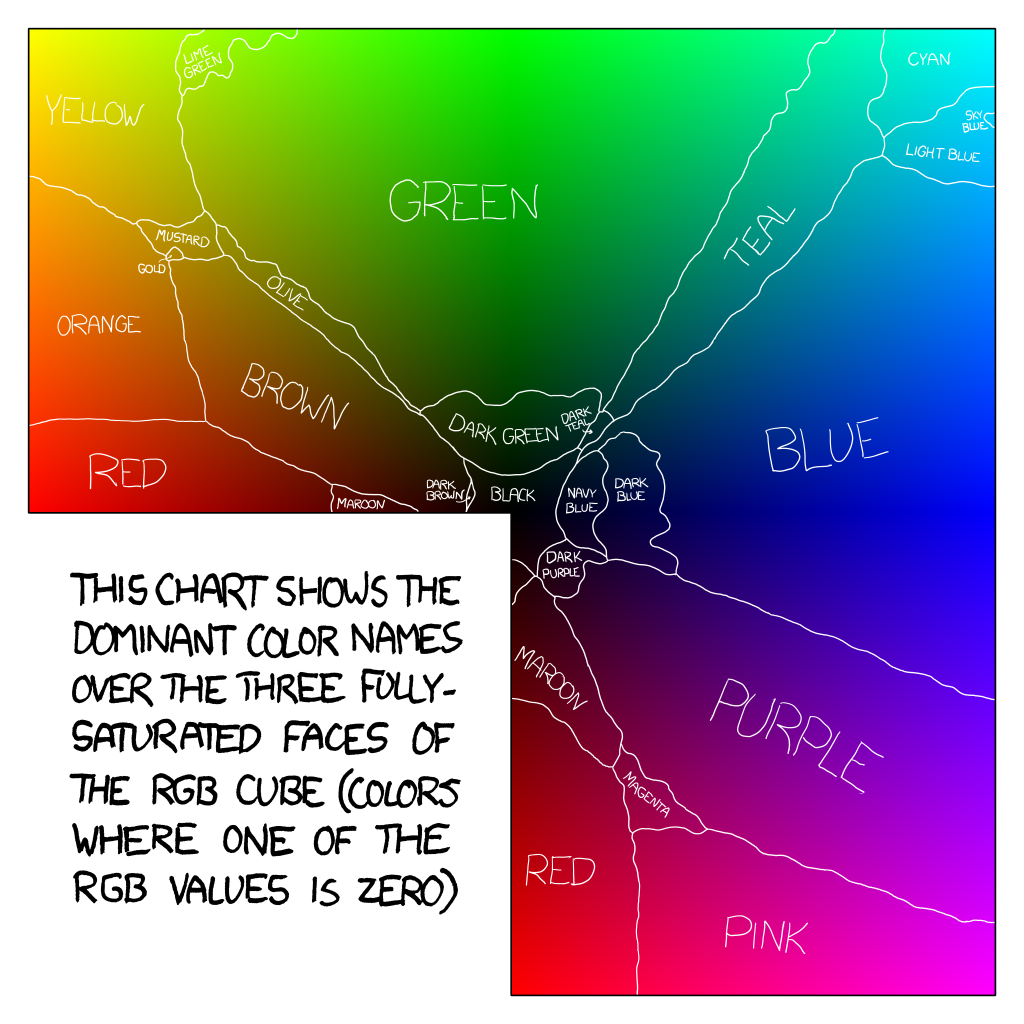
Recall this map of English color names, conveniently created from data by XKCD ( https://blog.xkcd.com/2010/05/03/color-survey-results/ ):
Image

Note how brown is just a word for dark yellow/orange, but other dark hues lack a unique name, except for maroon, but maroon's range is still smaller than brown's.

(1) Why does English have separate words for yellow/orange and brown? Why isn't brown simply called "dark yellow/orange" instead? I assume that this was inherited from PIE, because other languages descended from PIE do the same thing.
(2) But what about non-PIE languages? Do any lack a unique brown term and just use "dark yellow/orange" instead?
(3) Do any other non-PIE languages have a unique word for other dark hues like dark blue or dark green?
(4) Perhaps it's just useful to have a word for brown because of the abundance of this color in nature?, thereby making it useful to easily distinguish between yellow/orange and brown?
zompist
Site Admin
Posts: 4007
Joined: Sun Jul 08, 2018 5:46 am
Location: Right here, probably
Contact:

Re: Why does the word "brown" exist?

Post by zompist »

You should probably look at Berlin & Kay's color theory. In short: yes, there's a lot of language variation; but it's not simply random.

xkcd's map is kind of bad precisely because it's all fully-saturated. Precisely what distinguishes some colors is their higher or lower level of saturation. e.g.
* brown is darkish orange
* olive is whitish green
* pink is whitish red
* maroon is darkish red

One reason we don't call brown "dark orange" is because "brown" is the older term. Oranges didn't get to Europe until the late Middle Ages.

And possibly "brown" comes up pretty early because yellow is perceptually tied to its brightness. Pure yellow is as close to white as you can get with a spectral color. So "dark yellow" may strike people as a contradiction.
User avatar
malloc
Posts: 1424
Joined: Mon Jul 09, 2018 8:42 pm
Location: The Evil Empire

Re: Why does the word "brown" exist?

Post by malloc »

Why does any color word exist, for that matter? It has always felt strange to me that we have a separate word for pink given its rarity in the natural world and proximity to red. Apparently there is an implicational hierarchy for color terms in natural languages. Pretty much all languages have white and black with more specific color terms implying the presence of these. Brown implies the presence of white, black, red, yellow, green, and blue at the very least.
jcb
Posts: 474
Joined: Thu Jul 07, 2022 4:36 pm
Location: American Upper Midwest

Re: Why does the word "brown" exist?

Post by jcb »

Zompist wrote:And possibly "brown" comes up pretty early because yellow is perceptually tied to its brightness. Pure yellow is as close to white as you can get with a spectral color. So "dark yellow" may strike people as a contradiction.
But why is "yellow" tied to brightness in the first place? Why not have a single word for the hue that yellow and brown have in common?
malloc wrote: Wed Feb 25, 2026 10:11 pm Why does any color word exist, for that matter? It has always felt strange to me that we have a separate word for pink given its rarity in the natural world and proximity to red. Apparently there is an implicational hierarchy for color terms in natural languages. Pretty much all languages have white and black with more specific color terms implying the presence of these. Brown implies the presence of white, black, red, yellow, green, and blue at the very least.
(1) "pink" was originally the name of a flower (better known nowdays as a "carnation"), which then became the name for the color, just like "orange" the fruit became "orange" the color.
(2) I remember reading an article once that argued that modernity, industrialization, and mass production influenced languages to get/have more color terms, because there suddenly was more variety in the amount of colors that a person saw on a daily basis, and thus a need/incentive to distinguish them. This is what caused "orange" and "pink" to grow from being niche words denoting plants to basic color terms.
User avatar
Emily
Posts: 471
Joined: Fri Aug 03, 2018 6:24 am
Contact:

Re: Why does the word "brown" exist?

Post by Emily »

jcb wrote: Wed Feb 25, 2026 11:16 pm (2) I remember reading an article once that argued that modernity, industrialization, and mass production influenced languages to get/have more color terms, because there suddenly was more variety in the amount of colors that a person saw on a daily basis, and thus a need/incentive to distinguish them. This is what caused "orange" and "pink" to grow from being niche words denoting plants to basic color terms.
apologies for the pun but color me skeptical. these terms predate the industrial revolution and mass production by centuries.
User avatar
foxcatdog
Posts: 1838
Joined: Fri Nov 15, 2019 7:49 pm

Re: Why does the word "brown" exist?

Post by foxcatdog »

There are a lot of brown things, most mammals, a lot of lizards, tree bark, most rocks.
zompist
Site Admin
Posts: 4007
Joined: Sun Jul 08, 2018 5:46 am
Location: Right here, probably
Contact:

Re: Why does the word "brown" exist?

Post by zompist »

jcb wrote: Wed Feb 25, 2026 11:16 pm
Zompist wrote:And possibly "brown" comes up pretty early because yellow is perceptually tied to its brightness. Pure yellow is as close to white as you can get with a spectral color. So "dark yellow" may strike people as a contradiction.
But why is "yellow" tied to brightness in the first place?
Because of the ways our eyes work and what type of sun we have.

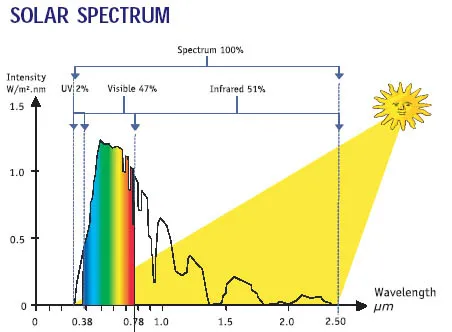
We have two type of light-sensitive cells in the eye: one type responds to brightness, one type (with three subtypes) responds to frequency.

Not surprisingly, our eyes evolved to be most sensitive to the frequencies the sun emits the most. That's why those frequencies are "visible light".

The three subtypes are more sensitive to short, medium, and long wavelengths. By subtracting one response curve from another you get a simple and beautiful way to distinguish frequencies. This produces a blue-vs-yellow signal and a red-vs-green signal.

As it happens, light that strongly triggers the yellow signal also strongly triggers the brightness signal. So yellow light, which is not inherently brighter than red or blue, looks brighter to us.
hwhatting
Posts: 1273
Joined: Mon Jul 09, 2018 3:09 am
Location: Bonn
Contact:

Re: Why does the word "brown" exist?

Post by hwhatting »

jcb wrote: Wed Feb 25, 2026 9:41 pm (1) Why does English have separate words for yellow/orange and brown? Why isn't brown simply called "dark yellow/orange" instead? I assume that this was inherited from PIE, because other languages descended from PIE do the same thing.
No; it's actually quite hard to reconstruct any PIE color terms except for "red" (*h1rewdh-); the words attested seem to have either meant "dark" or "light" or "grey / muddy" - so were about brightness, not about defined colors, or are otherwise all over the place (a root giving, e.g., "blue" in Germanic and "yellow" in Latin, or words for "yellow" and "green" being derived from the same root).
User avatar
Raphael
Posts: 6958
Joined: Sun Jul 22, 2018 6:36 am

Re: Why does the word "brown" exist?

Post by Raphael »

Tangentially related, on a purely aesthetic note, I myself think that the various brown-ish color shades look good on wood, human skin, bread, soil, and animal fur, but often look very bad in many other contexts. At least in contexts where you might expect to see bright colors, they can look completely out of place. But that's just me.
Travis B.
Posts: 9854
Joined: Sun Jul 15, 2018 8:52 pm

Re: Why does the word "brown" exist?

Post by Travis B. »

Of course, 'brown'-type colors are extremely common in the natural world, unlike some other colors whose names have been adopted more recently, which may explain the age of words like 'brown' while 'pink' and 'orange' are newer adoptions.
Yaaludinuya siima d'at yiseka wohadetafa gaare.
Ennadinut'a gaare d'ate eetatadi siiman.
T'awraa t'awraa t'awraa t'awraa t'awraa t'awraa t'awraa.
bradrn
Posts: 7503
Joined: Fri Oct 19, 2018 1:25 am

Re: Why does the word "brown" exist?

Post by bradrn »

zompist wrote: Wed Feb 25, 2026 11:40 pm Not surprisingly, our eyes evolved to be most sensitive to the frequencies the sun emits the most. That's why those frequencies are "visible light".
Alas, this is actually a misconception: see https://oceanopticsbook.info/view/light ... conception.
Conlangs: Scratchpad | Texts | antilanguage
Software: See http://bradrn.com/projects.html
Other: Ergativity for Novices

(Why does phpBB not let me add >5 links here?)
Travis B.
Posts: 9854
Joined: Sun Jul 15, 2018 8:52 pm

Re: Why does the word "brown" exist?

Post by Travis B. »

zompist wrote: Wed Feb 25, 2026 10:07 pm And possibly "brown" comes up pretty early because yellow is perceptually tied to its brightness. Pure yellow is as close to white as you can get with a spectral color. So "dark yellow" may strike people as a contradiction.
The reason why yellow looks 'bright' is that it optimally activates both red and green-pigmented cone cells in the eye with a single spectral color (remember that red and green pigments in the human eye are much closer to each other than either is to blue pigments).
Yaaludinuya siima d'at yiseka wohadetafa gaare.
Ennadinut'a gaare d'ate eetatadi siiman.
T'awraa t'awraa t'awraa t'awraa t'awraa t'awraa t'awraa.
User avatar
Raphael
Posts: 6958
Joined: Sun Jul 22, 2018 6:36 am

Re: Why does the word "brown" exist?

Post by Raphael »

bradrn wrote: Thu Feb 26, 2026 8:24 am
zompist wrote: Wed Feb 25, 2026 11:40 pm Not surprisingly, our eyes evolved to be most sensitive to the frequencies the sun emits the most. That's why those frequencies are "visible light".
Alas, this is actually a misconception: see https://oceanopticsbook.info/view/light ... conception.
Thank you, another assumption of mine shattered.
zompist
Site Admin
Posts: 4007
Joined: Sun Jul 08, 2018 5:46 am
Location: Right here, probably
Contact:

Re: Why does the word "brown" exist?

Post by zompist »

bradrn wrote: Thu Feb 26, 2026 8:24 am
zompist wrote: Wed Feb 25, 2026 11:40 pm Not surprisingly, our eyes evolved to be most sensitive to the frequencies the sun emits the most. That's why those frequencies are "visible light".
Alas, this is actually a misconception: see https://oceanopticsbook.info/view/light ... conception.
Very interesting, thanks. However, I'm not sure the page proves what he wants it to prove. He has two charts which locate the maximum solar radiation in the visible spectrum, and two which locate it in the infrared. Infrared vision is useful and some animals have it, but perception in the visible spectrum is far more common.

What's missing from the page is any discussion of what the difference between the wavelength and frequency charts means in practice (especially for the eye). I am genuinely curious about this.

I'd also note: does he actually maintain that solar irradiance curve is irrelevant? Would an eye attuned to 2000 nm— where there just isn't very much solar radiation— be just as good as our eyes, which max out at about 550 nm?

He makes a big deal of the fact that the radiation curve is not a point function. Yes, of course, that's what we want. Assume you are a motile multi-cellular creature that wants to develop color vision. Do you want, say, a sensor that detects lights of 501 nm? No, because light in the natural world is almost never monochromatic. It's a blur of light of different frequencies. What you want, and what you get in an eye, are sensors that detect a blur of different frequencies. This is why it's misleading to talk about cones detecting "red" or "green". They detect a wide range of frequencies and that's what you want.

(The eye could have done spectral analysis. Our instruments can. And so can our ears, with sound waves. But evolution was happy with these blurry response curves.)

He does mention that it may be hard for eyes to develop infrared receptors. I think what his actual charts show is that useful solar radiation is the visible spectrum plus a good chunk of the infrared. I'm happy to say that eyes throw out the latter because it's hard to measure (with the same mechanisms the eye already uses).
zompist
Site Admin
Posts: 4007
Joined: Sun Jul 08, 2018 5:46 am
Location: Right here, probably
Contact:

Re: Why does the word "brown" exist?

Post by zompist »

Just to understand what's going on in those charts, I added some equivalance lines. Each of the vertical lines of a particular color indicate light of the same frequency and wavelength. (The colors are not those of the corresponding frequency, and in fact I put them in backwards. Doesn't matter, it still works.)
solar-irradiance.png
solar-irradiance.png (22.66 KiB) Viewed 4387 times
Now it's easier to see why the charts differ: the bin sizes are different. Eg. the two bins on either side of the orange line, where most of the light comes in on the wavelength chart, take up over half of the frequency chart.

I think it's also easy to see that the radiation is as I said: most photons coming in from the sun are either in the visible spectrum (which I indicated in black on both charts) or in the near infrared.

(Also, I think he's playing games with the scale in a way that undermines his contention. Light is not limited to small multiples of 10^14 Hz! If you look at the entire electromagnetic spectrum from gamma rays to AM radio, the high end of the solar radiance curve is spectacularly narrow, and I hope he's not really maintaining that it's just weird chance that our eyes don't function on gamma rays.)
bradrn
Posts: 7503
Joined: Fri Oct 19, 2018 1:25 am

Re: Why does the word "brown" exist?

Post by bradrn »

zompist wrote: Thu Feb 26, 2026 6:48 pm Now it's easier to see why the charts differ: the bin sizes are different. Eg. the two bins on either side of the orange line, where most of the light comes in on the wavelength chart, take up over half of the frequency chart.
This is precisely his point! There are (at least) four different ways of measuring spectra, with none of them intrinsically ‘best’, and with a nonlinear relationship between them. It is misleading to cherry-pick the single plot which happens to match up with the sensitivity of the eye, while ignoring the others. Indeed, as he argues at the end, it’s just as easy to argue that the most ‘relevant’ distribution is that of photon count over frequency, which gives you a maximum in the infrared.
I'd also note: does he actually maintain that solar irradiance curve is irrelevant? Would an eye attuned to 2000 nm— where there just isn't very much solar radiation— be just as good as our eyes, which max out at about 550 nm?

[…]

I think it's also easy to see that the radiation is as I said: most photons coming in from the sun are either in the visible spectrum (which I indicated in black on both charts) or in the near infrared.

(Also, I think he's playing games with the scale in a way that undermines his contention. Light is not limited to small multiples of 10^14 Hz! If you look at the entire electromagnetic spectrum from gamma rays to AM radio, the high end of the solar radiance curve is spectacularly narrow, and I hope he's not really maintaining that it's just weird chance that our eyes don't function on gamma rays.)
I think the answer to this is that the integral over the distribution stays the same (which is sort of the whole point of probability distributions). Regardless of how you plot the distribution, the amount of energy between 500 nm and 1500 nm is identical to that between 6×10¹⁶ Hz and 2×10¹⁶ Hz — although the number of photons in that range will still be different, of course, so it’s still not entirely unambiguous. Still, you can talk about a wavelength range in which, say, 90% of solar photon irradiance occurs, and this range should exclude gamma and radio waves.
Conlangs: Scratchpad | Texts | antilanguage
Software: See http://bradrn.com/projects.html
Other: Ergativity for Novices

(Why does phpBB not let me add >5 links here?)
zompist
Site Admin
Posts: 4007
Joined: Sun Jul 08, 2018 5:46 am
Location: Right here, probably
Contact:

Re: Why does the word "brown" exist?

Post by zompist »

bradrn wrote: Fri Feb 27, 2026 4:58 am
zompist wrote: Thu Feb 26, 2026 6:48 pm Now it's easier to see why the charts differ: the bin sizes are different. Eg. the two bins on either side of the orange line, where most of the light comes in on the wavelength chart, take up over half of the frequency chart.
This is precisely his point! There are (at least) four different ways of measuring spectra, with none of them intrinsically ‘best’, and with a nonlinear relationship between them. It is misleading to cherry-pick the single plot which happens to match up with the sensitivity of the eye, while ignoring the others. Indeed, as he argues at the end, it’s just as easy to argue that the most ‘relevant’ distribution is that of photon count over frequency, which gives you a maximum in the infrared.
I don't really understand the difference between the first and second set of charts. Though charts 1 and 3 are really not that different.

The maximum, as I argued, is a red herring. Or an infrared herring. Who cares where the maximum is? His charts are a good demonstration that the maximum value doesn't matter! We care about the largest number of available photons-- the distribution of frequency or wavelength info.

I said it twice, but just in case: if you look at the top two charts, the vast majority of the sun's radiation is either in the visible light range, or in the near infrared. (There is a lot of infrared, this is just part of it.) Far from disproving the traditional view, he's just added one mystery: why our eyes don't extend into the infrared. There seem to be several reasons-- this guy suggests that a cone cell that would detect infrared would be "unstable". Some Googling suggests other reasons, such as water absorbing infrared, and the signal getting swamped by the body's own heat. Animals that do sense infrared, such as snaked, use an entirely different organ, so I'm happy saying that it's a physical limitation of cone cells, at least..
bradrn
Posts: 7503
Joined: Fri Oct 19, 2018 1:25 am

Re: Why does the word "brown" exist?

Post by bradrn »

zompist wrote: Fri Feb 27, 2026 5:34 am
bradrn wrote: Fri Feb 27, 2026 4:58 am
zompist wrote: Thu Feb 26, 2026 6:48 pm Now it's easier to see why the charts differ: the bin sizes are different. Eg. the two bins on either side of the orange line, where most of the light comes in on the wavelength chart, take up over half of the frequency chart.
This is precisely his point! There are (at least) four different ways of measuring spectra, with none of them intrinsically ‘best’, and with a nonlinear relationship between them. It is misleading to cherry-pick the single plot which happens to match up with the sensitivity of the eye, while ignoring the others. Indeed, as he argues at the end, it’s just as easy to argue that the most ‘relevant’ distribution is that of photon count over frequency, which gives you a maximum in the infrared.
I don't really understand the difference between the first and second set of charts. Though charts 1 and 3 are really not that different.
It’s a bit subtle… basically, a single photon at a longer wavelength has less energy than a single photon at a shorter wavelength, so counting by ‘amount of energy’ gives you different results than counting by ‘number of photons’. Sometimes the one is relevant, sometimes the other is. Photoreceptor proteins interact with individual photons, so arguably it’s the latter which is more relevant here.
I said it twice, but just in case: if you look at the top two charts, the vast majority of the sun's radiation is either in the visible light range, or in the near infrared. (There is a lot of infrared, this is just part of it.) Far from disproving the traditional view, he's just added one mystery: why our eyes don't extend into the infrared.
Yes, and that is precisely the ‘common misconception’ which he addresses — that the sensitivity of the eye is somehow uniquely aligned with the distribution of solar radiation. If this were really the most important mechanism at work in the evolution of our eyes, our eyes should extend well into the infrared, but they don’t, so that ‘explanation’ must be missing something very important — that being the ‘mystery’ you mention.

(The original paper he cites (Sofer & Lynch) puts this more bluntly: ‘The eye does not appear to be optimized for detection of the available sunlight, including the surprisingly large amount of infrared radiation in the environment’.)
There seem to be several reasons-- this guy suggests that a cone cell that would detect infrared would be "unstable". Some Googling suggests other reasons, such as water absorbing infrared, and the signal getting swamped by the body's own heat. Animals that do sense infrared, such as snaked, use an entirely different organ, so I'm happy saying that it's a physical limitation of cone cells, at least..
Sofer & Lynch agree that it’s strongly related to the transmission of water. They also go into more detail about the ‘unstable’ molecules — to summarise, the longer your wavelength, the bigger your molecule needs to be to interact with the photon, and such big photosensitive molecules tend to either react with water or fall apart at body temperature.
Conlangs: Scratchpad | Texts | antilanguage
Software: See http://bradrn.com/projects.html
Other: Ergativity for Novices

(Why does phpBB not let me add >5 links here?)
abahot
Posts: 123
Joined: Thu Oct 27, 2022 8:54 am
Location: United States

Re: Why does the word "brown" exist?

Post by abahot »

I'm not quite sure how the molecule thing is relevant, because some animals can and do sense infrared without using photosensitive molecules. They have a (much less sensitive) strategy where infrared receptors are activated by the heat of a large number of infrared photons hitting them.
bradrn
Posts: 7503
Joined: Fri Oct 19, 2018 1:25 am

Re: Why does the word "brown" exist?

Post by bradrn »

abahot wrote: Fri Feb 27, 2026 9:46 am I'm not quite sure how the molecule thing is relevant, because some animals can and do sense infrared without using photosensitive molecules. They have a (much less sensitive) strategy where infrared receptors are activated by the heat of a large number of infrared photons hitting them.
As zompist mentioned, yes.
Conlangs: Scratchpad | Texts | antilanguage
Software: See http://bradrn.com/projects.html
Other: Ergativity for Novices

(Why does phpBB not let me add >5 links here?)
Post Reply