Conlang Random Thread
Re: Conlang Random Thread
I'd be curious in participating in one, but looking at the previous ones makes me feel we'd need more people.
LZ – Lēri Ziwi
PS – Proto Sāzlakuic (ancestor of LZ)
PRk – Proto Rākēwuic
XI – Xú Iạlan
VN – verbal noun
SUP – supine
DIRECT – verbal directional
My language stuff
PS – Proto Sāzlakuic (ancestor of LZ)
PRk – Proto Rākēwuic
XI – Xú Iạlan
VN – verbal noun
SUP – supine
DIRECT – verbal directional
My language stuff
Re: Conlang Random Thread
Yeah, that was the problem. Hardly anyone from the other team actually submitted any languages, and even on our team the only reason we had much to show at all was that foxcatdog made a lot of languages.
Conlangs: Scratchpad | Texts | antilanguage
Software: See http://bradrn.com/projects.html
Other: Ergativity for Novices
(Why does phpBB not let me add >5 links here?)
Software: See http://bradrn.com/projects.html
Other: Ergativity for Novices
(Why does phpBB not let me add >5 links here?)
Re: Conlang Random Thread
Learning Ojibwe, I felt inspired that Vrkhazhian should have a "conjunct" form in contrast to an independent one. It would be used for relative and subordinate clauses.

Re: Conlang Random Thread
The quest to numerate my minimalist project continues. Assuming that I settle for boring old decimal, I still have many interesting options for how numbers work. The obvious approach is digits one through nine and roots for powers of ten. However that sounds surprisingly bloated for a language that only needs six color words. An alternative approach is biquinary, building numbers six through nine (nice) from five plus one through four. An additional improvement would involve deriving numbers from existing roots somehow, perhaps "five" from "hand" and "ten" from "body" and so forth.
That said, this approach also raises some significant challenges. The heavy reliance on the element "five" to form numbers would result in considerable repetition and make numbers longer than other approaches. The form "sixty seven" would become the unwieldy "five and one tens and five and two" or something along those lines. Deriving numbers from existing elements saves elements but also invites confusion. Imagine the difficulties of parsing "hand and two bodies" as "seventy".
That said, this approach also raises some significant challenges. The heavy reliance on the element "five" to form numbers would result in considerable repetition and make numbers longer than other approaches. The form "sixty seven" would become the unwieldy "five and one tens and five and two" or something along those lines. Deriving numbers from existing elements saves elements but also invites confusion. Imagine the difficulties of parsing "hand and two bodies" as "seventy".
Intelligentia artificiālis dēlenda est.
Idiot America | He/him
Idiot America | He/him
Re: Conlang Random Thread
What about binary? That’s as minimalist as you can get…
Conlangs: Scratchpad | Texts | antilanguage
Software: See http://bradrn.com/projects.html
Other: Ergativity for Novices
(Why does phpBB not let me add >5 links here?)
Software: See http://bradrn.com/projects.html
Other: Ergativity for Novices
(Why does phpBB not let me add >5 links here?)
-
/ˌnɐˈɾɛndɚduːd/
- Posts: 369
- Joined: Tue Feb 11, 2025 7:47 pm
- Location: now you see me, now you
Re: Conlang Random Thread
nice.
never mind, the door's over there.... "sixty seven" ...
also known as, 'notenderdude' or any variation thereof.
terminally in search of who asked.
terminally in search of who asked.
Re: Conlang Random Thread
Maybe so, but just using one and zero would result in fantastically long number words. I have experimented with binary based on successive powers of two which avoids this problem to some degree. Consider the difference between "one zero zero zero zero" and a basic root for sixteen. Granted roots for multiple powers of two would lose the minimalism of pure binary.
Decimal has kind of grown on me despite its arbitrary nature, though, precisely because it reflects human anatomy. With art increasingly under siege from computers, it feels increasingly important to stress the humanity of art. Giving my project numbers based on human anatomy sends the message that it's fundamentally for humans rather than AI.
Intelligentia artificiālis dēlenda est.
Idiot America | He/him
Idiot America | He/him
Re: Conlang Random Thread
I personally am a fan of using biquinary for 1-9, vigesimal for 20-90, and roots for powers of ten for 10, 100, 1000, and 10000, and combinations of roots for powers of ten for powers of ten greater than 10000.
Yaaludinuya siima d'at yiseka wohadetafa gaare.
Ennadinut'a gaare d'ate eetatadi siiman.
T'awraa t'awraa t'awraa t'awraa t'awraa t'awraa t'awraa.
Ennadinut'a gaare d'ate eetatadi siiman.
T'awraa t'awraa t'awraa t'awraa t'awraa t'awraa t'awraa.
Re: Conlang Random Thread
If you want to base things on binary, though, why not use hexadecimal or octal? Then you can fundamentally base things in binary, while having it being far more human-friendly than lots of ones and zeroes.
Yaaludinuya siima d'at yiseka wohadetafa gaare.
Ennadinut'a gaare d'ate eetatadi siiman.
T'awraa t'awraa t'awraa t'awraa t'awraa t'awraa t'awraa.
Ennadinut'a gaare d'ate eetatadi siiman.
T'awraa t'awraa t'awraa t'awraa t'awraa t'awraa t'awraa.
Re: Conlang Random Thread
That could certainly work. I have some promising ideas for hexadecimal numerals that would fit neatly with the conscript for my language.
Overall it feels like optimizing the number system in one way requires significant downsides elsewhere. There is a difficult balance between conceptual elegance, practical usability, lexical minimalism and so forth. Minimizing the number of roots requires more complex rules for combining them to form numbers of a given size. More arithmetically logical alternatives to decimal don't fit existing measurement systems very well. It is quite the conundrum. Consider the difference between the following:
six-thousand-seven-hundred-eight-ten-nine
five-one-thousand-five-two-hundred-five-three-ten-five-four
The latter requires fewer lexical items because higher digits are formed from lower digits, but it requires more morphemes for each number. It also has considerably more repetition since the element for "five" recurs with each digit. Furthermore it also shows more formal complexity since the digits themselves are constructed from smaller elements.
Intelligentia artificiālis dēlenda est.
Idiot America | He/him
Idiot America | He/him
Re: Conlang Random Thread
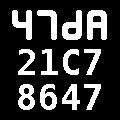
Here is a rough draft of proposed hexadecimal numerals. There are four basic strokes (shown in the top row) representing successive powers of two. The other digits are built by combining these and summing their respective values. For instance the digit 0xF (15 in decimal) contains strokes for one, two, four, and eight.
- Attachments
-
- hexnum.png (846 Bytes) Viewed 3088 times
Intelligentia artificiālis dēlenda est.
Idiot America | He/him
Idiot America | He/him
-
WeepingElf

- Posts: 2477
- Joined: Sun Jul 15, 2018 12:39 pm
- Location: Braunschweig, Germany
- Contact:
Re: Conlang Random Thread
Those make good sense and look nice!
Re: Conlang Random Thread
Seconded!
Yaaludinuya siima d'at yiseka wohadetafa gaare.
Ennadinut'a gaare d'ate eetatadi siiman.
T'awraa t'awraa t'awraa t'awraa t'awraa t'awraa t'awraa.
Ennadinut'a gaare d'ate eetatadi siiman.
T'awraa t'awraa t'awraa t'awraa t'awraa t'awraa t'awraa.

Re: Conlang Random Thread
Re: Conlang Random Thread
Quite cunning. You say it's hexadecimal, but the underlying system is binary. Nice!malloc wrote: ↑Fri Mar 13, 2026 12:31 pmHere is a rough draft of proposed hexadecimal numerals. There are four basic strokes (shown in the top row) representing successive powers of two. The other digits are built by combining these and summing their respective values. For instance the digit 0xF (15 in decimal) contains strokes for one, two, four, and eight.
JAL
Re: Conlang Random Thread
I feel uneasy about my case system. My cases feel too patternistic or monotonous. It just looks like all the affixes are -VC in the singular and -V̄Ca in the plural. The only variation away from this pattern is the vocative singular and equative case. Otherwise, not much variation in affix "shape" or affix vowels.
Sadly, my limited knowledge of sound changes results in my morphological systems being diachronically shallow. My constraints, which are important, also limit my options; specifically the constraints where hiatus is banned and that there cannot be more than two unstressed light syllables in a row.
I don't know, do these look naturalistic?
Moreover, I am not sure how best to assign the declension classes. I would like it to not be completely random (e.g. all kinship nouns and names are i-stem) but without accidentally creating noun class subsystems (e.g. like in Polish).
Sadly, my limited knowledge of sound changes results in my morphological systems being diachronically shallow. My constraints, which are important, also limit my options; specifically the constraints where hiatus is banned and that there cannot be more than two unstressed light syllables in a row.
I don't know, do these look naturalistic?
Animate a-stem
|
Animate i-stem
|
Inanimate a-stem
|
Inanimate i-stem
|
Moreover, I am not sure how best to assign the declension classes. I would like it to not be completely random (e.g. all kinship nouns and names are i-stem) but without accidentally creating noun class subsystems (e.g. like in Polish).
Last edited by Ahzoh on Mon Mar 16, 2026 4:20 pm, edited 2 times in total.
Re: Conlang Random Thread
They look fine to me. Of course, I can’t say anything about your phonaesthetic preferences.
Conlangs: Scratchpad | Texts | antilanguage
Software: See http://bradrn.com/projects.html
Other: Ergativity for Novices
(Why does phpBB not let me add >5 links here?)
Software: See http://bradrn.com/projects.html
Other: Ergativity for Novices
(Why does phpBB not let me add >5 links here?)
Re: Conlang Random Thread
That's what I thought too, but then I keep looking at it and doubting myself. I have tried to find naturalistic languages where all the case endings end in the same vowels but even they have a little variation.
- Hittiteistem.png (13.95 KiB) Viewed 2555 times