rotting bones wrote: ↑Wed Mar 18, 2026 4:43 am
From personal experience, I know that people in Muslim households repeat the belief that if you don't give charity when you see the poor calling their sustainer, Allah will lower your station by taking your wealth away from you through other means by the amount that the poor needed. [...]
History doesn't bear out this theory. Nor does Islamic law do anything to address this problem. It doesn't understand that stagnation is a characteristic that trade converges towards as the wealthy invest their resources in profit-extracting enterprises. All it does is require you to pay a paltry 2.5% of your wealth (not income, excluding essentials and debt!) towards compulsory charity (zakat).
I'd take a cultural-materialist view of this. Does zakat work? Not if your goal is eliminating inequality, no. But if the idea is to make an imperial system work better, it is probably better than the naked exploitation the nobles would otherwise indulge. So far as I know, every major civilization from the Egyptians on includes warnings to the rich not to oppress the poor, usually backed up by divine sanction and not infrequently by royal decrees. (As it happens I'm reading the Mahabharata right now, and though it's essentially a superhero film, it's also a morality tale where the gods punish unrighteousness, especially greed.)
Universalistic religions tend to appear and thrive just as large empires do. That doesn't mean they're created to make emperors happy. But an empire can sustain itself better if it the emperor has
some conscience. (In the 1700s, the Chinese emperors seemed deeply distressed by famines and floods and omens: these were expressions of divine displeasure and were ultimately their fault. It didn't make them Marxists, but it probably made them more amenable to public relief and dredging waterways.)
I don't know how common this belief is in other Abrahamic religions.
The bit about the rich being rich because they're
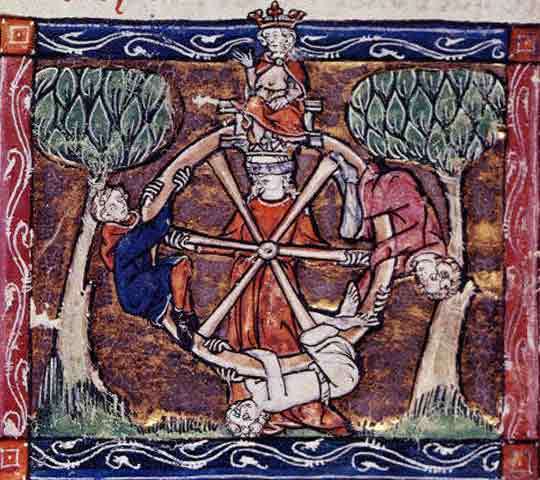
better people is pretty common in Christianity... but so are warnings that kings are also sinners, that God favors the poor, etc. In the Middle Ages it was taught that the demigoddess Fortune was responsible for redistributing wealth and power randomly to show the inherent equality of all humans. (
Here's a picture of Fortune, blindfolded to emphasize her impartiality.)
Jesus famously exhorted a rich man to give away everything he owned, a suggestion that the shocked the rich man as much as it would today. The very early church was communist, the most admired priests in medieval times were begging friars, and alms were always supposed to be given.
Again, viewing religions as not very successful attempts to dismantle hierarchy is not a very useful viewpoint. No one knew how to dismantle hierarchy, only God, and he was in no hurry.