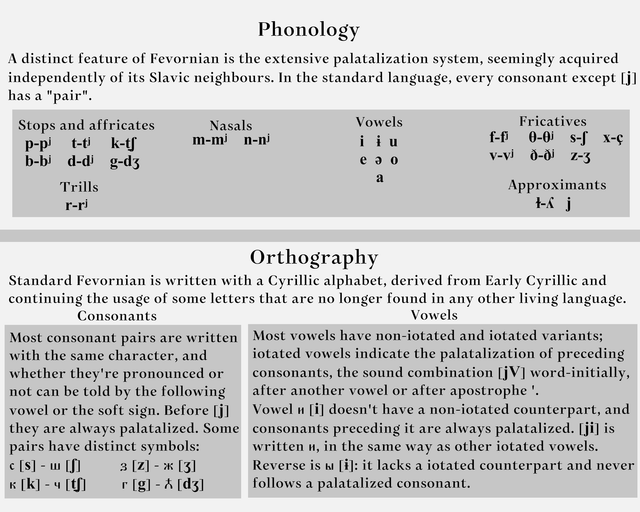
This project's first overview is this short, mostly visual, presentation above before I move to more detailed descriptions.
Fevornian - a non-Romance Italic language on the shores of the Danube
-
þeprussianfrog
- Posts: 48
- Joined: Tue Apr 14, 2026 4:38 am
- Location: Earþ
Fevornian - a non-Romance Italic language on the shores of the Danube
Fevornian is a conlang I recently have started, a non-Romance Italic language that had survived in Southeastern Europe.
This project's first overview is this short, mostly visual, presentation above before I move to more detailed descriptions.
More: show
- WeepingElf
- Posts: 2171
- Joined: Sun Jul 15, 2018 12:39 pm
- Location: Braunschweig, Germany
- Contact:
Re: Fevornian - a non-Romance Italic language on the shores of the Danube
Nice presentation!
-
þeprussianfrog
- Posts: 48
- Joined: Tue Apr 14, 2026 4:38 am
- Location: Earþ
Re: Fevornian - a non-Romance Italic language on the shores of the Danube
Nicely presentated, indeed. I like the use of pictures behind the inflection tables.
"But he had reckoned without my narrative powers! With one bound I narrated myself up the wall and into the bathroom, where I transformed him into a freestanding sink unit.
We washed our hands of him, and lived happily ever after."
Re: Fevornian - a non-Romance Italic language on the shores of the Danube
very cool! i'm really interested in seeing more detail!
one suggestion, however: it would be easier to read if you included a transliteration alongside the cyrillic
- Man in Space
- Posts: 2434
- Joined: Sat Jul 21, 2018 1:05 am
-
þeprussianfrog
- Posts: 48
- Joined: Tue Apr 14, 2026 4:38 am
- Location: Earþ
Re: Fevornian - a non-Romance Italic language on the shores of the Danube
Thanks everyone! The next update will probably be some basic lexicon and pronouns.
Re: Fevornian - a non-Romance Italic language on the shores of the Danube
Great concept and presentation, I like it!
What I would be interested in is the historical grammar and etymologies; as my main conlang Tautisca is also an Indo-European a posteriori language, I'm curious about what assumptions on IE / Proto-Italic reconstruction you made.
-
þeprussianfrog
- Posts: 48
- Joined: Tue Apr 14, 2026 4:38 am
- Location: Earþ
Re: Fevornian - a non-Romance Italic language on the shores of the Danube
With Proto-Italic I went with de Vaan's reconstructions, also used Wiktionary and Wikipedia's available parts on PI, Sabellic and Lat-Fal; also Rex E Wallace's works on Sabellic and Venetic. I generally researched whatever I could find because not much info on Italics (well, aside from Latin/Romance).hwhatting wrote: ↑Wed Apr 15, 2026 3:16 am Great concept and presentation, I like it!
What I would be interested in is the historical grammar and etymologies; as my main conlang Tautisca is also an Indo-European a posteriori language, I'm curious about what assumptions on IE / Proto-Italic reconstruction you made.
I guess the name of your IE conlang comes from *tewtéh₂? In present-day Fevornian, this word's descendant, тудꙓ [tudʲe], means "language" (тудꙓ фꙓворнꙓꙉꙓ [tudʲe fʲevornʲedʒe] is "Fevornian language", for example).
Re: Fevornian - a non-Romance Italic language on the shores of the Danube
If I am not mistaken, Tautisca is a Romance language set in present-day Germany, which makes me think that 'Tautisca' is meant to be cognate with Deutsch.
Edit: I looked it up and I am mistaken -- Tautisca is not meant to be in any specific actual IE branch.
Yaaludinuya siima d'at yiseka wohadetafa gaare.
Ennadinut'a gaare d'ate eetatadi siiman.
T'awraa t'awraa t'awraa t'awraa t'awraa t'awraa t'awraa.
Ennadinut'a gaare d'ate eetatadi siiman.
T'awraa t'awraa t'awraa t'awraa t'awraa t'awraa t'awraa.
Re: Fevornian - a non-Romance Italic language on the shores of the Danube
BTW, nice overview!
Yaaludinuya siima d'at yiseka wohadetafa gaare.
Ennadinut'a gaare d'ate eetatadi siiman.
T'awraa t'awraa t'awraa t'awraa t'awraa t'awraa t'awraa.
Ennadinut'a gaare d'ate eetatadi siiman.
T'awraa t'awraa t'awraa t'awraa t'awraa t'awraa t'awraa.
Re: Fevornian - a non-Romance Italic language on the shores of the Danube
*tewtéh₂, via PGm *þiudiskaz¹, is indeed the ancestor of Deutsch, which might be where you got that from?Travis B. wrote: ↑Wed Apr 15, 2026 7:48 pm If I am not mistaken, Tautisca is a Romance language set in present-day Germany, which makes me think that 'Tautisca' is meant to be cognate with Deutsch.
Edit: I looked it up and I am mistaken -- Tautisca is not meant to be in any specific actual IE branch.
¹ Modern English would be *theedish, but we only have Dutch
LZ – Lēri Ziwi
PS – Proto Sāzlakuic (ancestor of LZ)
PRk – Proto Rākēwuic
XI – Xú Iạlan
VN – verbal noun
SUP – supine
DIRECT – verbal directional
My language stuff
PS – Proto Sāzlakuic (ancestor of LZ)
PRk – Proto Rākēwuic
XI – Xú Iạlan
VN – verbal noun
SUP – supine
DIRECT – verbal directional
My language stuff
- WeepingElf
- Posts: 2171
- Joined: Sun Jul 15, 2018 12:39 pm
- Location: Braunschweig, Germany
- Contact:
Re: Fevornian - a non-Romance Italic language on the shores of the Danube
And Dutch is of course a loanword either from Middle Dutch or from Middle Low German.Lērisama wrote: ↑Thu Apr 16, 2026 4:09 am*tewtéh₂, via PGm *þiudiskaz¹, is indeed the ancestor of Deutsch, which might be where you got that from?Travis B. wrote: ↑Wed Apr 15, 2026 7:48 pm If I am not mistaken, Tautisca is a Romance language set in present-day Germany, which makes me think that 'Tautisca' is meant to be cognate with Deutsch.
Edit: I looked it up and I am mistaken -- Tautisca is not meant to be in any specific actual IE branch.
¹ Modern English would be *theedish, but we only have Dutch
Re: Fevornian - a non-Romance Italic language on the shores of the Danube
Well, it's meant to be Western IE; *tewta: is also attested in Celtic and other Western branches.Travis B. wrote: ↑Wed Apr 15, 2026 7:48 pm If I am not mistaken, Tautisca is a Romance language set in present-day Germany, which makes me think that 'Tautisca' is meant to be cognate with Deutsch.
Edit: I looked it up and I am mistaken -- Tautisca is not meant to be in any specific actual IE branch.
-
þeprussianfrog
- Posts: 48
- Joined: Tue Apr 14, 2026 4:38 am
- Location: Earþ
Re: Fevornian - a non-Romance Italic language on the shores of the Danube
The cognates are also attested in Indo-Iranian and possibly Hittite tbf.hwhatting wrote: ↑Thu Apr 16, 2026 10:49 amWell, it's meant to be Western IE; *tewta: is also attested in Celtic and other Western branches.Travis B. wrote: ↑Wed Apr 15, 2026 7:48 pm If I am not mistaken, Tautisca is a Romance language set in present-day Germany, which makes me think that 'Tautisca' is meant to be cognate with Deutsch.
Edit: I looked it up and I am mistaken -- Tautisca is not meant to be in any specific actual IE branch.
-
þeprussianfrog
- Posts: 48
- Joined: Tue Apr 14, 2026 4:38 am
- Location: Earþ
Re: Fevornian - a non-Romance Italic language on the shores of the Danube
Copula conjugation (present and imperfect).
Present
ѣзу [ezu] - 1sg
ѣс [es] - 2sg
ѣст [est] - 3sg
ѣсым [esɨm] - 1pl
ѣсть [estʲ] - 2pl
ѣшин [eʃin] - 3pl
Imperfect
ови [ovi] - 1sg
овꙓс [ovʲes] - 2sg
ovꙓт [ovʲet] - 3sg
овум [ovum] - 1pl
оводь [ovodʲ] - 2pl
овун [ovun] - 3p
Note: present tense is typically zero-copula.
The small sentence, for example,
"Cat is red"
will usually just be:
Кындорс родэрс. [kɨndors rodərs]
Present
ѣзу [ezu] - 1sg
ѣс [es] - 2sg
ѣст [est] - 3sg
ѣсым [esɨm] - 1pl
ѣсть [estʲ] - 2pl
ѣшин [eʃin] - 3pl
Imperfect
ови [ovi] - 1sg
овꙓс [ovʲes] - 2sg
ovꙓт [ovʲet] - 3sg
овум [ovum] - 1pl
оводь [ovodʲ] - 2pl
овун [ovun] - 3p
Note: present tense is typically zero-copula.
The small sentence, for example,
"Cat is red"
will usually just be:
Кындорс родэрс. [kɨndors rodərs]
Last edited by þeprussianfrog on Fri Apr 17, 2026 9:06 am, edited 1 time in total.
Re: Fevornian - a non-Romance Italic language on the shores of the Danube
Lovely presentation and I like the aesthetics of the language so far.
-
þeprussianfrog
- Posts: 48
- Joined: Tue Apr 14, 2026 4:38 am
- Location: Earþ
-
þeprussianfrog
- Posts: 48
- Joined: Tue Apr 14, 2026 4:38 am
- Location: Earþ
Re: Fevornian - a non-Romance Italic language on the shores of the Danube
Perfect tense (active)
Perfect tense, used for the finished actions in the past, is formed in a typical Balkan sprachbund fashion: present form of the verb тини [tʲinʲi] "have" + past participle of the action verb (masc.sg.nom).
In this particular form this participle will be formed by the verb stem+ѕ [ð], the declension of it in the function directly as a participle is more complicated and will be covered later.
Here's the examples for капю [kapʲu] "catch"
1sg
тини капꙓѕ [tʲinʲi kapʲeð]
2sg
тинис капꙓѕ [tʲinʲis ...]
3sg
тинит капꙓѕ [tʲinʲit ...]
1pl
тиним капꙓѕ [tʲinʲim ...]
2pl
тинидь капꙓѕ [tʲinʲidʲ ...]
3pl
тинин капꙓѕ [tʲinʲin ...]
Perfect tense, used for the finished actions in the past, is formed in a typical Balkan sprachbund fashion: present form of the verb тини [tʲinʲi] "have" + past participle of the action verb (masc.sg.nom).
In this particular form this participle will be formed by the verb stem+ѕ [ð], the declension of it in the function directly as a participle is more complicated and will be covered later.
Here's the examples for капю [kapʲu] "catch"
1sg
тини капꙓѕ [tʲinʲi kapʲeð]
2sg
тинис капꙓѕ [tʲinʲis ...]
3sg
тинит капꙓѕ [tʲinʲit ...]
1pl
тиним капꙓѕ [tʲinʲim ...]
2pl
тинидь капꙓѕ [tʲinʲidʲ ...]
3pl
тинин капꙓѕ [tʲinʲin ...]
-
þeprussianfrog
- Posts: 48
- Joined: Tue Apr 14, 2026 4:38 am
- Location: Earþ
Re: Fevornian - a non-Romance Italic language on the shores of the Danube
Colours
Тюс [tʲus] - colour, from a Turkic language, ultimately from Proto-Turkic *tǖs. The colour system of Fevornian is obviously more expansive than the scheme provided below, with various hues and shades (especially if one's a painter or a web designer, for example), but the scheme shows the basic list used in the modern language (note that some, like orange and beige, are recent loans).

родэрс [rodərs] - red, from Proto-Italic *ruðros. Is used for the saturated red objects (blood, wine, cranberry, ladybug) and also in the sense of "ginger": the colour of hair on people and wild mammals, feathers on birds and other animal pigmentations (compare Russian рыжий).
портокалꙓјс [portokalʲejs] - orange, from портокалс "orange (fruit)", itself a loanword from Greek πορτοκάλι or/and Ottoman Turkish پورتقال (compare Albanian portokall, Bulgarian портокал). Is very rarely used for animals or people's natural hair colour.
соѕ [soð] - yellow, from Proto-Italic *suzdos "dry". Semantic shift happened probably due to the colour of dry grass.
ловс [lovs] - lime green/yellowish-green from Proto-Italic *flāwos "blond/yellow".
даринꙓјс [darʲinʲejs] - mossy green/emerald green, from Proto-Celtic *dolinyā "leaf".
ширꙓјс [ʃirʲejs] - cyan/turquoise, greenish-blue, from Proto-Italic *kailom "sky". Used in most contexts.
финꙓѕ [fʲinʲeð] - cyan/turquoise, greenish-blue, from Latin venetus "Venetian; light blue (from the colour of Venetian Lagoon)", ultimately from the endonym of Adriatic Veneti (*wenetos?). Originally a dialectal form that became more commonly used during the romantic nationalism era: cyan is the national Fevornian colour, and this word implied a connection with the Adriatic Veneti, an ancient tribe believed to be among the ancestors of Fevornians. Most commonly used in high/poetic context, in songs and literature.
голубс [golubs] - light blue, from Russian голубой (by analogy of other Russian adjectives adapted via short form, although *голуб doesn't exist in standard Russian). Rarely used, usually in the context of a light blue colour distinct from cyan. Most commonly used in the speech of younger generations and in technical context.
калѳинс [kalθʲins] - dark blue, from Vulgar Latin *calthinus "yellowish". Semantic shift similar to the one in Albanian kaltër, from the same Vulgar Latin root.
јинѳинс [jinθʲins] - purple, from Ancient Greek ἰάνθῐνος.
роз [роз] - pink, a loanword from some Central European language, ultimately from Latin rosa "rose", compare Romanian roz, Hungarian rózsás.
беж [beʒ] - beige, from French beige. Usually used in technical context (cars, websites, phones...).
ашинꙓјс [aʃinʲejs] - sandy, beige. From ашинꙓ "sand", from a Sabellic language, ultimately from Etruscan 𐌚𐌀𐌑𐌄𐌍𐌀. Usually used in context of natural colours (animals, plants, rocks...).
ровс [rovs] - brown. From Latin rāvus "amber-coloured".
тꙓдꙓринс [tʲedʲerʲins] - dark, blackish brown. From тꙓдꙓрс "grouse", itself from Proto-Celtic *teteros.
отэрс [otərs] - black. From Proto-Italic *ātros.
пꙓꙉꙓјс [pʲedʒʲejs] - dark gray, blackish-gray. From Proto-Italic *piks "pitch". May be used as "gray" in the general meaning.
казэнс [kazəns] - light gray, whitish-gray. From Proto-Italic *kaznos. Also means "gray-haired" (from age).
олэбс [oləbs] - white. From Proto-Italic *alβos.
Тюс [tʲus] - colour, from a Turkic language, ultimately from Proto-Turkic *tǖs. The colour system of Fevornian is obviously more expansive than the scheme provided below, with various hues and shades (especially if one's a painter or a web designer, for example), but the scheme shows the basic list used in the modern language (note that some, like orange and beige, are recent loans).

родэрс [rodərs] - red, from Proto-Italic *ruðros. Is used for the saturated red objects (blood, wine, cranberry, ladybug) and also in the sense of "ginger": the colour of hair on people and wild mammals, feathers on birds and other animal pigmentations (compare Russian рыжий).
портокалꙓјс [portokalʲejs] - orange, from портокалс "orange (fruit)", itself a loanword from Greek πορτοκάλι or/and Ottoman Turkish پورتقال (compare Albanian portokall, Bulgarian портокал). Is very rarely used for animals or people's natural hair colour.
соѕ [soð] - yellow, from Proto-Italic *suzdos "dry". Semantic shift happened probably due to the colour of dry grass.
ловс [lovs] - lime green/yellowish-green from Proto-Italic *flāwos "blond/yellow".
даринꙓјс [darʲinʲejs] - mossy green/emerald green, from Proto-Celtic *dolinyā "leaf".
ширꙓјс [ʃirʲejs] - cyan/turquoise, greenish-blue, from Proto-Italic *kailom "sky". Used in most contexts.
финꙓѕ [fʲinʲeð] - cyan/turquoise, greenish-blue, from Latin venetus "Venetian; light blue (from the colour of Venetian Lagoon)", ultimately from the endonym of Adriatic Veneti (*wenetos?). Originally a dialectal form that became more commonly used during the romantic nationalism era: cyan is the national Fevornian colour, and this word implied a connection with the Adriatic Veneti, an ancient tribe believed to be among the ancestors of Fevornians. Most commonly used in high/poetic context, in songs and literature.
голубс [golubs] - light blue, from Russian голубой (by analogy of other Russian adjectives adapted via short form, although *голуб doesn't exist in standard Russian). Rarely used, usually in the context of a light blue colour distinct from cyan. Most commonly used in the speech of younger generations and in technical context.
калѳинс [kalθʲins] - dark blue, from Vulgar Latin *calthinus "yellowish". Semantic shift similar to the one in Albanian kaltër, from the same Vulgar Latin root.
јинѳинс [jinθʲins] - purple, from Ancient Greek ἰάνθῐνος.
роз [роз] - pink, a loanword from some Central European language, ultimately from Latin rosa "rose", compare Romanian roz, Hungarian rózsás.
беж [beʒ] - beige, from French beige. Usually used in technical context (cars, websites, phones...).
ашинꙓјс [aʃinʲejs] - sandy, beige. From ашинꙓ "sand", from a Sabellic language, ultimately from Etruscan 𐌚𐌀𐌑𐌄𐌍𐌀. Usually used in context of natural colours (animals, plants, rocks...).
ровс [rovs] - brown. From Latin rāvus "amber-coloured".
тꙓдꙓринс [tʲedʲerʲins] - dark, blackish brown. From тꙓдꙓрс "grouse", itself from Proto-Celtic *teteros.
отэрс [otərs] - black. From Proto-Italic *ātros.
пꙓꙉꙓјс [pʲedʒʲejs] - dark gray, blackish-gray. From Proto-Italic *piks "pitch". May be used as "gray" in the general meaning.
казэнс [kazəns] - light gray, whitish-gray. From Proto-Italic *kaznos. Also means "gray-haired" (from age).
олэбс [oləbs] - white. From Proto-Italic *alβos.