Thanks! I do agree that this is a better definition (although the difference really only matters for Thai and Lao).Richard W wrote: ↑Sun Mar 01, 2020 3:22 am"A segmental writing system in which consonant–vowel sequences are written as a unit: each unit is based on a consonant letter, and vowel notation is secondary".
This definition neatly sidesteps the issue of a default vowel, instead of hitting the issues that some Thai and Lao script writing systems are 'alphabets' while others are 'abugidas'.
Work with the Famous 1970s Pakuni Dinosaur and Myth Conlang and my Conlangs from This Past Year
Re: Work with the Famous 1970s Pakuni Dinosaur and Myth Conlang and my Conlangs from This Past Year
Conlangs: Scratchpad | Texts | antilanguage
Software: See http://bradrn.com/projects.html
Other: Ergativity for Novices
(Why does phpBB not let me add >5 links here?)
Software: See http://bradrn.com/projects.html
Other: Ergativity for Novices
(Why does phpBB not let me add >5 links here?)
Re: Work with the Famous 1970s Pakuni Dinosaur and Myth Conlang and my Conlangs from This Past Year
There's a similar situation with Phags-Pa - some languages use implicit vowels; others don't. Pali can be written as an 'alphabet' or an aubugida in the Thai and Lao scripts. The concept of alphasyllabary removes one of the strains in analysing Canadian syllabics.
Re: Work with the Famous 1970s Pakuni Dinosaur and Myth Conlang and my Conlangs from This Past Year
I didn’t know these facts about ʼPhags-Pa and Pali — thanks for sharing! And you’re right that this resolves the problems with categorising Canadian Aboriginal Syllabics; I can’t believe I forgot about that.Richard W wrote: ↑Sun Mar 01, 2020 3:57 amThere's a similar situation with Phags-Pa - some languages use implicit vowels; others don't. Pali can be written as an 'alphabet' or an aubugida in the Thai and Lao scripts. The concept of alphasyllabary removes one of the strains in analysing Canadian syllabics.
Conlangs: Scratchpad | Texts | antilanguage
Software: See http://bradrn.com/projects.html
Other: Ergativity for Novices
(Why does phpBB not let me add >5 links here?)
Software: See http://bradrn.com/projects.html
Other: Ergativity for Novices
(Why does phpBB not let me add >5 links here?)

Re: Work with the Famous 1970s Pakuni Dinosaur and Myth Conlang and my Conlangs from This Past Year
Just some quick thoughts here on my academia.edu profile definition of logographic writing systems:
I think I decided to specify them as those not descended from Wadi El-Hol Script because of things like how English uses all sorts of symbols and other things in its writing. Like !@#$%^ and then things it does to letters in advertisements and such. More recently, there's emoji.
But, again, if I messed up that definition, there's far more important terms in the list of terms that I give on my academia.edu profile.
There really is a whole unexplored and under-explored world of comparative logographic writing system nuances and amazing discoveries awaiting the person who'd like to read my writings or talk to me about it. In my writings put online, I've tried my best to make this clear. But it's a hard thing to convey. It's like visiting a foreign country or traveling to another world.
I recently did a post in the Language Forum of Zompist Bboard on Sumerian signs. No one has responded. There's many lifetimes' worth of discussion to be had on these things. No one responds. But for some discussion by me and others from around the world, consider visiting my facebook group Hieroglyphic Writing System Linguistics.
...
Also, I read the other things people wrote since my last post about work on the Pakuni conlang. Thank-you for that, I'm happy to see anyone else studies the linguistics of writing systems. It's very much under-studied by professionals as well as non-professionals. It occured to me that this might be how my life would be like when I chose to specialize in this topic. Being a pioneer, it seems sometimes tough if you don't have steady funding and tenure and such. Which is why I made several back-up plans, some of which have been paying off.
Last edited by Bob on Wed Mar 04, 2020 2:57 pm, edited 1 time in total.
Re: Work with the Famous 1970s Pakuni Dinosaur and Myth Conlang and my Conlangs from This Past Year
Update on Pakuni Studies 2020:
I finished making etymologies for the approximately 20 x 20 plants and animals from all geological periods! ( This accompanies special research I've been doing the last few years into animal word comparative etymology, a little done specifically for this Pakuni language. ) ( Last year I hand-crafted words for many prehistoric plants and animals as well as hominid tools and hunting techniques. Maybe that was always a conlanging dream of mine. )
But I don't know if I'll then go through and use the etymologies to make the words in Pakuni. It would be a lot of work.
( I added this to the facebook group Paleontology to which I post: To explore animal word comparative etymology, paleontology, and other subjects, I have designed an experiment where I invent words for prehistoric plants and animals in an artificial language partially of my own creation. This research has been very interesting and probably unique for the insights it has yielded regarding the use and creation of words in paleontology. )
...
And then the last thing I have to do with Pakuni for this year, or one of the last, is "space out" the English translations of the Art of War passages I selected. These two Art of War books by Sunzi and Sunbi are from about 500 BC and the Era of Confucius. I include the original texts in Classical Chinese, a language with which I am very familiar. ( One of the themes of Pakuni is prehistoric hunting but I didn't have any Classical Chinese texts on hunting and instead had this one on war. There's been some overlap and it's been interesting altogether. Great vocabulary, some insights and wisdom. )
But I don't know if I'll translate any of these many texts into Pakuni, this year. It's been a lot of work already. I did some work on body part vocabulary earlier, might do more, and then might focus on nature vocabulary after that. The language has ended up rich in hand-crafted body part vocabulary because a lot of the hand-crafted attention has gone to dinosaur name etymologies and words, which often include roots refering to body parts.
I actually computer-generated some 100,000 words for Pakuni but this year haven't felt like getting on the computer to use them. But they're there to show technique and method and in case I need them otherwise.
...
I also finished the Sumerian text about a giant bird that I wanted to add. And I'm still working on Sumerian signs on the side, just a bit.
...
I think about adding some more nursery rhymes. I've always wanted to do that for Pakuni. It would also be a good collection of texts to have for the Pakuni corpus. It was a kid's show. A lot of the texts I added are kid-friendly on various levels. I have this sizeable collection now of dinosaur books which are mostly geared toward kids, actually, with large amounts of illustrations and surprising levels of scientific detail. And the etymologies refer to these books and their art. So far as I can tell, I never actually studied much about dinosaurs as a grown-up.
I've had the same experience collecting books on Ancient Egypt: Many are kids books. Dinosaurs and Ancient Egypt are more likely to show up in the kids books sections of used bookstores and thrift stores, worldwide. I actually specialize quite a lot in Ancient Egypt and don't totally like this. But it is what is. And that, folks, is what anthropology is all about. (I'm an amateur anthropologist.)
Images:
Detail from a nice large image of the geological record.
This one is great and it's very zoomable.
https://deanbolton.ca/Geological-Time-Scale
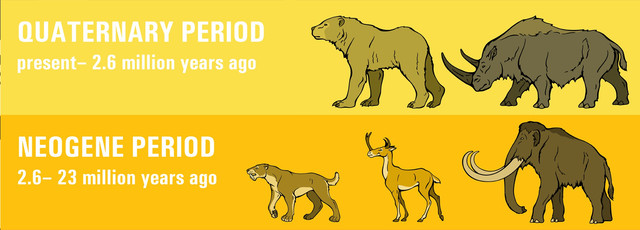
I finished making etymologies for the approximately 20 x 20 plants and animals from all geological periods! ( This accompanies special research I've been doing the last few years into animal word comparative etymology, a little done specifically for this Pakuni language. ) ( Last year I hand-crafted words for many prehistoric plants and animals as well as hominid tools and hunting techniques. Maybe that was always a conlanging dream of mine. )
But I don't know if I'll then go through and use the etymologies to make the words in Pakuni. It would be a lot of work.
( I added this to the facebook group Paleontology to which I post: To explore animal word comparative etymology, paleontology, and other subjects, I have designed an experiment where I invent words for prehistoric plants and animals in an artificial language partially of my own creation. This research has been very interesting and probably unique for the insights it has yielded regarding the use and creation of words in paleontology. )
...
And then the last thing I have to do with Pakuni for this year, or one of the last, is "space out" the English translations of the Art of War passages I selected. These two Art of War books by Sunzi and Sunbi are from about 500 BC and the Era of Confucius. I include the original texts in Classical Chinese, a language with which I am very familiar. ( One of the themes of Pakuni is prehistoric hunting but I didn't have any Classical Chinese texts on hunting and instead had this one on war. There's been some overlap and it's been interesting altogether. Great vocabulary, some insights and wisdom. )
But I don't know if I'll translate any of these many texts into Pakuni, this year. It's been a lot of work already. I did some work on body part vocabulary earlier, might do more, and then might focus on nature vocabulary after that. The language has ended up rich in hand-crafted body part vocabulary because a lot of the hand-crafted attention has gone to dinosaur name etymologies and words, which often include roots refering to body parts.
I actually computer-generated some 100,000 words for Pakuni but this year haven't felt like getting on the computer to use them. But they're there to show technique and method and in case I need them otherwise.
...
I also finished the Sumerian text about a giant bird that I wanted to add. And I'm still working on Sumerian signs on the side, just a bit.
...
I think about adding some more nursery rhymes. I've always wanted to do that for Pakuni. It would also be a good collection of texts to have for the Pakuni corpus. It was a kid's show. A lot of the texts I added are kid-friendly on various levels. I have this sizeable collection now of dinosaur books which are mostly geared toward kids, actually, with large amounts of illustrations and surprising levels of scientific detail. And the etymologies refer to these books and their art. So far as I can tell, I never actually studied much about dinosaurs as a grown-up.
I've had the same experience collecting books on Ancient Egypt: Many are kids books. Dinosaurs and Ancient Egypt are more likely to show up in the kids books sections of used bookstores and thrift stores, worldwide. I actually specialize quite a lot in Ancient Egypt and don't totally like this. But it is what is. And that, folks, is what anthropology is all about.
(I'm an amateur anthropologist.)Images:
Detail from a nice large image of the geological record.
This one is great and it's very zoomable.
https://deanbolton.ca/Geological-Time-Scale
Re: Work with the Famous 1970s Pakuni Dinosaur and Myth Conlang and my Conlangs from This Past Year
Well, I got back to Pakuni today after a several week haitus for coronavirus research.
I finished all the mammals and such after the KT Event today. I did that part first for some reason. And I finished writing out all the Art of War texts for possible later translation.
I'm wondering if the compound words and etymology should follow the language's syntax or what. I've studied tons of etymology and cannot remember, so I guess I will. It's not a big deal, it's whatever I can do that's awesome for this.
I'm assembling the words from roots but don't know how to do it exactly or would have to look it all up. So I just approximate it all and it manages to take a lot of time still anyway. It's ending up really nice.
Ironically, when everyone became aware of coronavirus here in the USA, about 3/13, I had been studying the evolution of all life for the past 3 months. So I was able to look up where viruses might fall in the "family tree" of all known life and such. And then, I otherwise generally study Prehistory a lot, so that makes me very equipt and useful for the present situation.
Despite having free time, I've been having trouble getting my hobby research done. I wonder how long the coronavirus thing will last. Maybe 1.5 years? I may not get much research done during that time. So it goes. At least I have done unique studies into history and prehistory in my life and foresaw that something like this might happen at any time.
So now here we are.
...
Again, I made a facebook group with all essential information on the coronavirus. It's Public so anyone can see it, but consider joining in support. The information is in links to reputable sources. I'm a former lifeguard and firefighter with training in medical records coding and billing and quite a bit of side research into medical matters.
The facebook group name is supposed to be funny and memorable to local people, here where I live.
Coronavirus Macomb County Michigan USA by Local Genius Larry Rogers Jr.
https://www.facebook.com/groups/960728787657295/
Here's wishing all good things to you and yours. Please try to stay safe and keep others safe.
- 90554547_1188502807986940_2396587082538549248_n (1).jpg (18.16 KiB) Viewed 2432 times
Re: Work with the Famous 1970s Pakuni Dinosaur and Myth Conlang and my Conlangs from This Past Year
First, I finished inventing new Pakuni Language vocabulary for Ice Age era mammals, everything Post-KT Event. While I do this, I study the words and ideas of paleontology.
( For all these, I am mostly using the overview of all plants and animals by geological period section of the Facts on File "Encyclopedia of Prehistory". )
Then, I recently finished inventing new Pakuni Language vocabulary for the lifeless eons of the Earth.
Next, I will be doing the first "geological periods" with life.
...
A lot of the animal and time period names are solidly made of Ancient Greek word parts. The period names are not so imaginatively created and tend to maybe resemble eachother maybe too much paleozoic, mesozoic, etc.
Image:
Here's a nice image of the early eons of the earth. But it's not available for free in high resolution. Ah well.
https://www.fishersci.com/shop/products ... ter/s04769
- Attachments
-
- F201419_p.eps-650.jpg (99.22 KiB) Viewed 2401 times