Thank you everyone.
most impressive. may I ask how you chose which English phones to go with which signs? and how to craft the signs?
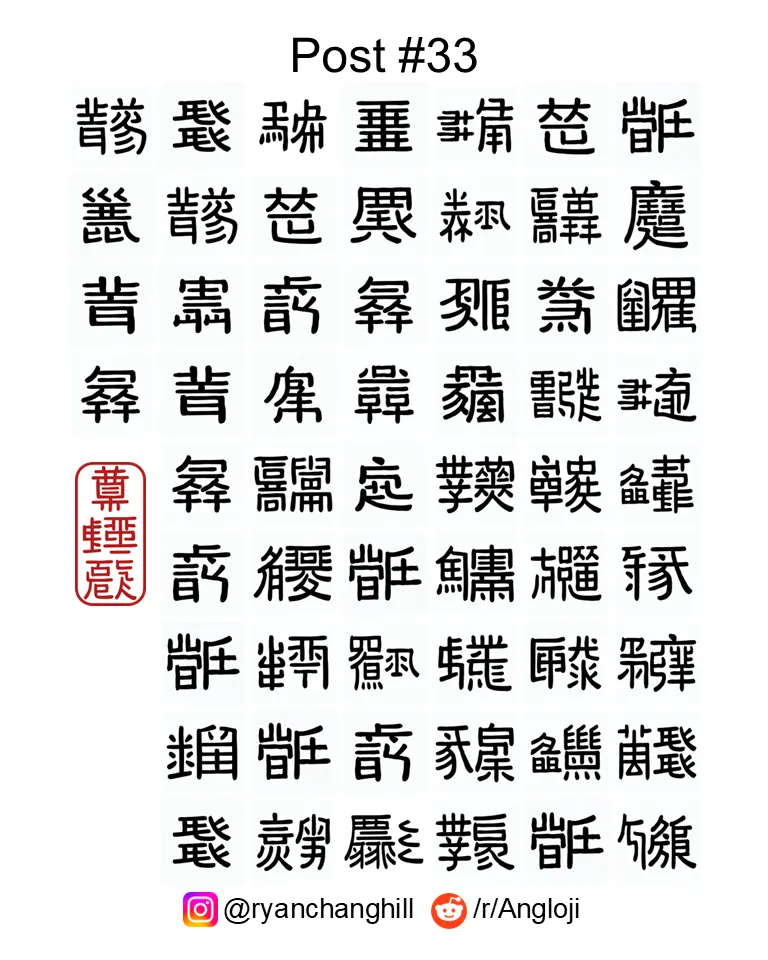
The English sounds are chosen based on phonetic similarity, as determined most often by taking words' IPA notations doing Levenshtein distance calculation with them, and then grouping them. Some words in a group may be rather distant from others, though, due to the fact that English is not as homophonic as Chinese and that I have also sometimes assigned unique characters to longer words without breaking them down as such (for example, both "wisdom" and "wise" exist as glyphs).
The Yingzi article grouped the words by rhymes, but words in Angloji phonetic groupings do not necessarily rhyme with each other.
Also, some of the phonetic groups are larger than others, and this means that if there are multiple words whose sounds and abstract meanings are similar, then they would have to be classified into a different phonetic group or be assigned a rather less fitting semantic group.
I crafted the graphic components based on the clerical script style of Chinese characters, particularly those found in
好太王碑/廣開土大王陵碑.
I admit my eyes aren't doing great lately, but I can't find your explanation of the characters. I found the inspiration and a translation of the characters - is that what you mean?
That is what I meant; I should have been more clear.
You absolutely nailed the hanzi aesthetic, although the graphic complexity reminds me of Tangut—there don't seem to be any pictographic characters akin to 日, 口, 刀, 女, etc. although this is probably an artifact of what you chose to translate. What are some of the simplest characters you have by stroke count?
Some of the semantic components used are themselves as standalone characters, and the phonetic components are also independent characters as well; these are the simpler ones, and the lowest stroke count is 3. Overall, I went complex because I saw this project as an artistic rather than a practical one, and wanted to avoid anything too close to existing real characters in Chinese or other writing systems.
How many characters would an average person know, in a hypothetical world where this was used instead of the Latin alphabet?
Interesting question! I imagine that, in an imaginary Anglophone country where this were the official writing system, there would be around 2000 characters that are considered to be the standard for a high school graduate. This is similar to the number of
joyo kanji in Japanese currently sitting at 2136. In such a nation, the official recommendation for writing vocabulary with rarer morphemes would likely be to use a combination of characters in the list, whose combination has a different reading than what would be expected from the individual characters, as in Japanese
jukujikun.
How do you keep track of all ten thousand? Do you have some sort of thematic dictionary?
I do keep a database of the characters. When I release a dictionary, I will likely release them either ordered by their phonetic components or by their English spellings.