Agreed.WeepingElf wrote: ↑Wed Aug 20, 2025 3:52 am I consider English spelling reforms a hopeless cause because the phonology, especially the vowel system, varies between regions, so whatever you do, there will be people who claim that you spell the same sound differently, different sounds the same, or both at the same time, and will thus mark your system off as a failure. Yet, it is a legitimate pursuit to play with alternative spellings of English.
Angloji - logographic English writing system
Re: Angloji - logographic English writing system
Conlangs: Scratchpad | Texts | antilanguage
Software: See http://bradrn.com/projects.html
Other: Ergativity for Novices
(Why does phpBB not let me add >5 links here?)
Software: See http://bradrn.com/projects.html
Other: Ergativity for Novices
(Why does phpBB not let me add >5 links here?)
Re: Angloji - logographic English writing system
I've played with English spelling reform in the past and have come to the conclusion that it is hopeless myself. If anything, I have come to the conclusion that the present English orthography is actually a good thing specifically because it is rather dialect-independent by its very nature.bradrn wrote: ↑Wed Aug 20, 2025 4:54 amAgreed.WeepingElf wrote: ↑Wed Aug 20, 2025 3:52 am I consider English spelling reforms a hopeless cause because the phonology, especially the vowel system, varies between regions, so whatever you do, there will be people who claim that you spell the same sound differently, different sounds the same, or both at the same time, and will thus mark your system off as a failure. Yet, it is a legitimate pursuit to play with alternative spellings of English.
Yaaludinuya siima d'at yiseka wohadetafa gaare.
Ennadinut'a gaare d'ate eetatadi siiman.
T'awraa t'awraa t'awraa t'awraa t'awraa t'awraa t'awraa.
Ennadinut'a gaare d'ate eetatadi siiman.
T'awraa t'awraa t'awraa t'awraa t'awraa t'awraa t'awraa.
Re: Angloji - logographic English writing system
(If anything, a more phonemic or phonetic orthography would make it easier to strongly impose a single standard pronunciation on the speakers of a given language.)
Yaaludinuya siima d'at yiseka wohadetafa gaare.
Ennadinut'a gaare d'ate eetatadi siiman.
T'awraa t'awraa t'awraa t'awraa t'awraa t'awraa t'awraa.
Ennadinut'a gaare d'ate eetatadi siiman.
T'awraa t'awraa t'awraa t'awraa t'awraa t'awraa t'awraa.
-
RyanChangHill
- Posts: 18
- Joined: Sat Aug 09, 2025 6:25 pm
Re: Angloji - logographic English writing system
German words with Angloji:
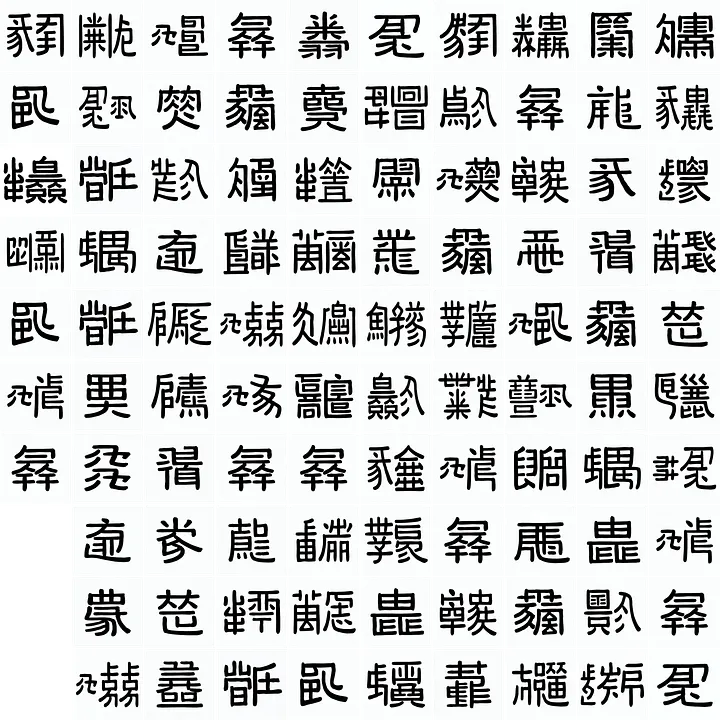
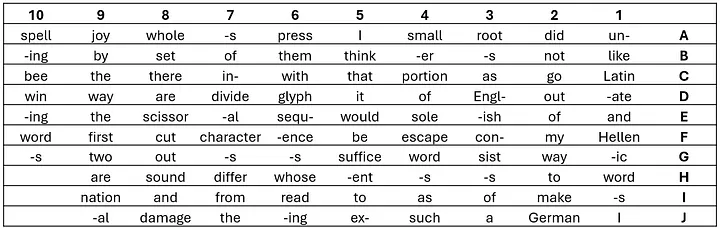
https://medium.com/@changhillryan/germa ... c497919785In any case, as much as I would love to learn every language that exists and create Angloji characters for every one of their words, I cannot realistically do so. As such, I must resort to providing options to either transliterate them or to write them like the previously mentioned jukujikun, the Japanese practice of taking kanji sequences and assigning them readings that are wholly different from what would be expected from the standard readings of each kanji.
-
quinterbeck
- Posts: 445
- Joined: Sat Jul 21, 2018 12:19 pm
Re: Angloji - logographic English writing system
I will put my opinion in and say I think this is an interesting project! When it comes to board users, I think we like in-depth descriptions of people's projects, and to offer praise, critiques, alternatives etc. So, like others, I'd like to browse the character set, and see explanations of different types of interrelations between characters.
For example, I notice that there are very common english morphemes, such as the plural, and comparative -er, which are written with quite complex characters. How did that come about in your design process? With their high frequency and few phonemes I would expect them to have simple characters with few strokes. Chinese text, as a comparison, often contains characters with fewer strokes alongside those with higher stroke count.
My impression is that the approach is very synchronic, as in, developed for English as it exists today. Is that right? It would be interesting to see a diachronic project, e.g. a character set for Old English and then modified for the Old French and Latinate vocabulary as it enters the language. Maybe ending up with a kunyomi/onyomi style system, or something else.
For example, I notice that there are very common english morphemes, such as the plural, and comparative -er, which are written with quite complex characters. How did that come about in your design process? With their high frequency and few phonemes I would expect them to have simple characters with few strokes. Chinese text, as a comparison, often contains characters with fewer strokes alongside those with higher stroke count.
My impression is that the approach is very synchronic, as in, developed for English as it exists today. Is that right? It would be interesting to see a diachronic project, e.g. a character set for Old English and then modified for the Old French and Latinate vocabulary as it enters the language. Maybe ending up with a kunyomi/onyomi style system, or something else.
Re: Angloji - logographic English writing system
Sounds like a considerable challenge...though, perhaps take the current project, and go back in time with it, shedding "Viking/Latinate/Old French" vocabulary as one moves further to earlier dates, until arriving at what the project would look like under Old English...and then either continue onwards, or flesh it out further (which could also be done earlier while heading further back in time)quinterbeck wrote: ↑Sat Aug 23, 2025 6:09 amMy impression is that the approach is very synchronic, as in, developed for English as it exists today. Is that right? It would be interesting to see a diachronic project, e.g. a character set for Old English and then modified for the Old French and Latinate vocabulary as it enters the language. Maybe ending up with a kunyomi/onyomi style system, or something else.
No matter what is decided, please keep up the great work, and have fun.
-
RyanChangHill
- Posts: 18
- Joined: Sat Aug 09, 2025 6:25 pm
Re: Angloji - logographic English writing system
New article
Jukujikun words have long been a fascination of mine, particularly in their usage with names. The unpredictability of Japanese place names and surnames like Hase (長谷) or Shinonome (東雲) is endless, and there is always something new to learn. English names are no less multifarious from their long histories of documented phonetic changes, not to mention the massive number of borrowings from non-English languages. Japanese has a few loanword assignments to phonetically unrelated kanji sequences in a similar vein, such as rakko (海獺, meaning sea otter, from the Ainu word meaning the same) and kudara (百濟, referring to the ancient Korean kingdom of Baekje, from a yet unknown Old Korean term). It is always a fun intellectual exercise to track the origins of proper nouns, and even more exciting to assign Angloji characters to them based on the etymological findings. Here, I demonstrate this with the two aforementioned fighters’ names.
-
RyanChangHill
- Posts: 18
- Joined: Sat Aug 09, 2025 6:25 pm
Re: Angloji - logographic English writing system
The reason I give everyone for the complexity of the common characters is that I had to do this in order to avoid any existing glyphs, whether as a rare variant Chinese character or as part of any other writing system. Tangut did this, and Chinese itself also has a few characters which, despite their being common, are also rather complex, like 爲.quinterbeck wrote: ↑Sat Aug 23, 2025 6:09 am I will put my opinion in and say I think this is an interesting project! When it comes to board users, I think we like in-depth descriptions of people's projects, and to offer praise, critiques, alternatives etc. So, like others, I'd like to browse the character set, and see explanations of different types of interrelations between characters.
For example, I notice that there are very common english morphemes, such as the plural, and comparative -er, which are written with quite complex characters. How did that come about in your design process? With their high frequency and few phonemes I would expect them to have simple characters with few strokes. Chinese text, as a comparison, often contains characters with fewer strokes alongside those with higher stroke count.
My impression is that the approach is very synchronic, as in, developed for English as it exists today. Is that right? It would be interesting to see a diachronic project, e.g. a character set for Old English and then modified for the Old French and Latinate vocabulary as it enters the language. Maybe ending up with a kunyomi/onyomi style system, or something else.
It was created for modern English, and I am considering creating characters for Latin, albeit in a different style and likely with unrelated shapes for the most part.
-
quinterbeck
- Posts: 445
- Joined: Sat Jul 21, 2018 12:19 pm
Re: Angloji - logographic English writing system
Why did you have to avoid existing glyphs?RyanChangHill wrote: ↑Fri Sep 19, 2025 8:51 am The reason I give everyone for the complexity of the common characters is that I had to do this in order to avoid any existing glyphs, whether as a rare variant Chinese character or as part of any other writing system.
Re: Angloji - logographic English writing system
It should be remembered here that both kanji and hanja specifically share character forms with hanzi, to the point that Han unification could be carried out with (a level of) success.quinterbeck wrote: ↑Wed Sep 24, 2025 12:16 amWhy did you have to avoid existing glyphs?RyanChangHill wrote: ↑Fri Sep 19, 2025 8:51 am The reason I give everyone for the complexity of the common characters is that I had to do this in order to avoid any existing glyphs, whether as a rare variant Chinese character or as part of any other writing system.
Yaaludinuya siima d'at yiseka wohadetafa gaare.
Ennadinut'a gaare d'ate eetatadi siiman.
T'awraa t'awraa t'awraa t'awraa t'awraa t'awraa t'awraa.
Ennadinut'a gaare d'ate eetatadi siiman.
T'awraa t'awraa t'awraa t'awraa t'awraa t'awraa t'awraa.
-
zompist
- Site Admin
- Posts: 4373
- Joined: Sun Jul 08, 2018 5:46 am
- Location: Right here, probably
- Contact:
Re: Angloji - logographic English writing system
However, Tangut does not work this way.
Re: Angloji - logographic English writing system
Yaaludinuya siima d'at yiseka wohadetafa gaare.
Ennadinut'a gaare d'ate eetatadi siiman.
T'awraa t'awraa t'awraa t'awraa t'awraa t'awraa t'awraa.
Ennadinut'a gaare d'ate eetatadi siiman.
T'awraa t'awraa t'awraa t'awraa t'awraa t'awraa t'awraa.
Re: Angloji - logographic English writing system
This is just my guess: either to...quinterbeck wrote: ↑Wed Sep 24, 2025 12:16 amWhy did you have to avoid existing glyphs?RyanChangHill wrote: ↑Fri Sep 19, 2025 8:51 am The reason I give everyone for the complexity of the common characters is that I had to do this in order to avoid any existing glyphs, whether as a rare variant Chinese character or as part of any other writing system.
a. avoid repeated PMs to the tune of "but you can't make that be the sign for toothpaste, because its the sign for horse!"
b. use it as a design challenge.
-
RyanChangHill
- Posts: 18
- Joined: Sat Aug 09, 2025 6:25 pm
Re: Angloji - logographic English writing system
Both reasons are true. It was also:This is just my guess: either to...
a. avoid repeated PMs to the tune of "but you can't make that be the sign for toothpaste, because its the sign for horse!"
b. use it as a design challenge.
- I wanted to avoid any potential copyright issues, in the small chance that it somehow becomes commercially viable.
- I really enjoyed making the glyphs themselves, that was a big part of the fun.
- I felt that there were still plenty of permutations of strokes and and shapes that could be combined to create new kanji-like glyphs, and wanted to explore them as much as I could. I am currently planning another project, this time using the seal script (篆書) style, which gives me more freedom.
Re: Angloji - logographic English writing system
I'm pretty sure that the vast majority of the contents of most if not all Siniform scripts aren't copywritten. Specific combinations, such as in company names, might be legally protected - but thats true of what you'd find in any script's users.RyanChangHill wrote: ↑Fri Sep 26, 2025 7:28 pmBoth reasons are true. It was also:This is just my guess: either to...
a. avoid repeated PMs to the tune of "but you can't make that be the sign for toothpaste, because its the sign for horse!"
b. use it as a design challenge.
- I wanted to avoid any potential copyright issues, in the small chance that it somehow becomes commercially viable.

Last edited by keenir on Sat Sep 27, 2025 4:06 pm, edited 1 time in total.
Re: Angloji - logographic English writing system
Did you forget a ‘not’ in the first sentence?keenir wrote: ↑Fri Sep 26, 2025 8:14 pmI'm pretty sure that the vast majority of the contents of most if not all Siniform scripts are copywritten. Specific combinations, such as in company names, might be legally protected - but thats true of what you'd find in any script's users.RyanChangHill wrote: ↑Fri Sep 26, 2025 7:28 pmBoth reasons are true. It was also:This is just my guess: either to...
a. avoid repeated PMs to the tune of "but you can't make that be the sign for toothpaste, because its the sign for horse!"
b. use it as a design challenge.
- I wanted to avoid any potential copyright issues, in the small chance that it somehow becomes commercially viable.
Conlangs: Scratchpad | Texts | antilanguage
Software: See http://bradrn.com/projects.html
Other: Ergativity for Novices
(Why does phpBB not let me add >5 links here?)
Software: See http://bradrn.com/projects.html
Other: Ergativity for Novices
(Why does phpBB not let me add >5 links here?)

Re: Angloji - logographic English writing system
In other words, the conscripting equivalent of what I once did, when I decided that the root of "to eat" would be /ʃunt-/, forgetting that I'd decided to transcribe /ʃ/ as <c>.keenir wrote: ↑Fri Sep 26, 2025 2:56 pmThis is just my guess: either to...quinterbeck wrote: ↑Wed Sep 24, 2025 12:16 amWhy did you have to avoid existing glyphs?RyanChangHill wrote: ↑Fri Sep 19, 2025 8:51 am The reason I give everyone for the complexity of the common characters is that I had to do this in order to avoid any existing glyphs, whether as a rare variant Chinese character or as part of any other writing system.
a. avoid repeated PMs to the tune of "but you can't make that be the sign for toothpaste, because its the sign for horse!"
mais grand il tour, mais rapid e fort e spes caze la merda
Re: Angloji - logographic English writing system
D'oh, yes. Thank you.bradrn wrote: ↑Sat Sep 27, 2025 3:09 amDid you forget a ‘not’ in the first sentence?keenir wrote: ↑Fri Sep 26, 2025 8:14 pmI'm pretty sure that the vast majority of the contents of most if not all Siniform scripts aren't copywritten. Specific combinations, such as in company names, might be legally protected - but thats true of what you'd find in any script's users.RyanChangHill wrote: ↑Fri Sep 26, 2025 7:28 pm
Both reasons are true. It was also:
- I wanted to avoid any potential copyright issues, in the small chance that it somehow becomes commercially viable.
Edited.
-
RyanChangHill
- Posts: 18
- Joined: Sat Aug 09, 2025 6:25 pm
Re: Angloji - logographic English writing system
I think sequences of words or characters are not copywritten or copywritable, but perhaps glyphs may be if made for artistic purposes by an individual. Conlang copyright is murky in general. I don't think I would get into trouble if I used any glyph shapes that are too similar to some rare Chinese character variants, but there would be more issues if I did that with a character from Xu Bing's A Book from the Sky.keenir wrote: ↑Fri Sep 26, 2025 8:14 pmI'm pretty sure that the vast majority of the contents of most if not all Siniform scripts aren't copywritten. Specific combinations, such as in company names, might be legally protected - but thats true of what you'd find in any script's users.RyanChangHill wrote: ↑Fri Sep 26, 2025 7:28 pmBoth reasons are true. It was also:This is just my guess: either to...
a. avoid repeated PMs to the tune of "but you can't make that be the sign for toothpaste, because its the sign for horse!"
b. use it as a design challenge.
- I wanted to avoid any potential copyright issues, in the small chance that it somehow becomes commercially viable.
-
Man in Space

- Posts: 2604
- Joined: Sat Jul 21, 2018 1:05 am
Re: Angloji - logographic English writing system
IANAL, but the way the relevant legislation reads:RyanChangHill wrote: ↑Sat Sep 27, 2025 7:53 pmI think sequences of words or characters are not copywritten or copywritable, but perhaps glyphs may be if made for artistic purposes by an individual. Conlang copyright is murky in general. I don't think I would get into trouble if I used any glyph shapes that are too similar to some rare Chinese character variants, but there would be more issues if I did that with a character from Xu Bing's A Book from the Sky.keenir wrote: ↑Fri Sep 26, 2025 8:14 pmI'm pretty sure that the vast majority of the contents of most if not all Siniform scripts aren't copywritten. Specific combinations, such as in company names, might be legally protected - but thats true of what you'd find in any script's users.RyanChangHill wrote: ↑Fri Sep 26, 2025 7:28 pm
Both reasons are true. It was also:
- I wanted to avoid any potential copyright issues, in the small chance that it somehow becomes commercially viable.
It was held that shorthand could not be copyrighted (Brief English Systems v. Owen). More recently, in 2004, the USCO held, on appeal, that D’ni writing glyphs would be denied registration (PDF).17 USC § 102(b) wrote:In no case does copyright protection for an original work of authorship extend to any idea, procedure, process, system, method of operation, concept, principle, or discovery, regardless of the form in which it is described, explained, illustrated, or embodied in such work.
You probably could—whether it is, to understate, a good idea or not is a different matter.
