Angloji - logographic English writing system
Posted: Thu Aug 14, 2025 11:35 pm
Not sure if this is the right forum to post in, since I am working with English rather than a conlang, but here goes.
I came across the Yingzi article many years ago, and I thought that creating a full-fledged system for English might be an interesting artistic project for me to take on. As such, I developed the idea of a Japanese/Chinese-like English writing system for the past few years.
I created a set of over 10,000 characters with which English could be written. I started by first designing a large number of standalone characters (pictograms, ideograms - many are very abstract and not readily recognizable), and then combining them as semantic-phonetic pairs (形聲字). There are also some combinations whose meanings come together to create new meanings (會意字).
Another important feature I implemented is the usage of character combinations whose normal readings are not used, but instead have a completely different reading, inspired by jukujikun (熟字訓) in Japanese.
I wrote an example text here, with explanation of the characters to be found here.
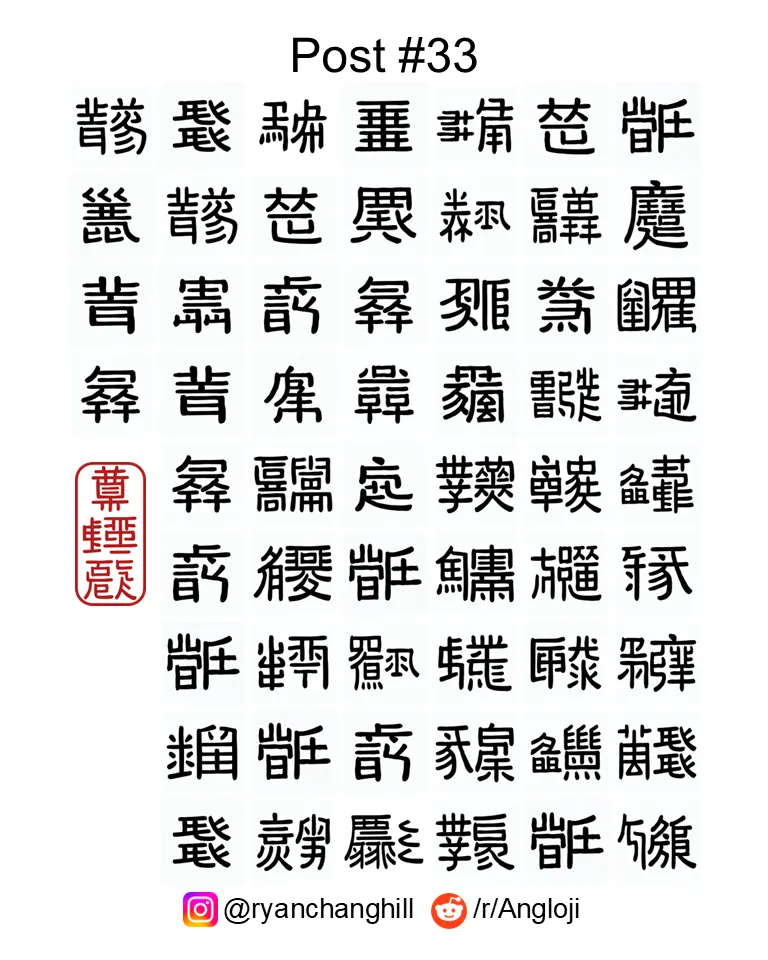
More can be found on my subreddit (/r/Angloji) and my Instagram (@ryanchanghill), and I will post here regularly as well.
I came across the Yingzi article many years ago, and I thought that creating a full-fledged system for English might be an interesting artistic project for me to take on. As such, I developed the idea of a Japanese/Chinese-like English writing system for the past few years.
I created a set of over 10,000 characters with which English could be written. I started by first designing a large number of standalone characters (pictograms, ideograms - many are very abstract and not readily recognizable), and then combining them as semantic-phonetic pairs (形聲字). There are also some combinations whose meanings come together to create new meanings (會意字).
Another important feature I implemented is the usage of character combinations whose normal readings are not used, but instead have a completely different reading, inspired by jukujikun (熟字訓) in Japanese.
I wrote an example text here, with explanation of the characters to be found here.
More can be found on my subreddit (/r/Angloji) and my Instagram (@ryanchanghill), and I will post here regularly as well.
