So here's what I wrote after that discussion:
This is meant as a brief overview of what it can mean for you, physically, if temperatures where you are get close to or drop below freezing. I'm writing it because I think it might be interesting or useful for people from warmer places who have little or no experiences with freezing weather themselves, and who want to know how that's like - perhaps for fiction they're working on. Perhaps it might even be useful as a conworlding resource.
So, some basics. The freezing point of non-salty water at the usual air pressures of places that aren't too high above sea level is at or very close to a temperature that's called zero degrees in Celsius and 32 degrees in Fahrenheit. (Yes, physicists, I know. You can stop yelling at me. I know that I'm grossly oversimplifying things. I'm trying to use everyday terminology here.) There are parts of the world where it never or almost never gets that cold; there are parts of the world where it sometimes gets that cold; and there are parts of the world where it's often or even always that cold.
The two main interesting forms that water takes at freezing temperatures are solid ice and snow. Solid ice is a very hard and very heavy substance that can sometimes be transparent - mainly when the piece of ice you're dealing with is small or thin - but is often white. It also has the annoying feature that its surface is extremely smooth and slippery, so that it's often difficult or impossible to get any kind of grip on it.
I'm too lazy to explain in detail what exactly snow
is, from the perspective of physicists, here. Let's just say that it's usually quite soft, at least when it has fallen recently, and white, except if it has gotten dirty. It can sometimes be a kind of powder, but more often, at least where I live, it has a texture that makes it clump.
When liquid water freezes, you usually end up with solid ice. Getting snow is a lot more complicated. Most of the time, it only happens inside clouds, though there's also technology to do it artificially these days.
As far as I know, what I'm about to write now is not something specialists say; it's a classification I've invented for this post. (Correct me if other people have come up with it before.) But I think for practical purposes, freezing weather can be divided into at least three main scenarios:
1) It's a little bit below freezing, or perhaps things move back and forth between a little bit below freezing and a little bit above freezing.
2) It's a few degrees below freezing for a while.
3) It's
many degrees below freezing for a while.
All three of these scenarios have their upsides and their downsides. I only have experiences with the first two scenarios myself (at least as far as I can remember), because I've never been to places where the third scenario is common.
The main problem with the first scenario is that you might get really a lot of thin layers of ice on the ground and other surfaces outside. Perhaps you get rain, and then the rain freezes when it hits the ground. That's called "freezing rain". Or perhaps you get some snow, and then it melts, and then it freezes again, becoming a layer of ice.
That is
really bad, because ice is so slippery. Cars often can't drive any more, and people often can't walk any more. It can become seriously difficult for life to go on.
Now, you can try to mitigate ice by spreading sand on the ground, to give people and cars some chance of getting a grip. But there are limits to how well that works. Another possible method is to spread salt on the ground. Salty water freezes at a somewhat lower temperature than fresh water, so if it's no more than a few degrees below freezing, you can try to melt ice by putting salt on it. Of course it only makes sense to even prepare to do that in places where Scenarios 1 and 2 are fairly common, and Scenario 3 is less common.
In Scenario 2, you're more likely to get a fair amount of snow. This has the advantage that it's usually less slippery than ice. You can still slip and fall if you're walking on snow, though, or get wheelspin if you're driving a car. And of course your car might get stuck, and you might find it difficult to walk. Cars will usually drive slowly, and people will usually walk carefully.
In both Scenario 1 and Scenario 2, people can and often do use antifreeze, a special chemical mixture which is liquid and freezes at lower temperatures than water, to keep water in places where it's exposed to cold from freezing. De-icing sprays can remove ice from windows and windshields. There are limits to how cold it can get for these things to keep working, though.
While freshly fallen snow is, as I mentioned, usually quite soft, once enough people have walked or cars have driven across a layer of snow, it will have been pounded into something less thick and a good deal harder, where feet barely or not at all leave footprints. That kind of snow can be slippery, though.
Places where Scenarios 1 and 2 happen can be divided into those where these scenarios usually happen a few times a year for brief time periods, and those where they happen often and for longer time periods. In the first kind of place, which is the only kind of place that I really have experience with, either of these scenarios might lead to ordinary life grinding to a halt until it gets warmer. In the second kind of place, that would be very impractical, so people there might have found better ways to cope and keep life going.
Perhaps the biggest drawback of the second scenario is that it can easily and quickly turn into the first scenario. That's less of a problem in the third scenario. Once you get to the third scenario, things can get really uncomfortable, and sometimes downright weird.
In both the first and the second scenario, you can usually leave a patch of naked skin exposed to the fresh air outside for a short time without problems. It's not most people's idea of fun, but it's doable. After all, some people like jumping into icy water naked or almost naked, too. But get far enough into the third scenario, and leaving
any skin exposed to the cold becomes a worse and worse idea. It can lead to serious injuries.
Once it gets cold enough, if you're a cis man, and you're outside, and you want to go to a more or less secluded spot to urinate, you should better finish quickly, or the cold might do nasty things to your penis.
Then there's the effect of really cold temperatures on metal. Once it gets cold enough, some metals become brittle like glass, so that, if you let something made out of one of these metals drop top the ground, it will shatter like something made out of glass would.
The one advantage of Scenario 3 is that it's less likely than Scenario 2 to quickly turn into Scenario 1.
Both Scenario 2 and Scenario 3 can lead to water pipes bursting. Ice takes up a bit more space than the same amount of liquid water. If you take a liter or a gallon of liquid water and freeze it, you get more than a liter or a gallon of ice. If the water is in a pipe when it freezes, you get more ice than would fit into the pipe. So it bursts.
All three scenarios can, and the second and third scenario usually will, involve icicles. That is, a kind of stalactites made of ice that hang down from the edges of roofs and similar things.
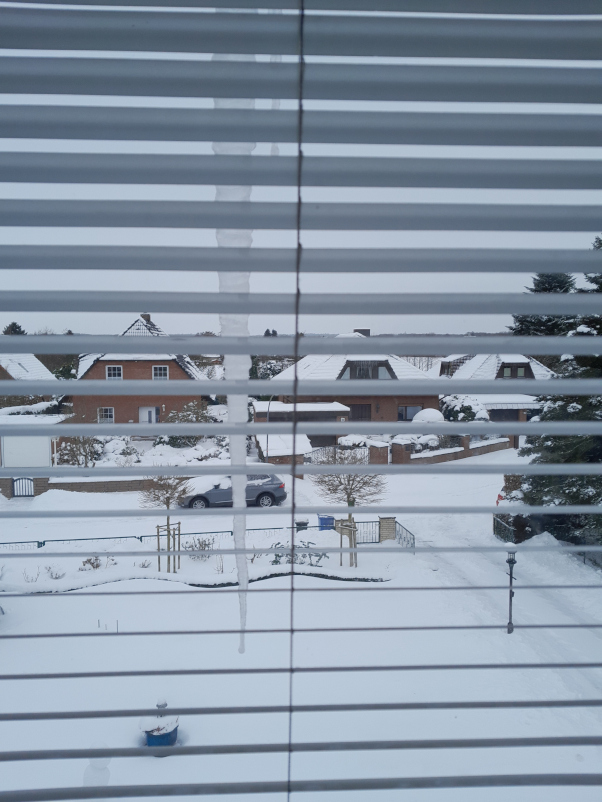
- icicle.jpg (213.63 KiB) Viewed 10881 times
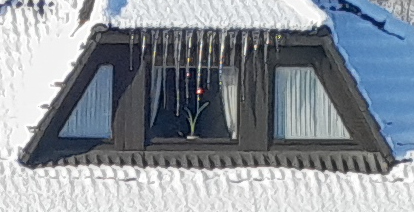
- iciclerow.jpg (60.47 KiB) Viewed 10881 times
If you're from a place where you know icicles mainly from movies, you might not think about them much. Depending on your aesthetic preferences, you might think of them as pretty. How can something that's made of a solid form of water and that looks pretty be worth worrying about?
But icicles are serious business. They consist of a material that is both hard and heavy, they're pointy, and they usually sooner or later fall down, sometimes from a great height, with their pointy end pointing downwards. They'll smash through your skull and your brain, and the only thing you can do about it is to try to reduce the risk by spending as little time as possible under the edges of roofs and in other places where they might form.
If there's a layer of ice on top of a lake or pond, it's possible that people, children or adults, will try to walk on the ice when it's not really strong enough to carry their weight. Perhaps just for fun, or perhaps to show off how daring they are. That is very bad. It's one of the ways to die in that kind of weather.
In my experience, children in sometimes snowy places tend to like snow a lot more than adults. I don't know how universal that is, though.
In most places where things get cold, they sooner or later get warmer again. Eventually, temperatures are above freezing. That means things can only get better for the moment, right? Not necessarily.
A minor point is the aesthetic side of things. Melting snow often looks a lot uglier than safely frozen snow. It can be very grey and dirty. Especially if it gets mixed with the sand that people had previously spread on top of it to enable walking and driving. Picturesque landscapes turn drab. But more important is the fact that a seriously snow-covered area contains a lot of what is, after all, water, in a solid form. Once it melts, you get a lot of newly liquid water in places where there previously was none. As you might guess, this can lead to problems. In places like that, at those times of the year, a certain amount of flooding is common.
That's all I can think of on this topic for now. Did I forget anything important?