Far stranger things have happened: e.g. the Austronesian languages where all nouns begin with /n/ (due to fusion of a former article).
Conlang Random Thread
Re: Conlang Random Thread
Conlangs: Scratchpad | Texts | antilanguage
Software: See http://bradrn.com/projects.html
Other: Ergativity for Novices
(Why does phpBB not let me add >5 links here?)
Software: See http://bradrn.com/projects.html
Other: Ergativity for Novices
(Why does phpBB not let me add >5 links here?)
Re: Conlang Random Thread
I think the system you have is fine, but if you really want more variation what I would suggest is removing the final consonant of one of the animate singular and one of the inanimate singular endings (e.g. have the animate accusative and inanimate genitive end in a bare stem vowel).
Yaaludinuya siima d'at yiseka wohadetafa gaare.
Ennadinut'a gaare d'ate eetatadi siiman.
T'awraa t'awraa t'awraa t'awraa t'awraa t'awraa t'awraa.
Ennadinut'a gaare d'ate eetatadi siiman.
T'awraa t'awraa t'awraa t'awraa t'awraa t'awraa t'awraa.
Re: Conlang Random Thread
Whoa really? Do you remember the name of this language, apart presumably from starting with /n/?
Intelligentia artificiālis dēlenda est.
Idiot America | He/him
Idiot America | He/him
Re: Conlang Random Thread
Sakao, amongst others. Apparently it’s quite widespread in the region. However, it looks like in all the languages where this occurs, some subclasses of nouns are excluded, most usually animate nouns (which took a different article originally). Also, it seems common for the initial /n/ to disappear in closely-bound constructions like noun compounds.
Conlangs: Scratchpad | Texts | antilanguage
Software: See http://bradrn.com/projects.html
Other: Ergativity for Novices
(Why does phpBB not let me add >5 links here?)
Software: See http://bradrn.com/projects.html
Other: Ergativity for Novices
(Why does phpBB not let me add >5 links here?)
Re: Conlang Random Thread
I was thinking, maybe the i-stem and u-stem inanimate genitive singular cases could be long vowels, but I started to cook with hyper-reducing the cases. Kinda reminds me like Pashto or Hindi/UrduTravis B. wrote: ↑Mon Mar 16, 2026 6:36 pm I think the system you have is fine, but if you really want more variation what I would suggest is removing the final consonant of one of the animate singular and one of the inanimate singular endings (e.g. have the animate accusative and inanimate genitive end in a bare stem vowel).
Animate a-stem
|
Animate i-stem
|
Animate u-stem
|
Inanimate a-stem
|
Inanimate i-stem
|
Inanimate u-stem
|
gībā asmas
wing-CNS.INAN.NOM.PL eagle.GVS-AN.GEN.SG
"the eagle's wings"
Last edited by Ahzoh on Fri Mar 20, 2026 5:44 pm, edited 2 times in total.

Re: Conlang Random Thread
You don't need 'knowledge' of sound changes per se. I assume you have enough knowledge to know that k > l doesn't go, but m > b does, for example. But it's impossible to suggest more differentiated endings without knowing more about the phonology and phonitactics of the language proper.
EDIT: You could also look at harmonizing patterns, like having the -ili in the plurals become -ini (l > n isn't an unusual sound change) because of the n in the other forms.
JAL
Re: Conlang Random Thread
What I mean is turning something like /lɛsp-ʔətsɒpʰ-ə-sə/ into /lɛsp:su:ɛsi:/. These aren't crazy sound changes, but they're not something I would immediately come up with.
Nor would I immediately come up with the sort of shenanigans Tiramisu did to turn <inpandārāzna> into <pindās>
These kinda things would take me months, maybe years to get such inspiration. Yet people can casually rattle these off onto a quick-n-dirty scratchpad.
And it's not like I haven't spent significant amounts of time pouring over a variety of attested and theoretically plausible sound changes.
But it's impossible to suggest more differentiated endings without knowing more about the phonology and phonitactics of the language proper.
- Syllable structure is CV(:)(C), Superheavy syllables (CV:C) are dispreferred and usually result from vowel coalescence which in turn form from intervocalic elision of weak consonants (glides and laryngeals). They may be left alone (/ˈka.pi.ʔas/ > /ˈka.pi.as/ > /ka.ˈpa:s/) or shortened (/na.ˈhab.bis/ > /na.ˈab.bis/ > /ˈna:b.bis/ > /ˈnab.bis/).
- Weak consonants that are adjacent to strong consonants (in front or behind) elide and lengthen the preceding vowel.
- Stress falls on the heaviest non-final syllable; if there are no heavy non-final syllables then stress is on the penultimate (two syllables) or antepenultimate (more than two syllables).
- There cannot be more than two unstressed light syllables in a row; it is not allowed and at least one of the vowels must elide or lengthen
- Word-final short vowels are subject to elision, especially if it's in the third weak syllable in a row; the second-final short vowel might elide or lengthen instead.
/m n ŋ/ <m n n̮>
/pʰ pʼ b tʰ tʼ d kʰ kʼ g ʔ/ <p ṗ b t ṭ d k ḳ g ʔ>
/f s sʼ z ɬ ɬʼ ɮ x/ <f s ṣ z ś ṣ́ ź ḫ>
/w r l j// <w r l y>
And, of course, /e e:/ come mainly from the elision of pharyngeals, while /Vj Vi/ bcome /i:/ and /Vw Vu/ become /u:/.
Re: Conlang Random Thread
I have to opposite problem, I always see these wild possibilities and then something like Alũbetah happens :D.Ahzoh wrote: ↑Tue Mar 17, 2026 4:00 amNor would I immediately come up with the sort of shenanigans Tiramisu did to turn <inpandārāzna> into <pindās>
JAL
Re: Conlang Random Thread
My latest verb morphology is something of a blend of Semitic and Ojibwe. A notable rip off of Ojibwe is the form of the verb known as the "conjunct", which is used for dependent and relative clauses among other things.
Though I think maybe the conjunct verb forms should all have suffixes
Parraḫni ramṣā!
When I speak, you listen/hear!
Strong Independent
|
Strong Conjunct
|
Strong Conjunct
|
Parraḫni ramṣā!
When I speak, you listen/hear!
Re: Conlang Random Thread
Cool, that is some interesting allophony.
 .
.The hexadecimal approach is certainly appealing from an abstract conceptual standpoint and the fact that the numerals work so well. That said, it also feels distinctly artificial even by the standards of my highly stylized minimalist project. At the very least, I would need to work on humanizing the system as it were.
Intelligentia artificiālis dēlenda est.
Idiot America | He/him
Idiot America | He/him
Re: Conlang Random Thread
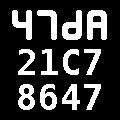
Perhaps it would be sufficient to adopt a more handwritten style? I played around a bit with my broad-edged nib and came up with this alternate style, as well as an attempt at a ballpoint adaption:
- malloc-numerals.jpeg (102.06 KiB) Viewed 2527 times
(Please forgive the mistakes…)
Conlangs: Scratchpad | Texts | antilanguage
Software: See http://bradrn.com/projects.html
Other: Ergativity for Novices
(Why does phpBB not let me add >5 links here?)
Software: See http://bradrn.com/projects.html
Other: Ergativity for Novices
(Why does phpBB not let me add >5 links here?)
Re: Conlang Random Thread
That really is amazing. You could make quite a good career as a calligrapher. That said, my point is more that human languages rarely use binary or anything approximating it. The system I've sketched makes sense if you're already familiar with mathematics and especially computer science but would feel quite alien to someone intuitively counting with their fingers. Nobody would naturally think to count "one two two-one four four-one..." after all.
Intelligentia artificiālis dēlenda est.
Idiot America | He/him
Idiot America | He/him
Re: Conlang Random Thread
Thanks! Though if you look at it more closely it’s a bit too irregular to be really good.
Yes, but counting ‘one, two, three, four, five… fifteen, sixteen, one-zero’ is a lot less unnatural. To me the internal structure of the numerals is just a neat design detail, sort of like how Hangeul letters have phonetically justified shapes.Nobody would naturally think to count "one two two-one four four-one..." after all.
Conlangs: Scratchpad | Texts | antilanguage
Software: See http://bradrn.com/projects.html
Other: Ergativity for Novices
(Why does phpBB not let me add >5 links here?)
Software: See http://bradrn.com/projects.html
Other: Ergativity for Novices
(Why does phpBB not let me add >5 links here?)

Re: Conlang Random Thread

The refined phonology.
Re: Conlang Random Thread
Contemplating another adverbial case marker, which I call the instrumental-locative. Mainly used to describe means by which certain actions are done (go by foot, hit/strike by hand, kill it with fire, etc.), but it can also indicate direction (pour into the vessel) or path (gandē namātā "through the mountain(s) we went"). Like the equative, it is another means by which adverbs are conveyed.
The morpheme is -ʕ(V), which due to sound changes results in the case being the same in every paradigm and syncretic in number
Maybe I'll have limited passives such as "X died by Y" = "X was killed by Y"
Bonus sentence:
Mātnin gandē napraḫ ʔAsmas ʔit=tarmaṣ nīya
[ˈmɑ̂ːt.nin ˈgɑ́n.deː ˈnɑ́p.rɑx ˈʔɑ́s.mɑs ʔit.ˈtár.masʼ ˈnîː.jɑ] (Imperial)
[ˈmɑːtʰ.nin ˈkɑn.teː ˈnɑpʰ.rɑx ˈʔɑs.mɑs ʔit.ˈtʰar.mat͡s ˈniː.jɑ] (Common)
"As we went through the mountain(s), I spoke/called out to Eagle and he listened to/heard me"
The morpheme is -ʕ(V), which due to sound changes results in the case being the same in every paradigm and syncretic in number
Code: Select all
 SG /  PL   >  SG /  PL
-aʕ / -aːʕa > -eː / -eː
-iʕ / -iːʕa > -eː / -eː
-uʕ / -uːʕa > -eː / -eː
Bonus sentence:
Mātnin gandē napraḫ ʔAsmas ʔit=tarmaṣ nīya
[ˈmɑ̂ːt.nin ˈgɑ́n.deː ˈnɑ́p.rɑx ˈʔɑ́s.mɑs ʔit.ˈtár.masʼ ˈnîː.jɑ] (Imperial)
[ˈmɑːtʰ.nin ˈkɑn.teː ˈnɑpʰ.rɑx ˈʔɑs.mɑs ʔit.ˈtʰar.mat͡s ˈniː.jɑ] (Common)
"As we went through the mountain(s), I spoke/called out to Eagle and he listened to/heard me"
Re: Conlang Random Thread
The current proposal is essentially binary up to sixteen rather than having separate roots for numbers up to sixteen. The latter approach would certainly make the number system less crudely artificial, but it would lose the minimalism that originally motivated the proposal.
Intelligentia artificiālis dēlenda est.
Idiot America | He/him
Idiot America | He/him
Re: Conlang Random Thread
I think it would be possible to make number words up to 16 which are made up of recognisable binary submorphemes yet remain coherent words of their own, similar to what I tried to do with the written numerals. After all, lots of natlangs have number words made up of smaller components.malloc wrote: ↑Sat Mar 21, 2026 6:57 pmThe current proposal is essentially binary up to sixteen rather than having separate roots for numbers up to sixteen. The latter approach would certainly make the number system less crudely artificial, but it would lose the minimalism that originally motivated the proposal.
Conlangs: Scratchpad | Texts | antilanguage
Software: See http://bradrn.com/projects.html
Other: Ergativity for Novices
(Why does phpBB not let me add >5 links here?)
Software: See http://bradrn.com/projects.html
Other: Ergativity for Novices
(Why does phpBB not let me add >5 links here?)
Re: Conlang Random Thread
It should be remembered that it is quite common in natlangs to form 6 through 9 with 5 plus 1 through 4 and 11 through 19 with 10 plus 1 through 9.bradrn wrote: ↑Sat Mar 21, 2026 7:04 pmI think it would be possible to make number words up to 16 which are made up of recognisable binary submorphemes yet remain coherent words of their own, similar to what I tried to do with the written numerals. After all, lots of natlangs have number words made up of smaller components.malloc wrote: ↑Sat Mar 21, 2026 6:57 pmThe current proposal is essentially binary up to sixteen rather than having separate roots for numbers up to sixteen. The latter approach would certainly make the number system less crudely artificial, but it would lose the minimalism that originally motivated the proposal.
Yaaludinuya siima d'at yiseka wohadetafa gaare.
Ennadinut'a gaare d'ate eetatadi siiman.
T'awraa t'awraa t'awraa t'awraa t'awraa t'awraa t'awraa.
Ennadinut'a gaare d'ate eetatadi siiman.
T'awraa t'awraa t'awraa t'awraa t'awraa t'awraa t'awraa.
-
rotting bones
- Posts: 3308
- Joined: Tue Dec 04, 2018 5:16 pm
Re: Conlang Random Thread
In technical contexts, English uses numbers with a base of 2 (edit: or 16). I've been thinking Ancient Galactic uses different bases in different ordinary contexts.
Re: Conlang Random Thread
How so? Programmers use binary and hexadecimal, but not usually spoken and certainly not for cardinal numbers. Not even the most hard-core techbro would count to "four sixteens and five".rotting bones wrote: ↑Sat Mar 21, 2026 7:43 pmIn technical contexts, English uses numbers with a base of 2 (edit: or 16). I've been thinking Ancient Galactic uses different bases in different ordinary contexts.
Intelligentia artificiālis dēlenda est.
Idiot America | He/him
Idiot America | He/him